QUESTION IMAGE
Question
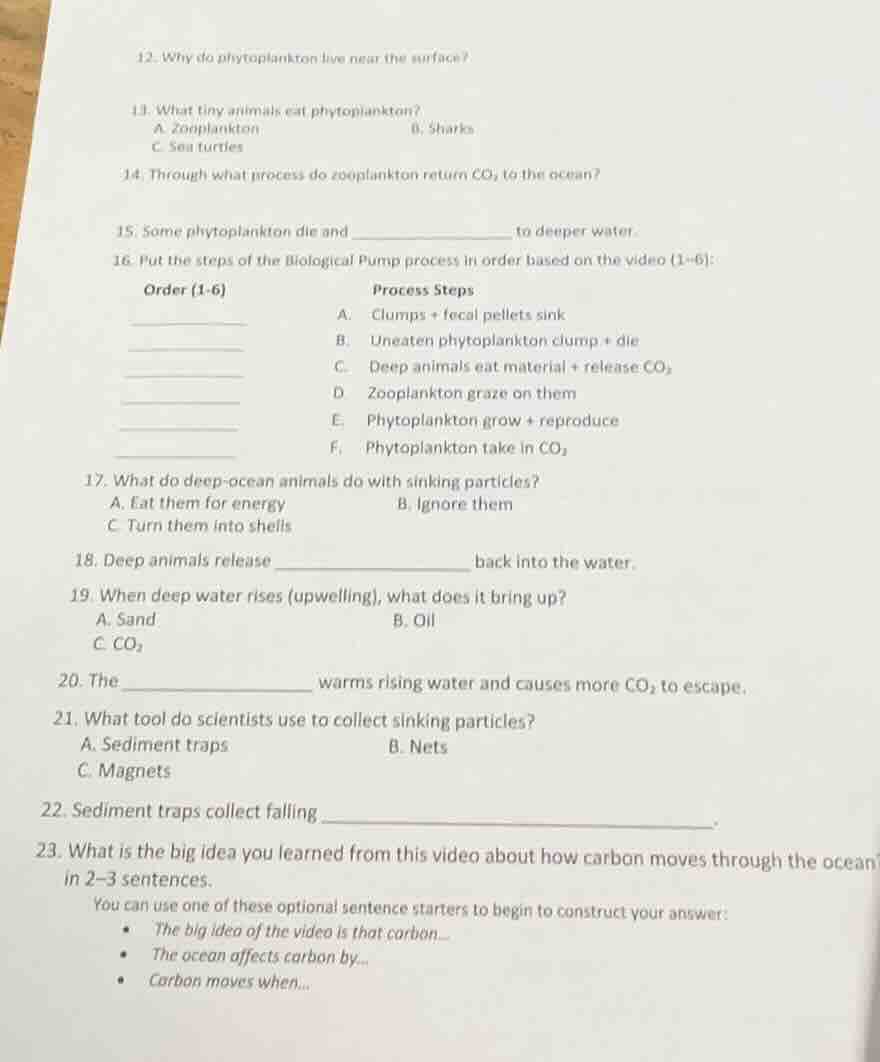
- why do phytoplankton live near the surface?
- what tiny animals eat phytoplankton?
a. zooplankton
b. sharks
c. sea turtles
- through what process do zooplankton return co₂ to the ocean?
- some phytoplankton die and ______________ to deeper water.
- put the steps of the biological pump process in order based on the video (1-6):
order (1-6) process steps
a. clumps + fecal pellets sink
b. uneaten phytoplankton clump + die
c. deep animals eat material + release co₂
d. zooplankton graze on them
e. phytoplankton grow + reproduce
f. phytoplankton take in co₂
- what do deep-ocean animals do with sinking particles?
a. eat them for energy
b. ignore them
c. turn them into shells
- deep animals release ______________ back into the water.
- when deep water rises (upwelling), what does it bring up?
a. sand
b. oil
c. co₂
- the ______________ warms rising water and causes more co₂ to escape.
- what tool do scientists use to collect sinking particles?
a. sediment traps
b. nets
c. magnets
- sediment traps collect falling ______________.
- what is the big idea you learned from this video about how carbon moves through the ocean in 2-3 sentences.
you can use one of these optional sentence starters to begin to construct your answer:
- the big idea of the video is that carbon...
- the ocean affects carbon by...
- carbon moves when...
Brief Explanations
- Phytoplankton are photosynthetic organisms that require sunlight to produce energy, so they live near the sunlit surface.
- Zooplankton are small aquatic animals that feed directly on phytoplankton, while sharks and sea turtles are larger consumers that do not target tiny phytoplankton.
- Zooplankton perform cellular respiration, which breaks down organic matter[LLM SSE On Failure]

Snap & solve any problem in the app
Get step-by-step solutions on Sovi AI
Photo-based solutions with guided steps
Explore more problems and detailed explanations
- They need sunlight for photosynthesis.
- A. Zooplankton
- Respiration
- Sink
- 1. F; 2. E; 3. D; 4. B; 5. A; 6. C
- A. Eat them for energy
- CO₂ (carbon dioxide)
- C. CO₂
- Sun
- A. Sediment traps
- Organic particles/carbon-rich material
- The big idea of the video is that carbon moves through the ocean via the Biological Pump: phytoplankton take in surface CO₂, are consumed or die, sink as organic matter, are broken down by deep-ocean organisms, and released CO₂ is eventually brought back to the surface via upwelling, creating a continuous carbon cycle.