QUESTION IMAGE
Question
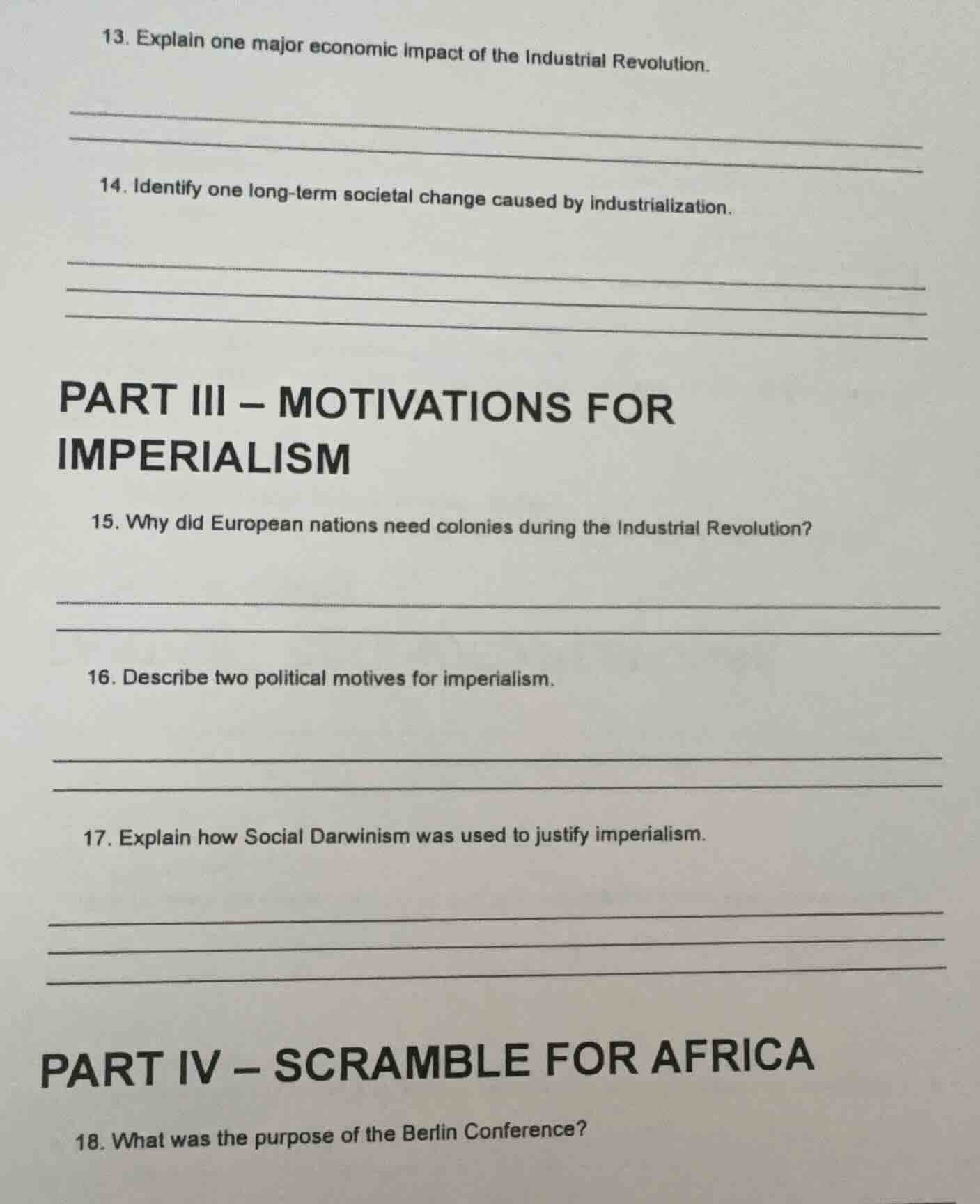
- explain one major economic impact of the industrial revolution.
- identify one long-term societal change caused by industrialization.
part iii – motivations for imperialism
- why did european nations need colonies during the industrial revolution?
- describe two political motives for imperialism.
- explain how social darwinism was used to justify imperialism.
part iv – scramble for africa
- what was the purpose of the berlin conference?
Brief Explanations
- The Industrial Revolution shifted economies from agrarian to industrial, creating a new capitalist system focused on mass production and profit. Factories required large inputs of raw materials, and produced far more goods than local markets could absorb, so nations sought global trade routes and markets, boosting international economic interdependence and creating a global capitalist economy centered on industrial powers.
- Industrialization drew large numbers of people from rural agricultural areas to urban centers where factories were located, permanently shifting population distribution and creating dense, industrialized cities as the core of societal life.
- European industrial powers needed colonies to secure a steady supply of cheap, raw materials (like cotton, rubber, and minerals) to feed their factory production, and to create exclusive captive markets where they could sell their mass-produced manufactured goods at high profits, as domestic markets became saturated.
- First, European nations sought to expand their geopolitical power and global influence by controlling more territories, which allowed them to establish military bases and strategic outposts. Second, leaders used imperial conquest to distract domestic populations from internal social and economic tensions, uniting citizens around national pride from territorial gains.
- Social Darwinism adapted Darwin's "survival of the fittest" theory to human societies, arguing that European nations were the "fittest" due to their industrial and technological superiority. Imperial powers claimed that conquering and "civilizing" less industrialized, non-European societies was a natural, justified process to ensure the "progress" of human civilization.
- The Berlin Conference (1884-1885) was organized to formalize the division of African territory among European imperial powers, establishing rules for claiming colonies to avoid violent conflicts between European nations as they competed to control African lands and resources.

Snap & solve any problem in the app
Get step-by-step solutions on Sovi AI
Photo-based solutions with guided steps
Explore more problems and detailed explanations
- It established a global capitalist economy centered on industrialized nations, driving demand for global raw material sources and new consumer markets for mass-produced goods.
- The mass migration of populations from rural agricultural regions to urban industrial centers, leading to the permanent rise of dense, factory-based cities.
- European nations needed colonies to access cheap, abundant raw materials for their industrial factories and to create captive markets to sell their surplus manufactured goods.
- 1. To expand geopolitical power and establish strategic military outposts across the globe. 2. To unify domestic populations around national pride from territorial gains, distracting from internal social tensions.
- Social Darwinism was used to frame European industrial nations as the "fittest" human societies, justifying the conquest of non-European societies as a natural, progressive act to "civilize" less developed groups.
- To create formal rules for European nations to divide and claim African territories, preventing violent conflicts between imperial powers during the Scramble for Africa.