QUESTION IMAGE
Question
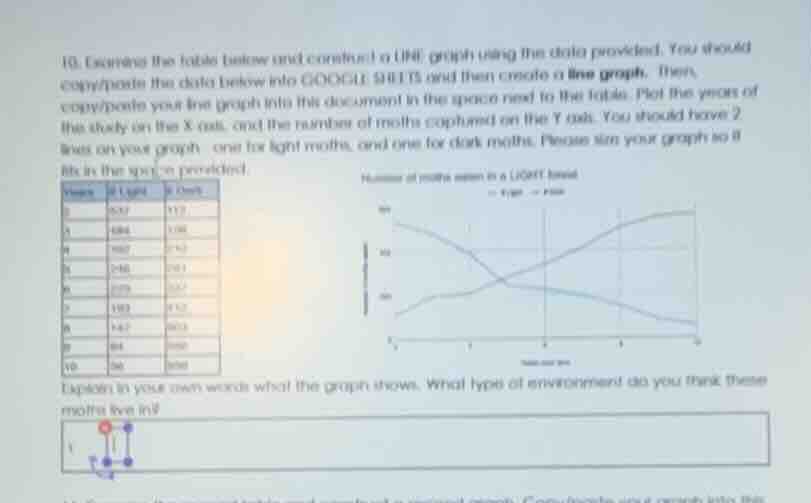
- gather the data below and construct a line graph using the data provided. you should copy/paste the data below into google sheets and then create a line graph. then, copy/paste your line graph into this document in the space used for the table. plot the years of the study on the x - axis, and the number of moths captured on the y - axis. you should have 2 lines on your graph - one for light moths, and one for dark moths. please size your graph so it fits in the space is provided.
explain in your own words what the graph shows. what type of environment do you think these moths live in?
To address this problem, we analyze the task of graphing moth data and interpreting the results:
Step 1: Graph Construction
- X - axis: Plot the years (or time intervals) provided in the data table.
- Y - axis: Plot the number of light - colored and dark - colored moths (two separate lines, one for each moth type).
- Use Google Sheets (or similar software) to input the data, create a line graph, and adjust the scale so the graph fits the provided space.
Step 2: Graph Interpretation
- The graph will show the population trends of light and dark moths over time. For example, if dark moths increase while light moths decrease (or vice versa), it may relate to environmental changes like industrial pollution (e.g., the peppered moth example, where dark moths thrived in polluted, sooty environments as they were camouflaged, while light moths were more visible to predators).
Step 3: Environmental Inference
- If dark moths are more numerous over time, the environment likely has increased soot/pollution (e.g., near industrial areas), as dark coloration provides camouflage. If light moths are more common, the environment may be cleaner (e.g., rural or post - pollution - reduction areas), where light - colored surfaces (like lichen - covered trees) are prevalent.
(for the written response)
The graph displays how the populations of light - and dark - colored moths change over time. By observing which moth type becomes more/less common, we infer the environment:
- Polluted (Industrial) Environment: If dark moths increase, soot from factories darkens tree trunks, so dark moths avoid predators better.
- Clean (Non - Industrial) Environment: If light moths increase, tree trunks are light (e.g., with lichen), so light moths are camouflaged.

Snap & solve any problem in the app
Get step-by-step solutions on Sovi AI
Photo-based solutions with guided steps
Explore more problems and detailed explanations
(for the written response section)
The graph shows the change in the number of light - and dark - colored moths over time. If dark moths become more common, these moths likely live in a polluted (industrial) environment (e.g., near factories with sooty, dark tree trunks, where dark moths are camouflaged from predators). If light moths are more common, the environment is likely clean (e.g., rural, with light - colored, lichen - covered trees), where light moths are better camouflaged. (Adjust based on your actual graph’s trend.)