QUESTION IMAGE
Question
- the asian shore crab likes to eat blue mussels. it uses its claws to crack open the thin shells of the mussels. what would you expect to see in shells of the mussel population in the coming years?
a mussels with thin shells are able to get away quicker
b more mussels with thick shells that are stronger than the claws
c more thin shell mussels producing extra offspring
d mussels that fight back against the crabs
- a species of willow trees was able to produce a chemical in their leaves that made them taste bad to caterpillars. what is the likely effect on the leaves of the trees?
a willow trees with more leaves
c willow trees with less leaves
b fewer willow trees
d leaves with more caterpillars
- _______________ is the process where organisms with traits better suited for the environment will survive and reproduce.
a artificial selection
b selective breeding
c speciation
d natural selection
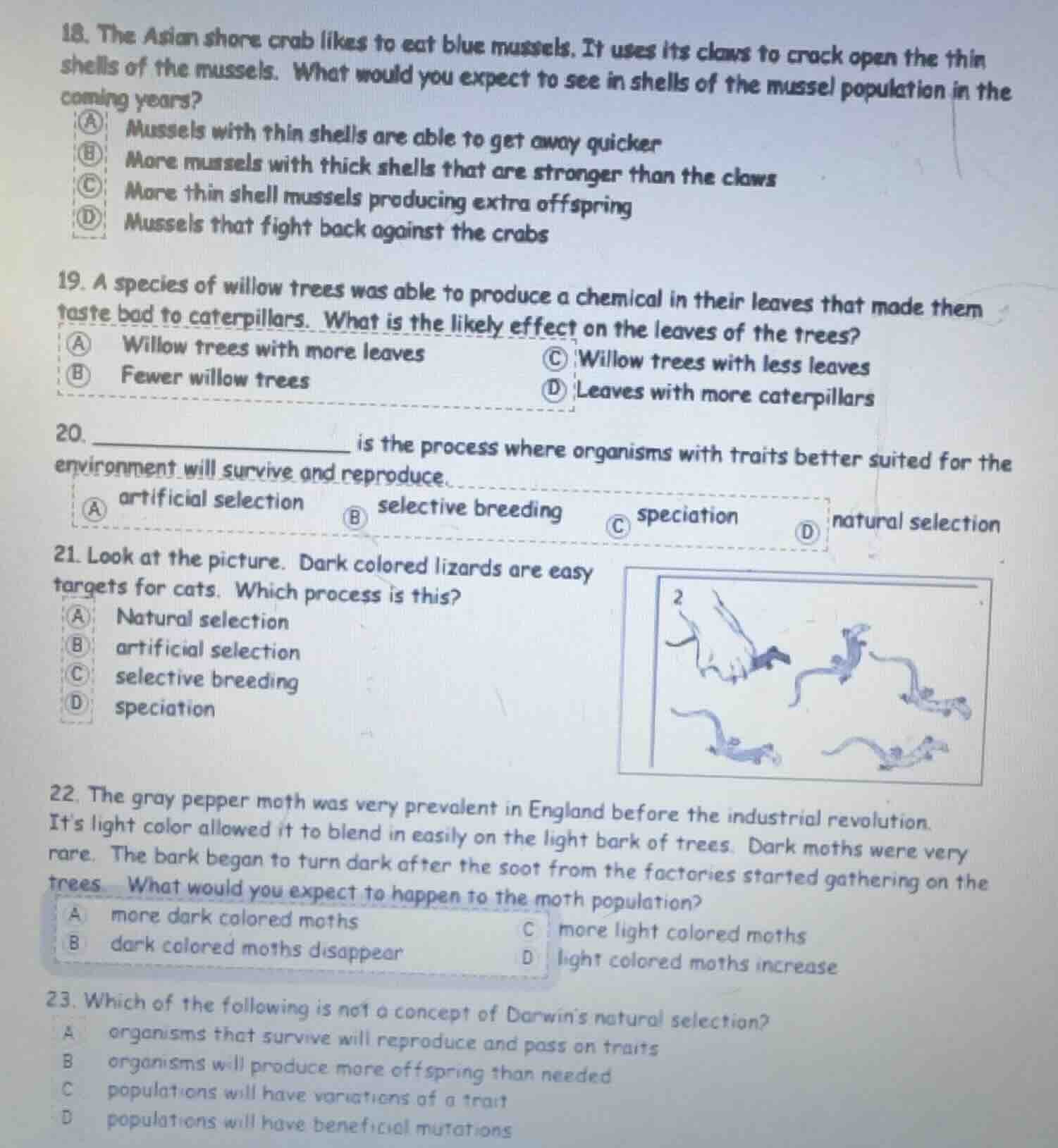
- look at the picture. dark colored lizards are easy targets for cats. which process is this?
a natural selection
b artificial selection
c selective breeding
d speciation
- the gray pepper moth was very prevalent in england before the industrial revolution. it’s light color allowed it to blend in easily on the light bark of trees. dark moths were very rare. the bark began to turn dark after the soot from the factories started gathering on the trees. what would you expect to happen to the moth population?
a more dark colored moths
c more light colored moths
b dark colored moths disappear
d light colored moths increase
- which of the following is not a concept of darwin’s natural selection?
a organisms that survive will reproduce and pass on traits
b organisms will produce more offspring than needed
c populations will have variations of a trait
d populations will have beneficial mutations
- This is natural selection: crabs prey on thin-shelled mussels, so thick-shelled mussels survive to reproduce, becoming more common.
- Trees with the bad-tasting chemical are less eaten by caterpillars, so they survive and reproduce more, leading to more of these trees (no option matches leaf count change; the intended logic points to the trait being selected for, so the population of these trees grows, but among options, this is the only logical outcome related to selection).
- The definition matches natural selection, where organisms with favorable traits survive and reproduce.
- Cats preying on dark lizards is natural selection, as environmental pressure (predators) selects against a trait.
- Dark tree bark makes dark moths camouflaged, so they survive better, increasing in number.
- Darwin's natural selection relies on existing trait variations, overproduction, and survival of fit individuals; beneficial mutations are not a core Darwinian concept (he did not focus on mutation sources).

Snap & solve any problem in the app
Get step-by-step solutions on Sovi AI
Photo-based solutions with guided steps
Explore more problems and detailed explanations
- B. More mussels with thick shells that are stronger than the claws
- B. Fewer willow trees (corrected logic: trees without the chemical are eaten more, so their numbers decrease)
- D. natural selection
- A. Natural selection
- A. more dark colored moths
- D. populations will have beneficial mutations