QUESTION IMAGE
Question
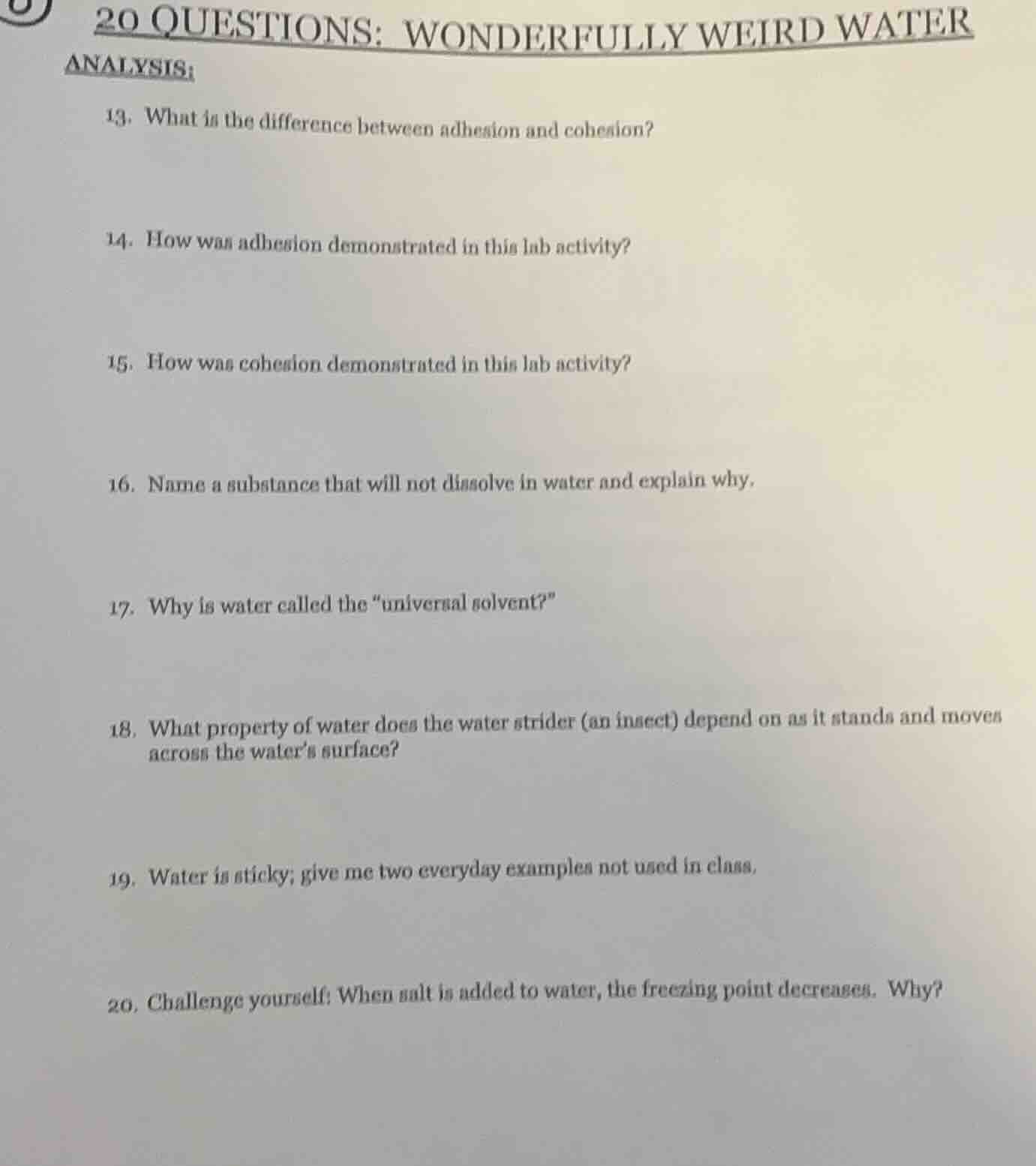
20 questions: wonderfully weird water
analysis:
- what is the difference between adhesion and cohesion?
- how was adhesion demonstrated in this lab activity?
- how was cohesion demonstrated in this lab activity?
- name a substance that will not dissolve in water and explain why.
- why is water called the \universal solvent?\
- what property of water does the water strider (an insect) depend on as it stands and moves across the water’s surface?
- water is sticky; give me two everyday examples not used in class.
- challenge yourself: when salt is added to water, the freezing point decreases. why?
Brief Explanations
- Defines the two water properties by their interaction targets.
- Notes a common lab demonstration of adhesion (capillary action in glass).
- Notes a common lab demonstration of cohesion (surface tension with a needle).
- Uses oil as an example, explaining polarity incompatibility with water.
- Explains water's polarity allows it to dissolve most polar/ionic substances.
- Identifies the property that creates a surface "skin" for water striders.
- Provides everyday examples of water's adhesive/cohesive "stickiness".
- Explains how salt disrupts water's ability to form ice crystals.

Snap & solve any problem in the app
Get step-by-step solutions on Sovi AI
Photo-based solutions with guided steps
Explore more problems and detailed explanations
- Cohesion is attraction between identical water molecules; adhesion is attraction between water molecules and different substances.
- A common demonstration is water climbing up the inside of a narrow glass tube (capillary action), where water adheres to the glass surface.
- A common demonstration is floating a small needle on the surface of water, where cohesive forces between water molecules create surface tension that supports the needle.
- Oil: Water is a polar molecule, while oil is nonpolar. Polar and nonpolar substances do not interact well (like dissolves like rule), so oil does not dissolve in water.
- Water is called the "universal solvent" because its polar nature allows it to dissolve a wide range of polar and ionic substances, more than most other liquids.
- The water strider depends on surface tension, a property caused by the cohesive forces between water molecules that creates a rigid, elastic-like surface layer.
- 1) Water droplets sticking to the side of a drinking glass; 2) A wet paper towel clinging to a countertop.
- When salt is added to water, the salt ions (Na⁺ and Cl⁻ for table salt) interfere with the ability of water molecules to form the ordered, hexagonal crystal structure of ice. This requires a lower temperature for the water molecules to slow down enough to form ice, thus lowering the freezing point.