QUESTION IMAGE
Question
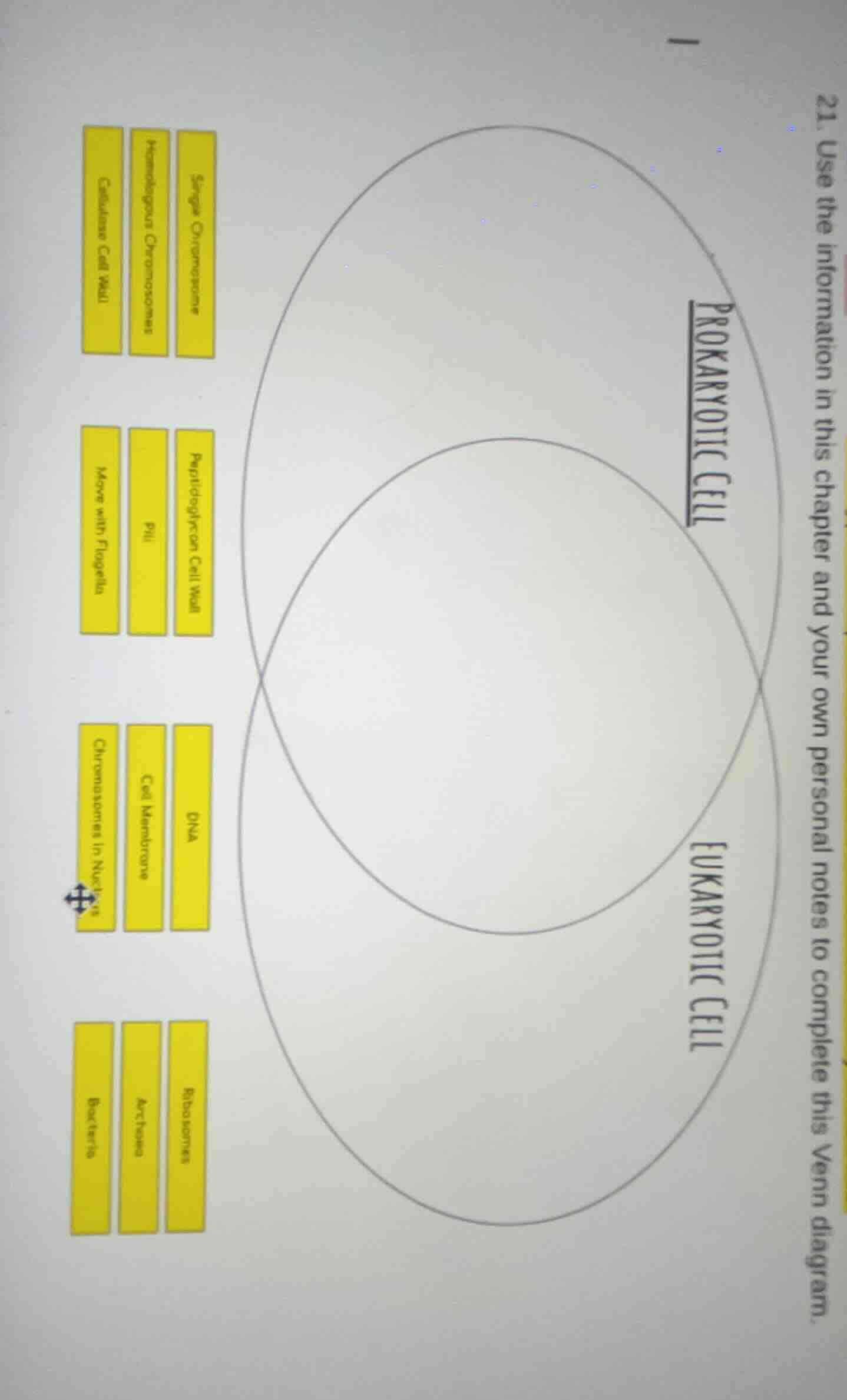
- use the information in this chapter and your own personal notes to complete this venn diagram. prokaryotic cell eukaryotic cell single chromosome homologous chromosomes cellulose cell wall peptidoglycan cell wall pili move with flagella dna cell membrane chromosomes in nucleus ribosomes archaea bacteria
Brief Explanations
- Prokaryotic Cell Only: These are features unique to prokaryotes. Prokaryotes have a single, circular chromosome, peptidoglycan cell walls (in bacteria), pili, move via flagella, and include the domains Bacteria and Archaea.
- Eukaryotic Cell Only: These are features unique to eukaryotes. Eukaryotes have paired homologous chromosomes, cellulose cell walls (in plants/fungi), and their chromosomes are enclosed within a nucleus.
- Both (Overlap): These are shared features of all cells. All prokaryotes and eukaryotes have DNA, a cell membrane, and ribosomes to synthesize proteins.

Snap & solve any problem in the app
Get step-by-step solutions on Sovi AI
Photo-based solutions with guided steps
Explore more problems and detailed explanations
PROKARYOTIC CELL (Only):
- Single Chromosome
- Peptidoglycan Cell Wall
- Pili
- Move with Flagella
- Bacteria
- Archaea
BOTH (Overlap):
- DNA
- Cell Membrane
- Ribosomes
EUKARYOTIC CELL (Only):
- Homologous Chromosomes
- Cellulose Cell Wall
- Chromosomes in Nucleus