QUESTION IMAGE
Question
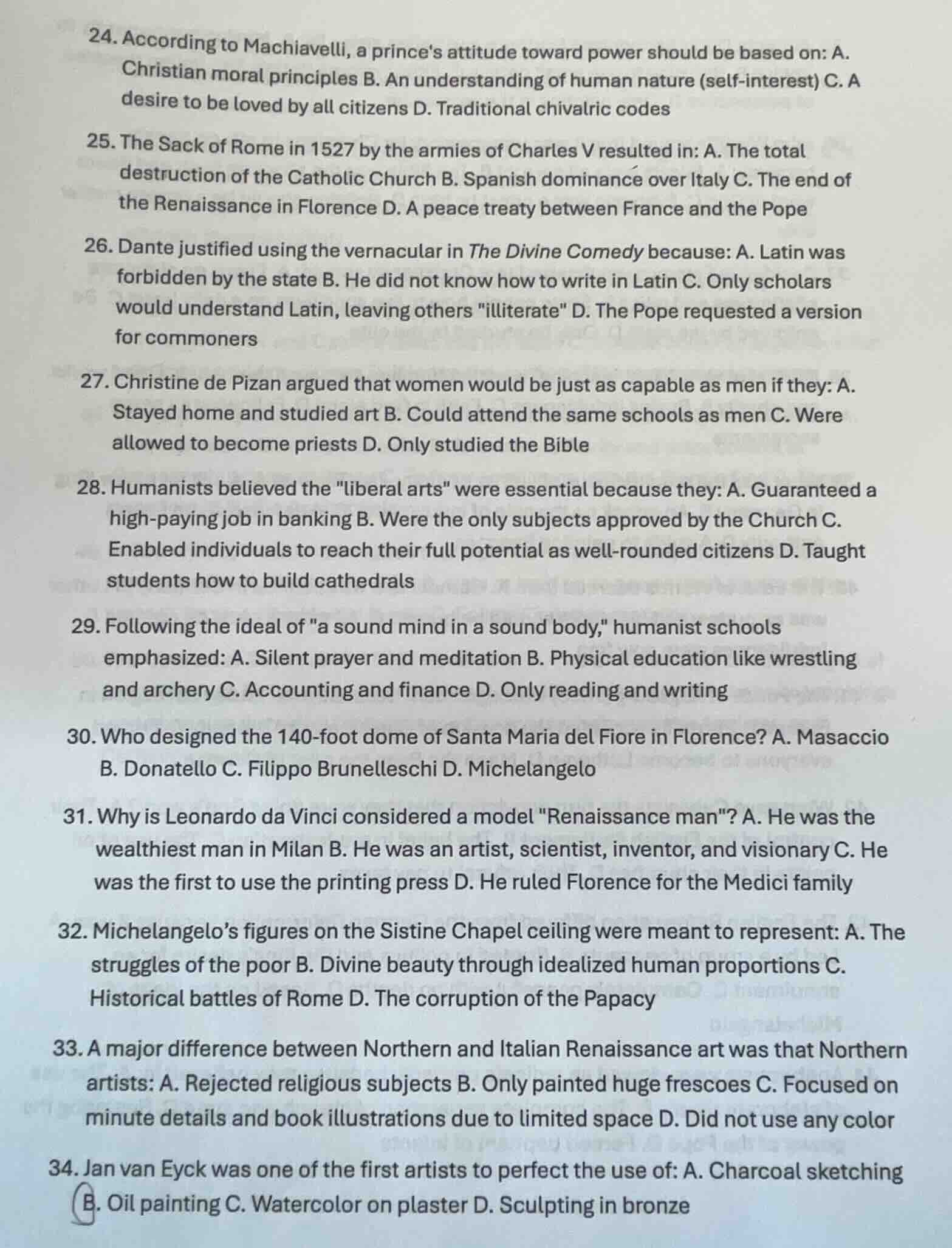
- according to machiavelli, a princes attitude toward power should be based on: a. christian moral principles b. an understanding of human nature (self - interest) c. a desire to be loved by all citizens d. traditional chivalric codes
- the sack of rome in 1527 by the armies of charles v resulted in: a. the total destruction of the catholic church b. spanish dominance over italy c. the end of the renaissance in florence d. a peace treaty between france and the pope
- dante justified using the vernacular in the divine comedy because: a. latin was forbidden by the state b. he did not know how to write in latin c. only scholars would understand latin, leaving others \illiterate\ d. the pope requested a version for commoners
- christine de pizan argued that women would be just as capable as men if they: a. stayed home and studied art b. could attend the same schools as men c. were allowed to become priests d. only studied the bible
- humanists believed the \liberal arts\ were essential because they: a. guaranteed a high - paying job in banking b. were the only subjects approved by the church c. enabled individuals to reach their full potential as well - rounded citizens d. taught students how to build cathedrals
- following the ideal of \a sound mind in a sound body,\ humanist schools emphasized: a. silent prayer and meditation b. physical education like wrestling and archery c. accounting and finance d. only reading and writing
- who designed the 140 - foot dome of santa maria del fiore in florence? a. masaccio b. donatello c. filippo brunelleschi d. michelangelo
- why is leonardo da vinci considered a model
enaissance man\? a. he was the wealthiest man in milan b. he was an artist, scientist, inventor, and visionary c. he was the first to use the printing press d. he ruled florence for the medici family
- michelangelo’s figures on the sistine chapel ceiling were meant to represent: a. the struggles of the poor b. divine beauty through idealized human proportions c. historical battles of rome d. the corruption of the papacy
- a major difference between northern and italian renaissance art was that northern artists: a. rejected religious subjects b. only painted huge frescoes c. focused on minute details and book illustrations due to limited space d. did not use any color
- jan van eyck was one of the first artists to perfect the use of: a. charcoal sketching b. oil painting c. watercolor on plaster d. sculpting in bronze
Brief Explanations
- Machiavelli's The Prince argues rulers should prioritize understanding self-interested human nature over traditional morals.
- The 1527 Sack of Rome by Charles V's forces established Spanish control over Italy.
- Dante used vernacular in The Divine Comedy to reach non-scholars, as only academics understood Latin.
- Christine de Pizan claimed women matched men's capability if given equal educational access.
- Renaissance humanists saw liberal arts as key to developing well-rounded, fully realized citizens.
- Humanist schools followed "sound mind in sound body" by including physical education like wrestling.
- Filippo Brunelleschi designed the iconic dome of Florence's Santa Maria del Fiore.
- Leonardo da Vinci is a Renaissance man for his mastery of art, science, invention, and visionary thinking.
- Michelangelo's Sistine Chapel ceiling figures use idealized human proportions to depict divine beauty.
- Northern Renaissance art focused on fine details and book illustrations, unlike Italy's large frescoes.
- Jan van Eyck was a pioneer in perfecting oil painting techniques.

Snap & solve any problem in the app
Get step-by-step solutions on Sovi AI
Photo-based solutions with guided steps
Explore more problems and detailed explanations
- B. An understanding of human nature (self-interest)
- B. Spanish dominance over Italy
- C. Only scholars would understand Latin, leaving others "illiterate"
- B. Could attend the same schools as men
- C. Enabled individuals to reach their full potential as well-rounded citizens
- B. Physical education like wrestling and archery
- C. Filippo Brunelleschi
- B. He was an artist, scientist, inventor, and visionary
- B. Divine beauty through idealized human proportions
- C. Focused on minute details and book illustrations due to limited space
- B. Oil painting