QUESTION IMAGE
Question
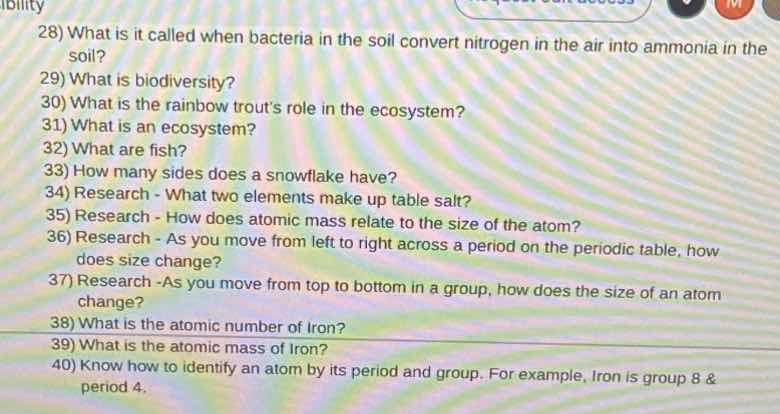
- what is it called when bacteria in the soil convert nitrogen in the air into ammonia in the soil?
- what is biodiversity?
- what is the rainbow trouts role in the ecosystem?
- what is an ecosystem?
- what are fish?
- how many sides does a snowflake have?
- research - what two elements make up table salt?
- research - how does atomic mass relate to the size of the atom?
- research - as you move from left to right across a period on the periodic table, how does size change?
- research -as you move from top to bottom in a group, how does the size of an atom change?
- what is the atomic number of iron?
- what is the atomic mass of iron?
- know how to identify an atom by its period and group. for example, iron is group 8 & period 4.
Brief Explanations
- This is a key nitrogen cycle process where soil bacteria fix atmospheric N₂.
- It refers to the variety of all living organisms on Earth.
- Rainbow trout are secondary/tertiary consumers, controlling prey populations.
- It is a community of organisms interacting with their physical environment.
- Fish are aquatic, gill-breathing vertebrates with fins.
- Snowflakes are hexagonal, so they have 6 sides.
- Table salt is a ionic compound of two common elements.
- Atomic mass depends on protons/neutrons; larger atoms often have higher mass, but not always due to isotopes.
- Increasing nuclear charge pulls electrons closer, reducing atomic radius.
- New electron shells are added, increasing atomic radius.
- It is the number of protons in an atom's nucleus, unique to each element.
- The average atomic mass of iron accounts for its isotopes.
- Periods are horizontal rows, groups are vertical columns on the periodic table.

Snap & solve any problem in the app
Get step-by-step solutions on Sovi AI
Photo-based solutions with guided steps
Explore more problems and detailed explanations
- Nitrogen fixation
- Biodiversity is the variety of all living organisms (including species, genetic, and ecosystem diversity) on Earth.
- Rainbow trout are predatory consumers (secondary or tertiary consumers) that control populations of smaller aquatic organisms, transfer energy up the food web, and act as prey for larger predators.
- An ecosystem is a biological community of interacting organisms and their physical (abiotic) environment.
- Fish are aquatic, craniate, gill-bearing vertebrates that lack limbs with digits, and most are ectothermic.
- 6
- Sodium (Na) and Chlorine (Cl)
- Generally, larger atoms have higher atomic mass, but this is not a strict rule because atomic mass is the sum of protons and neutrons, and some smaller atoms may have more neutrons (isotopes) than larger atoms.
- Atomic size (atomic radius) decreases from left to right across a period.
- Atomic size (atomic radius) increases from top to bottom within a group.
- The atomic number is the number of protons in the nucleus of an atom, which defines the identity of an element.
- 55.845 u (unified atomic mass units)
- To identify an atom by period and group: Locate the horizontal row (period) and vertical column (group) on the periodic table. For example, Iron (Fe) is in Period 4 (4th horizontal row) and Group 8 (8th vertical column).