QUESTION IMAGE
Question
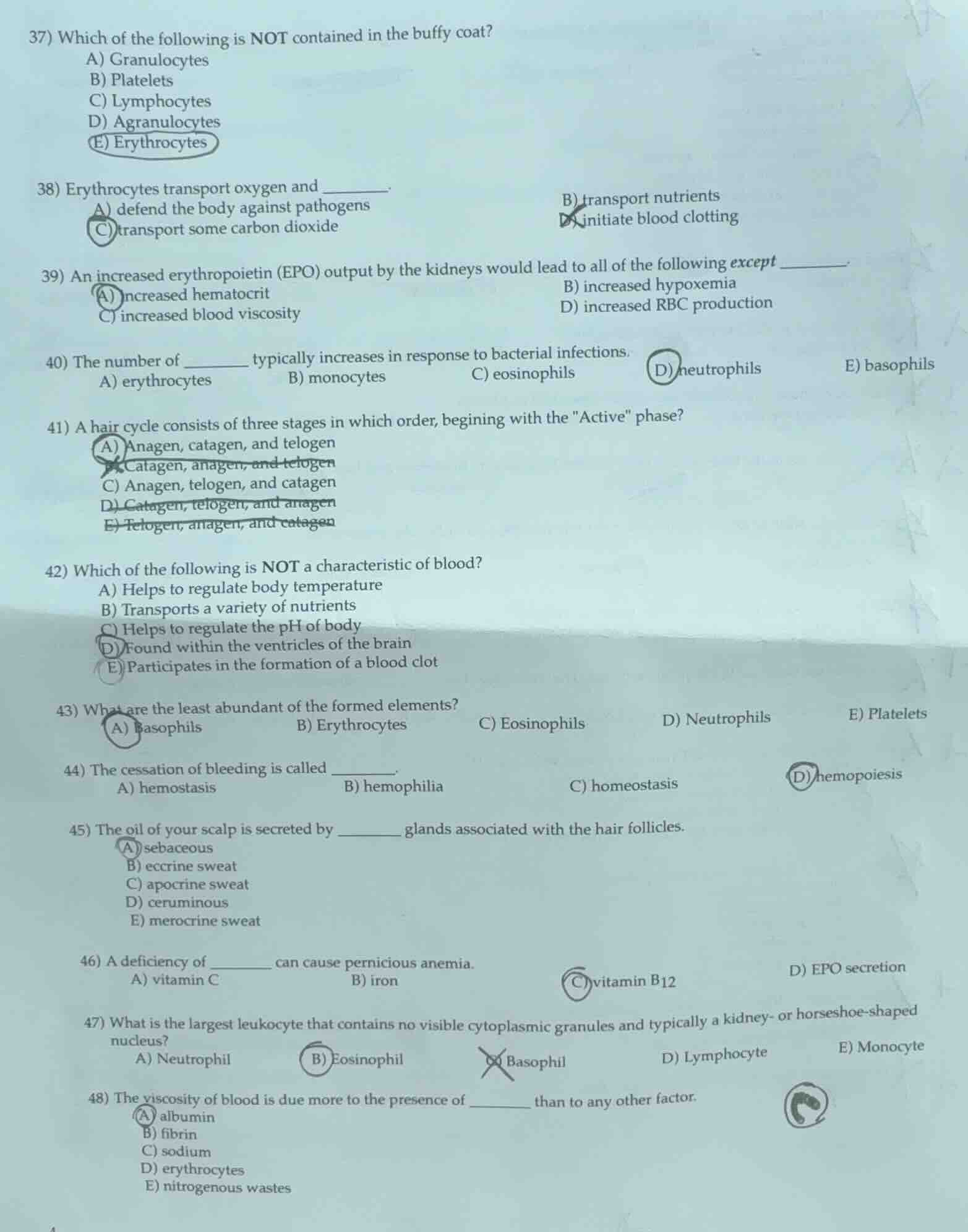
- which of the following is not contained in the buffy coat?
a) granulocytes
b) platelets
c) lymphocytes
d) agranulocytes
e) erythrocytes
- erythrocytes transport oxygen and ______.
a) defend the body against pathogens
b) transport nutrients
c) transport some carbon dioxide
d) initiate blood clotting
- an increased erythropoietin (epo) output by the kidneys would lead to all of the following except ______.
a) increased hematocrit
b) increased hypoxemia
c) increased blood viscosity
d) increased rbc production
- the number of ______ typically increases in response to bacterial infections.
a) erythrocytes
b) monocytes
c) eosinophils
d) neutrophils
e) basophils
- a hair cycle consists of three stages in which order, begining with the \active\ phase?
a) anagen, catagen, and telogen
b) catagen, anagen, and telogen
c) anagen, telogen, and catagen
d) catagen, telogen, and anagen
e) telogen, anagen, and catagen
- which of the following is not a characteristic of blood?
a) helps to regulate body temperature
b) transports a variety of nutrients
c) helps to regulate the ph of body
d) found within the ventricles of the brain
e) participates in the formation of a blood clot
- what are the least abundant of the formed elements?
a) basophils
b) erythrocytes
c) eosinophils
d) neutrophils
e) platelets
- the cessation of bleeding is called ______.
a) hemostasis
b) hemophilia
c) homeostasis
d) hemopoiesis
- the oil of your scalp is secreted by ______ glands associated with the hair follicles.
a) sebaceous
b) eccrine sweat
c) apocrine sweat
d) ceruminous
e) merocrine sweat
- a deficiency of ______ can cause pernicious anemia.
a) vitamin c
b) iron
c) vitamin b12
d) epo secretion
- what is the largest leukocyte that contains no visible cytoplasmic granules and typically a kidney- or horseshoe-shaped nucleus?
a) neutrophil
b) eosinophil
c) basophil
d) lymphocyte
e) monocyte
- the viscosity of blood is due more to the presence of ______ than to any other factor.
a) albumin
b) fibrin
c) sodium
d) erythrocytes
e) nitrogenous wastes
- The buffy coat is the middle layer of separated blood, containing white blood cells and platelets. Erythrocytes (red blood cells) settle at the bottom.
- Erythrocytes primarily carry oxygen, and they also transport a portion of carbon dioxide from tissues to lungs.
- Erythropoietin (EPO) stimulates red blood cell production, which increases hematocrit, blood viscosity, and reduces hypoxemia (low blood oxygen).
- Neutrophils are the first immune cells to respond to bacterial infections, so their numbers rise sharply.
- The hair cycle starts with the active growth phase (anagen), followed by the transitional phase (catagen), then the resting phase (telogen).
- The fluid in brain ventricles is cerebrospinal fluid, not blood; blood regulates temperature, transports nutrients, balances pH, and aids clotting.
- Basophils are the rarest type of white blood cell, making up less than 1% of formed elements.
- Hemostasis is the physiological process that stops bleeding. Hemophilia is a bleeding disorder, homeostasis is general internal balance, and hemopoiesis is blood cell formation.
- Sebaceous glands are associated with hair follicles and secrete sebum (scalp oil) to lubricate hair and skin.
- Pernicious anemia is caused by a deficiency in vitamin B12, often due to lack of intrinsic factor for absorption.
- Monocytes are the largest leukocytes, with agranular cytoplasm and a kidney/horseshoe-shaped nucleus.
- Erythrocytes are the most numerous formed elements in blood, and their high concentration is the main factor contributing to blood viscosity.

Snap & solve any problem in the app
Get step-by-step solutions on Sovi AI
Photo-based solutions with guided steps
Explore more problems and detailed explanations
- E) Erythrocytes
- C) transport some carbon dioxide
- B) increased hypoxemia
- D) neutrophils
- A) Anagen, catagen, and telogen
- D) Found within the ventricles of the brain
- A) Basophils
- A) hemostasis
- A) sebaceous
- C) vitamin B12
- E) Monocyte
- D) erythrocytes