QUESTION IMAGE
Question
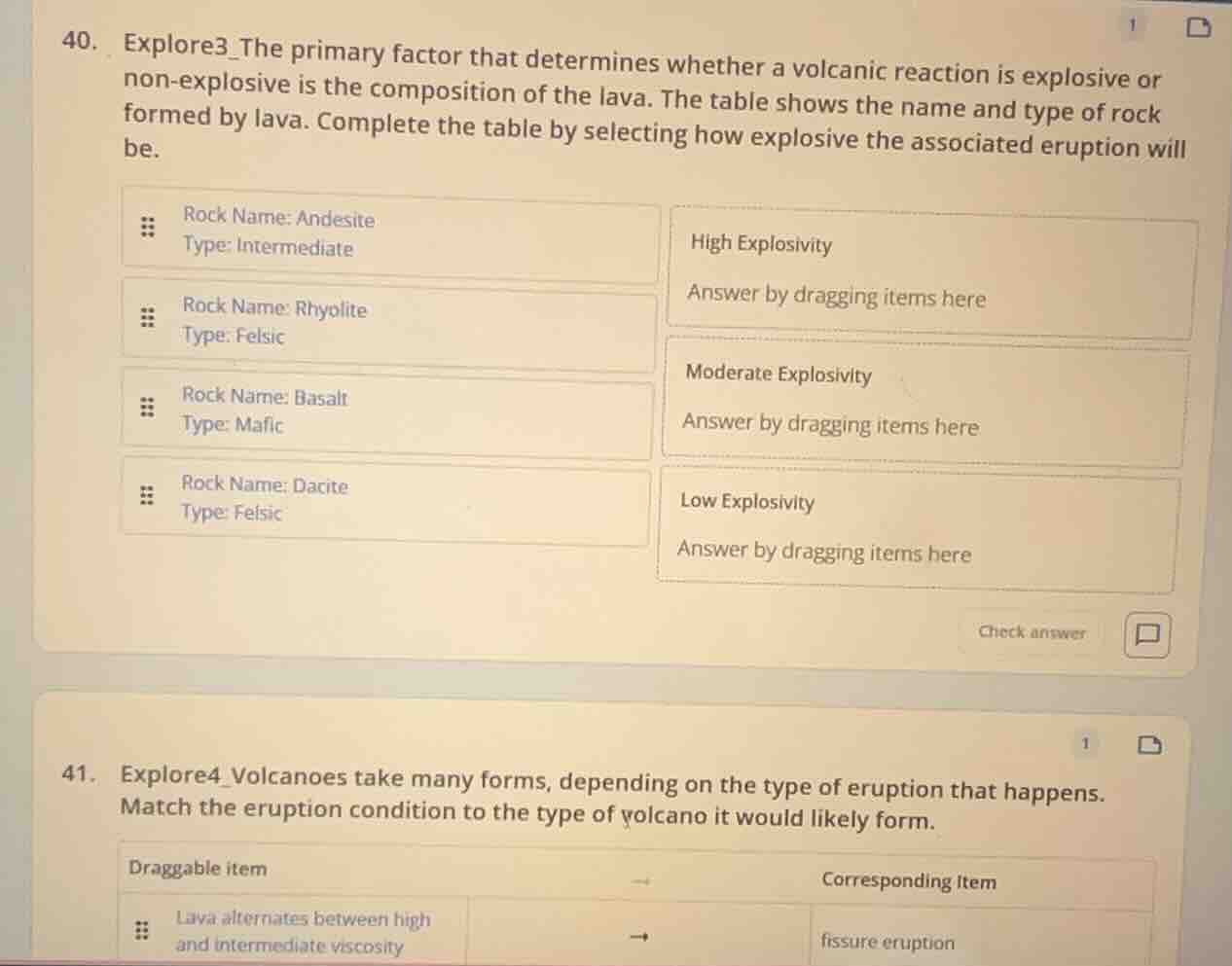
- explore3_the primary factor that determines whether a volcanic reaction is explosive or non - explosive is the composition of the lava. the table shows the name and type of rock formed by lava. complete the table by selecting how explosive the associated eruption will be.
rock name: andesite
type: intermediate
rock name: rhyolite
type: felsic
rock name: basalt
type: mafic
rock name: dacite
type: felsic
high explosivity
answer by dragging items here
moderate explosivity
answer by dragging items here
low explosivity
answer by dragging items here
check answer
- explore4_volcanoes take many forms, depending on the type of eruption that happens. match the eruption condition to the type of volcano it would likely form.
draggable item
corresponding item
lava alternates between high and intermediate viscosity
fissure eruption
Question 40:
To determine the explosivity, we use the relationship between lava type (mafic, intermediate, felsic) and explosivity:
- Mafic (Basalt): Low silica, low viscosity, gentle eruptions → Low Explosivity.
- Intermediate (Andesite): Moderate silica/viscosity → Moderate Explosivity.
- Felsic (Rhyolite, Dacite): High silica, high viscosity, trapped gases → Rhyolite (high silica) has High Explosivity; Dacite (less silica than Rhyolite but still felsic) has Moderate Explosivity (or High? Wait, correction: Felsic lavas (high silica) are most explosive. Rhyolite (felsic) → High Explosivity. Dacite (felsic, but slightly less silica than Rhyolite) → Moderate? Wait, standard:
- Basalt (mafic) → Low Explosivity.
- Andesite (intermediate) → Moderate Explosivity.
- Rhyolite (felsic) → High Explosivity.
- Dacite (felsic, intermediate-felsic) → Moderate to High? Wait, the table has three columns: High, Moderate, Low. Let's align:
- Rock Name: Andesite (Type: Intermediate) → Moderate Explosivity.
- Rock Name: Rhyolite (Type: Felsic) → High Explosivity.
- Rock Name: Basalt (Type: Mafic) → Low Explosivity.
- Rock Name: Dacite (Type: Felsic) → Moderate Explosivity (since it’s felsic but less explosive than Rhyolite, or maybe High? Wait, maybe the intended mapping is:
- High Explosivity: Rhyolite (felsic, most explosive).
- Moderate Explosivity: Andesite (intermediate), Dacite (felsic-intermediate).
- Low Explosivity: Basalt (mafic).
So:
- Andesite (Intermediate) → Moderate Explosivity.
- Rhyolite (Felsic) → High Explosivity.
- Basalt (Mafic) → Low Explosivity.
- Dacite (Felsic) → Moderate Explosivity (or High? Let’s confirm standard volcanic explosivity:
- Mafic (basalt): Low Explosivity (quiet eruptions).
- Intermediate (andesite): Moderate Explosivity.
- Felsic (rhyolite, dacite): Rhyolite (highest), Dacite (moderate-high), but in the table, we have three categories. So likely:
- Basalt (mafic) → Low.
- Andesite (intermediate) → Moderate.
- Rhyolite (felsic) → High.
- Dacite (felsic) → Moderate (since it’s between andesite and rhyolite in silica).
The given match is incorrect. A fissure eruption is caused by low-viscosity (mafic) lava flowing out in cracks, not by alternating high/intermediate viscosity. Alternating high/intermediate viscosity would relate to composite volcanoes (e.g., stratovolcanoes) with mixed eruptions. Fissure eruptions are for low-viscosity (mafic) lava, like flood basalts. So the correct match for "Lava alternates between high and intermediate viscosity" would be a stratovolcano (composite volcano), while "fissure eruption" matches "low-viscosity lava (mafic) erupts from cracks".

Snap & solve any problem in the app
Get step-by-step solutions on Sovi AI
Photo-based solutions with guided steps
Explore more problems and detailed explanations
- Andesite (Intermediate) → Moderate Explosivity
- Rhyolite (Felsic) → High Explosivity
- Basalt (Mafic) → Low Explosivity
- Dacite (Felsic) → Moderate Explosivity