QUESTION IMAGE
Question
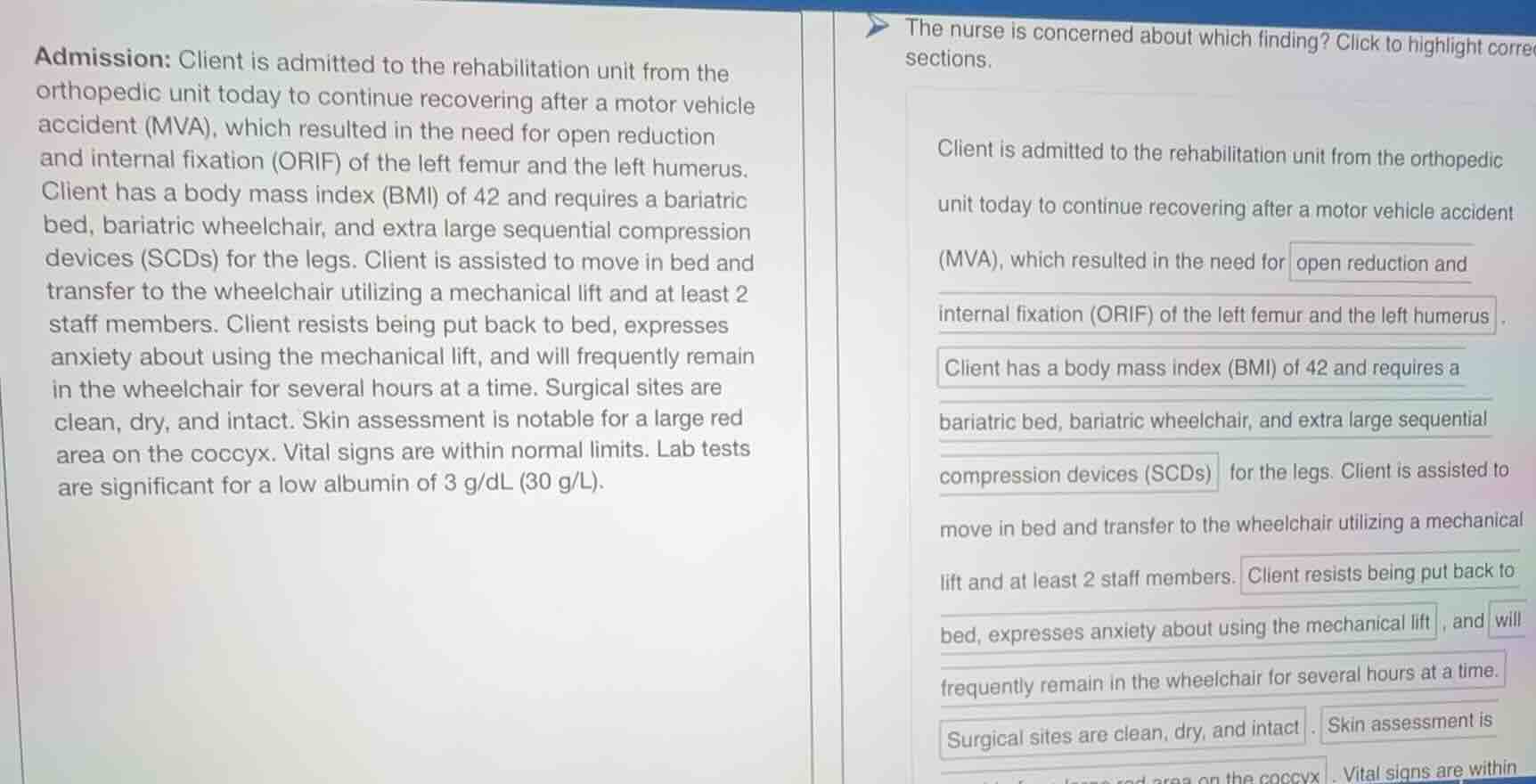
admission: client is admitted to the rehabilitation unit from the orthopedic unit today to continue recovering after a motor vehicle accident (mva), which resulted in the need for open reduction and internal fixation (orif) of the left femur and the left humerus. client has a body mass index (bmi) of 42 and requires a bariatric bed, bariatric wheelchair, and extra large sequential compression devices (scds) for the legs. client is assisted to move in bed and transfer to the wheelchair utilizing a mechanical lift and at least 2 staff members. client resists being put back to bed, expresses anxiety about using the mechanical lift, and will frequently remain in the wheelchair for several hours at a time. surgical sites are clean, dry, and intact. skin assessment is notable for a large red area on the coccyx. vital signs are within normal limits. lab tests are significant for a low albumin of 3 g/dl (30 g/l). the nurse is concerned about which finding? click to highlight corre sections. client is admitted to the rehabilitation unit from the orthopedic unit today to continue recovering after a motor vehicle accident (mva), which resulted in the need for open reduction and internal fixation (orif) of the left femur and the left humerus. client has a body mass index (bmi) of 42 and requires a bariatric bed, bariatric wheelchair, and extra large sequential compression devices (scds) for the legs. client is assisted to move in bed and transfer to the wheelchair utilizing a mechanical lift and at least 2 staff members. client resists being put back to bed, expresses anxiety about using the mechanical lift, and will frequently remain in the wheelchair for several hours at a time. surgical sites are clean, dry, and intact. skin assessment is notable for a large red area on the coccyx. vital signs are within
To determine the nurse's concern, we analyze each finding:
- ORIF and surgical sites being intact are expected post - surgery.
- BMI 42 and related equipment needs are known factors.
- Resistance to bed, anxiety about lift, and prolonged wheelchair use are psychosocial/comfort, but the large red area on coccyx (from skin assessment) and low albumin (3 g/dL, normal albumin is ~3.5 - 5 g/dL) are key. Low albumin increases risk of skin breakdown, and the red coccyx area is an early sign of pressure injury. Prolonged wheelchair use (due to resistance to bed) plus low albumin and obesity (BMI 42) heighten this risk. The highlighted option with "Skin assessment is notable for a large red area on the coccyx" and the context of low albumin and prolonged sitting is the concern. Also, the option including "Lab tests are significant for a low albumin of 3 g/dL (30 g/L)" ties to skin integrity risk. But the most direct finding the nurse would be concerned about (as a priority for skin breakdown) is the large red area on coccyx, and the low albumin exacerbates it. The correct highlighted section (from the options) that combines the skin finding and the risk factors (or the skin finding itself as a change) is the one with "Skin assessment is notable for a large red area on the coccyx" and the related lab and BMI context.

Snap & solve any problem in the app
Get step-by-step solutions on Sovi AI
Photo-based solutions with guided steps
Explore more problems and detailed explanations
The correct highlighted section (among the options) is the one containing "Skin assessment is notable for a large red area on the coccyx" (along with the context of low albumin and prolonged wheelchair use, but the key finding the nurse is concerned about is the large red area on the coccyx, which is a sign of potential pressure injury, especially with low albumin and obesity). So the answer is the section: "Skin assessment is notable for a large red area on the coccyx" (and the related lab result "Lab tests are significant for a low albumin of 3 g/dL (30 g/L)" as they together increase the risk of skin breakdown).