QUESTION IMAGE
Question
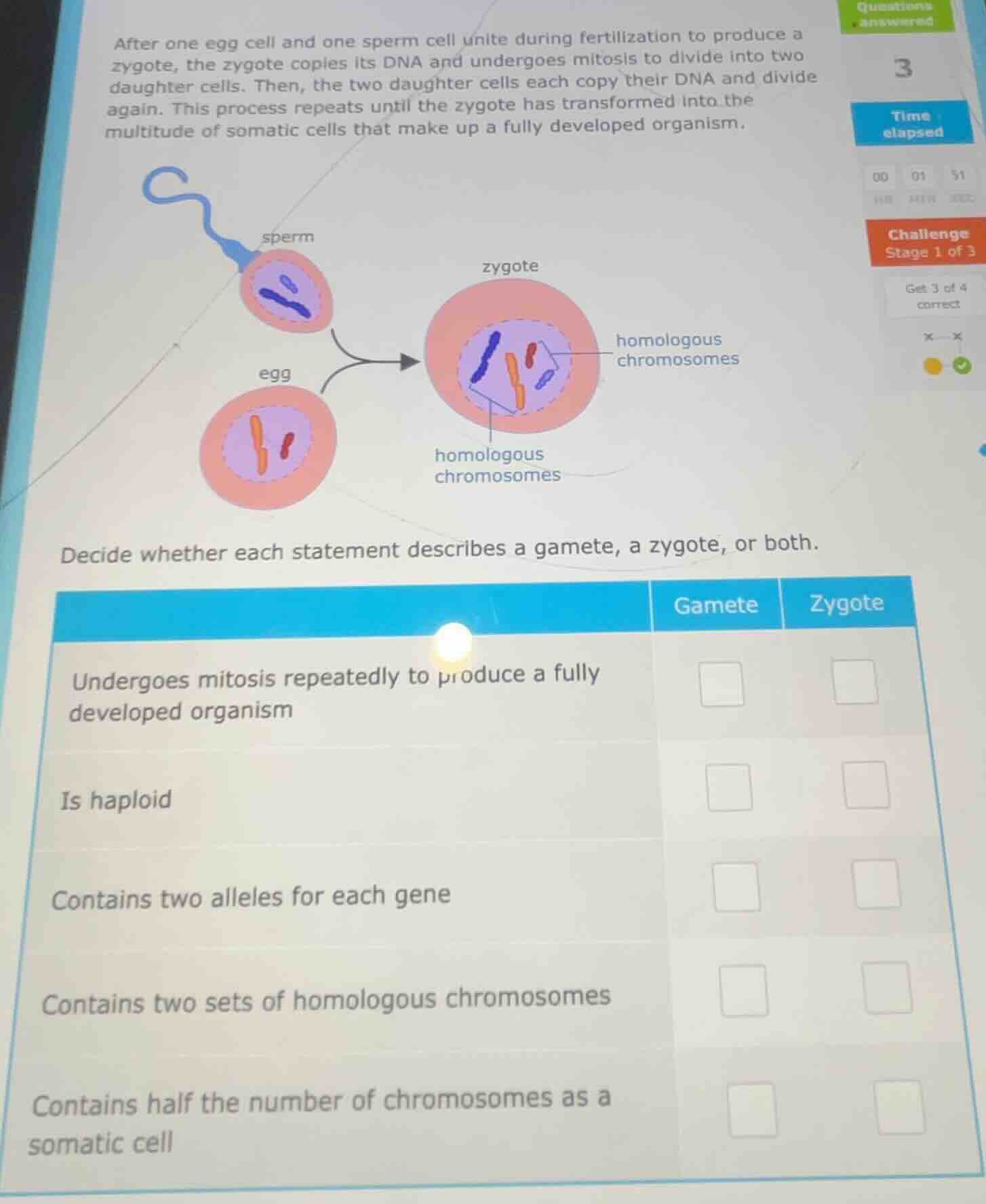
after one egg cell and one sperm cell unite during fertilization to produce a zygote, the zygote copies its dna and undergoes mitosis to divide into two daughter cells. then, the two daughter cells each copy their dna and divide again. this process repeats until the zygote has transformed into the multitude of somatic cells that make up a fully developed organism.
decide whether each statement describes a gamete, a zygote, or both.
| gamete | zygote | |
|---|---|---|
| is haploid | ||
| contains two alleles for each gene | ||
| contains two sets of homologous chromosomes | ||
| contains half the number of chromosomes as a somatic cell |
Brief Explanations
- The opening text states the zygote undergoes repeated mitosis to form a full organism; gametes do not divide this way.
- Gametes (sperm/egg) are haploid, meaning they have one set of chromosomes, while zygotes are diploid.
- Zygotes receive one allele from each parent gamete, so they have two alleles per gene; gametes only have one.
- Zygotes form from the fusion of two haploid gametes, resulting in two homologous chromosome sets; gametes only have one set.
- Somatic cells are diploid, like zygotes. Gametes are haploid, so they have half the chromosome count of somatic cells.

Snap & solve any problem in the app
Get step-by-step solutions on Sovi AI
Photo-based solutions with guided steps
Explore more problems and detailed explanations
- Undergoes mitosis repeatedly to produce a fully developed organism: Zygote
- Is haploid: Gamete
- Contains two alleles for each gene: Zygote
- Contains two sets of homologous chromosomes: Zygote
- Contains half the number of chromosomes as a somatic cell: Gamete