QUESTION IMAGE
Question
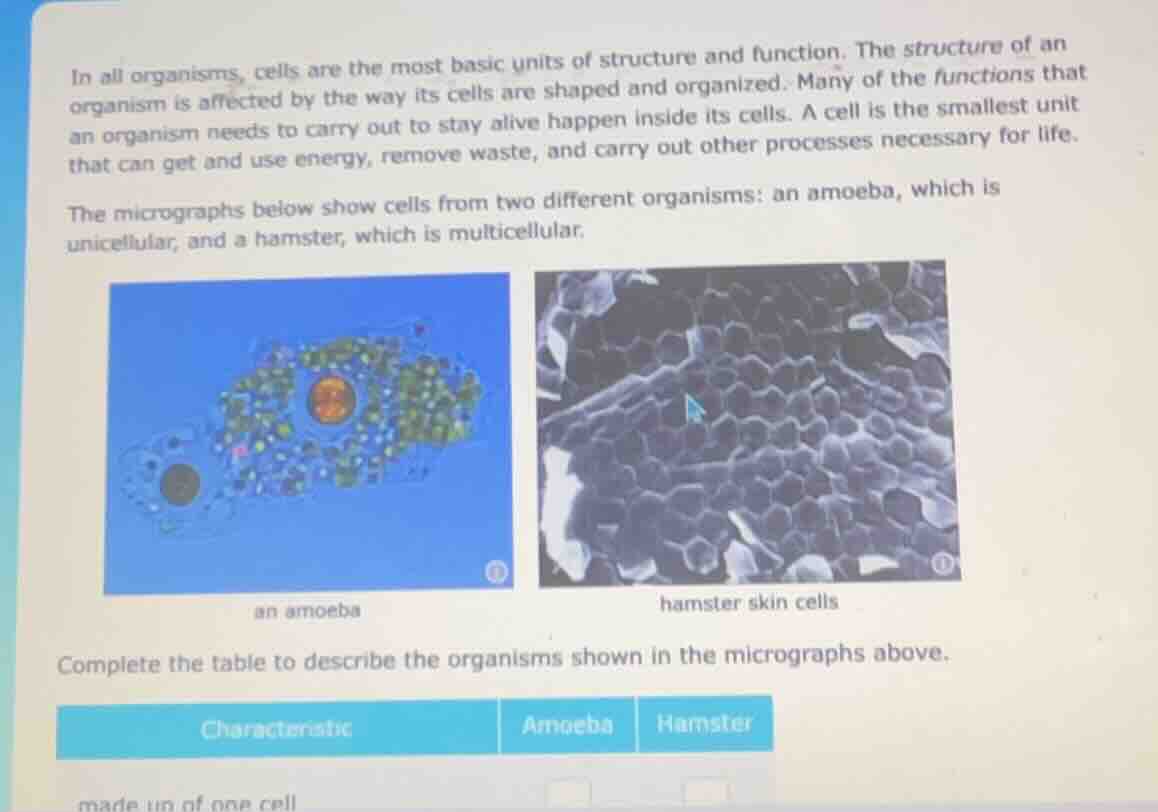
in all organisms, cells are the most basic units of structure and function. the structure of an organism is affected by the way its cells are shaped and organized. many of the functions that an organism needs to carry out to stay alive happen inside its cells. a cell is the smallest unit that can get and use energy, remove waste, and carry out other processes necessary for life. the micrographs below show cells from two different organisms: an amoeba, which is unicellular, and a hamster, which is multicellular. an amoeba hamster skin cells complete the table to describe the organisms shown in the micrographs above. characteristic amoeba hamster made up of one cell
To complete the table for the "made up of one cell" characteristic:
For Amoeba:
The text states the amoeba is unicellular (meaning it is made up of one cell). So we mark "Yes" (or check the box, depending on the table's input method) for Amoeba.
For Hamster:
The text states the hamster is multicellular (meaning it is made up of many cells, not one). So we mark "No" (or leave the box unchecked) for Hamster.
If we assume the table uses checkboxes (or "Yes"/"No"):
| Characteristic | Amoeba | Hamster |
|---|
(Note: If the table expects specific input like "Yes"/"No" or a checkmark, adjust accordingly. The key is Amoeba is unicellular (one cell) and Hamster is multicellular (many cells).)

Snap & solve any problem in the app
Get step-by-step solutions on Sovi AI
Photo-based solutions with guided steps
Explore more problems and detailed explanations
To complete the table for the "made up of one cell" characteristic:
For Amoeba:
The text states the amoeba is unicellular (meaning it is made up of one cell). So we mark "Yes" (or check the box, depending on the table's input method) for Amoeba.
For Hamster:
The text states the hamster is multicellular (meaning it is made up of many cells, not one). So we mark "No" (or leave the box unchecked) for Hamster.
If we assume the table uses checkboxes (or "Yes"/"No"):
| Characteristic | Amoeba | Hamster |
|---|
(Note: If the table expects specific input like "Yes"/"No" or a checkmark, adjust accordingly. The key is Amoeba is unicellular (one cell) and Hamster is multicellular (many cells).)