QUESTION IMAGE
Question
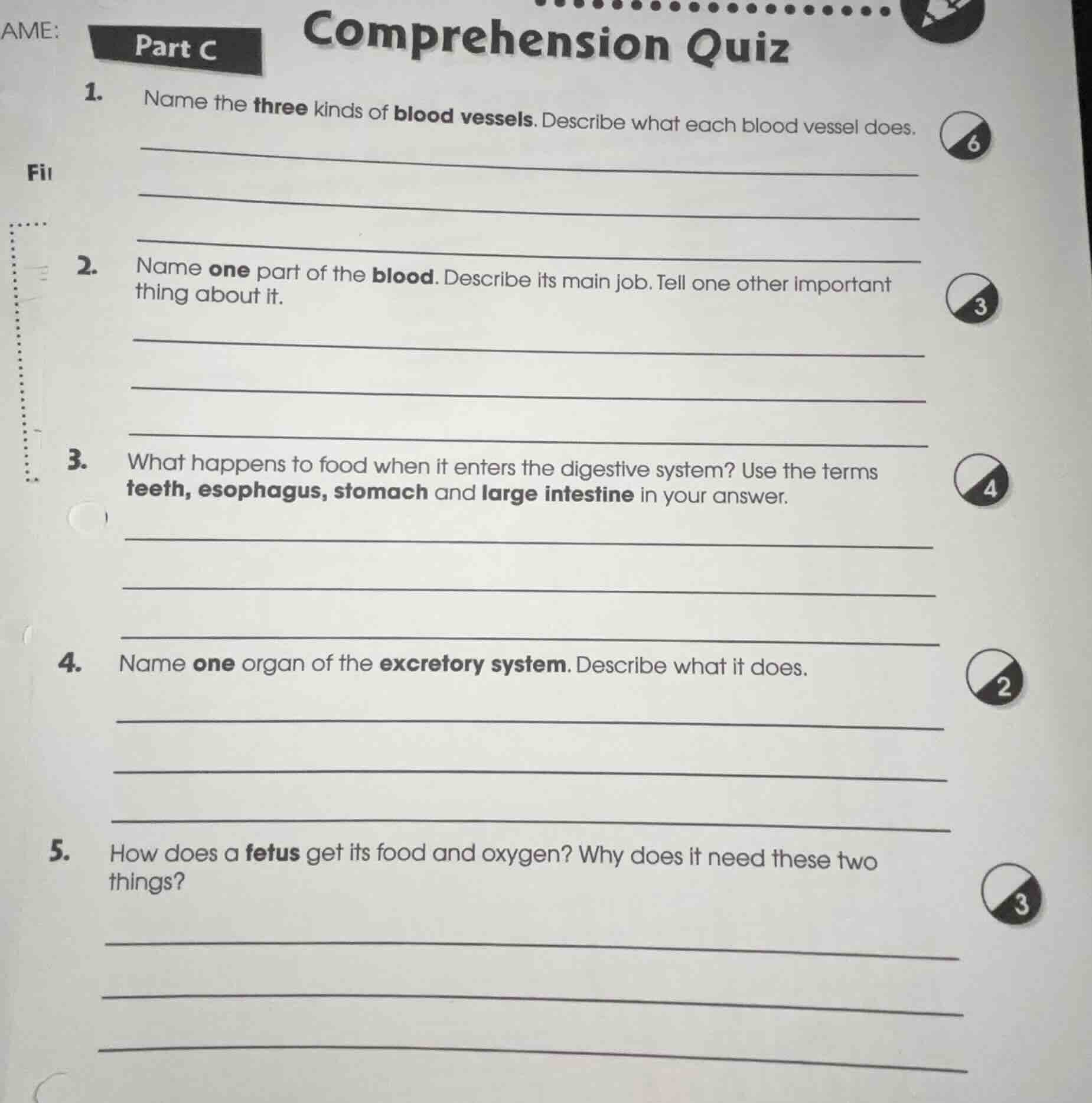
ame:part ccomprehension quiz1. name the three kinds of blood vessels. describe what each blood vessel does.fil2. name one part of the blood. describe its main job. tell one other important thing about it.3. what happens to food when it enters the digestive system? use the terms teeth, esophagus, stomach and large intestine in your answer.4. name one organ of the excretory system. describe what it does.5. how does a fetus get its food and oxygen? why does it need these two things?
Brief Explanations
- Identifies the three primary blood vessel types and their core functions in circulation.
- Selects a key blood component, outlines its main role, and adds a secondary relevant fact.
- Traces food's path through the digestive system using all required terms to explain breakdown and processing.
- Names a major excretory organ and its role in waste removal.
- Explains the fetal nutrient/oxygen delivery mechanism and the biological need for these resources.

Snap & solve any problem in the app
Get step-by-step solutions on Sovi AI
Photo-based solutions with guided steps
Explore more problems and detailed explanations
- - Arteries: Carry oxygen-rich blood away from the heart to body tissues.
- Veins: Carry oxygen-poor blood (and waste) back to the heart from body tissues.
- Capillaries: Tiny vessels where oxygen, nutrients, and waste are exchanged between blood and body cells.
- Example (Red Blood Cells):
- Main job: Transport oxygen from the lungs to body cells, and carry carbon dioxide waste away from cells.
- Other fact: They contain hemoglobin, a protein that binds to oxygen and gives blood its red color.
- First, the teeth physically break food into small pieces (mechanical digestion). The chewed food travels down the esophagus, a muscular tube that pushes it to the stomach. In the stomach, strong acids and enzymes chemically break down food into a thick liquid, and muscles churn it for further mechanical digestion. The partially digested food moves to the large intestine, where water and remaining nutrients are absorbed into the body, and the leftover solid waste is formed into feces to be eliminated.
- Example (Kidneys):
- The kidneys filter waste products, excess water, and extra minerals from the blood to form urine. They also balance the body's fluid levels and regulate electrolyte levels to maintain stable internal body conditions.
- A fetus gets food (nutrients) and oxygen from its mother's bloodstream through the placenta, a temporary organ that connects the fetus to the mother's uterus. Nutrients and oxygen pass from the mother's blood vessels into the fetus's blood vessels via the umbilical cord.
- The fetus needs food (nutrients) to fuel growth, build new cells and tissues, and support all developing body systems. It needs oxygen to perform cellular respiration, the process that releases energy from nutrients to power the fetus's metabolic functions and growth.