QUESTION IMAGE
Question
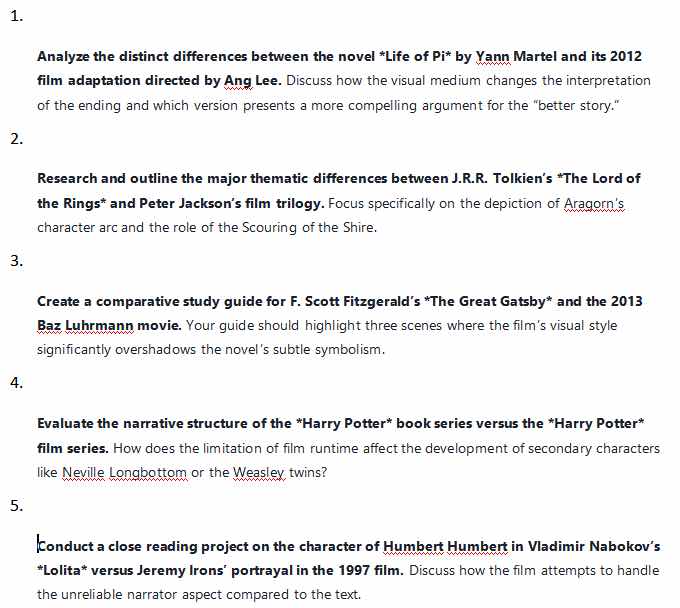
1.
analyze the distinct differences between the novel “life of pi” by yann martel and its 2012 film adaptation directed by ang lee. discuss how the visual medium changes the interpretation of the ending and which version presents a more compelling argument for the “better story.”
2.
research and outline the major thematic differences between j.r.r. tolkien’s the lord of the rings and peter jackson’s film trilogy. focus specifically on the depiction of aragorn’s character arc and the role of the scouring of the shire.
3.
create a comparative study guide for f. scott fitzgerald’s the great gatsby and the 2013 baz luhrmann movie. your guide should highlight three scenes where the film’s visual style significantly overshadows the novel’s subtle symbolism.
4.
evaluate the narrative structure of the harry potter book series versus the harry potter film series. how does the limitation of film runtime affect the development of secondary characters like neville longbottom or the weasley twins?
5.
conduct a close reading project on the character of humbert humbert in vladimir nabokov’s lolita versus jeremy irons’ portrayal in the 1997 film. discuss how the film attempts to handle the unreliable narrator aspect compared to the text.
1.
- Core Differences Between Text and Film:
- The novel Life of Pi relies on Pi's first-person, introspective narration, leaning heavily on internal monologue, philosophical rumination, and detailed descriptions of his mental state during his ordeal. The film uses visual spectacle (e.g., the glowing bioluminescent ocean, the tiger's physical presence) to convey emotion and atmosphere, which replaces much of the novel's internal focus.
- For the ending: The novel presents the two versions of Pi's story through extended verbal testimony, forcing readers to sit with the moral and existential weight of choosing between the "better story" (with the tiger) and the brutal, human-centric truth. The film softens this by using visual cues: it briefly shows the violent human version in stark, gritty footage, then cuts back to the warm, vivid imagery of the tiger and island. This visual framing guides viewers toward the whimsical story more explicitly than the novel, which lets readers linger in the ambiguity longer.
- Compelling Argument for "Better Story": The novel makes a more compelling argument because it prioritizes the reader's active choice. By withholding visual bias, it forces readers to confront the discomfort of moral ambiguity and the intentional act of choosing to believe the more hopeful, imaginative narrative. The film's visual spectacle makes the "better story" feel like a given, rather than a deliberate, meaningful choice.
- Aragorn's Character Arc:
- In Tolkien's text, Aragorn's journey is defined by slow, quiet self-acceptance of his royal lineage. He spends much of the story avoiding his claim, focused on duty rather than personal ambition, and his coronation feels earned through gradual, understated growth.
- In Peter Jackson's films, Aragorn's arc is amplified for drama: he is framed as a reluctant hero with overt moments of doubt (e.g., his hesitation to take the Paths of the Dead) and grand, cinematic displays of courage (e.g., charging the Pelennor Fields alone). The film emphasizes his action hero traits over the novel's focus on his quiet wisdom and sense of stewardship.
- The Scouring of the Shire:
- Tolkien's text includes the Scouring of the Shire as a critical coda: it shows that the hobbits' home is not untouched by the war, and forces the main characters to confront evil in their familiar, peaceful space. It reinforces the theme that even small, ordinary people must fight for their homes.
- Jackson's films cut this entire subplot, as it would disrupt the triumphant, uplifting tone of the final coronation and return to the Shire. This removes the novel's nuanced commentary on the lingering costs of war and the need for vigilance even after a "victory."
- Scene 1: The Opening Party at Gatsby's Mansion
- Novel: Fitzgerald uses subtle symbolism (e.g., the empty, superficial conversations, the distant figure of Gatsby watching from the shadows) to critique the emptiness of the Jazz Age elite. The focus is on the moral decay beneath the glamour.
- Film: Luhrmann's version uses over-the-top visual spectacle (bright neon lights, chaotic dance sequences, modern pop music) to depict the party. This visual excess overshadows the novel's subtle critique, framing the party as a fun, energetic event rather than a symbol of hollow decadence.
- Scene 2: The Plaza Hotel Confrontation
- Novel: The tension builds through sharp dialogue and quiet, simmering resentment. The focus is on the emotional cruelty of Tom and the fragility of Gatsby's illusion of Daisy.
- Film: The scene is amplified with dramatic camera angles, sweeping shots of the hotel suite, and loud, heightened performances. The visual drama overshadows the novel's subtle exploration of emotional manipulation and shattered dreams.
- Scene 3: Gatsby's Death in the Pool
- Novel: The scene is quiet, somber, and isolated. Gatsby's death is a lonely, understated moment that emphasizes his tragic, unrecognized sacrifice.
- Film: Luhrmann uses a dramatic, slow-motion sequence with swelling music and close-up shots of Gatsby's face. The visual melodrama overshadows the novel's subtle commentary on the invisibility of the marginalized and the cold indifference of the elite.

Snap & solve any problem in the app
Get step-by-step solutions on Sovi AI
Photo-based solutions with guided steps
Explore more problems and detailed explanations
- Distinct differences: The novel uses introspective, philosophical first-person narration; the film replaces internal focus with visual spectacle.
- Ending interpretation change: The novel lets readers sit with ambiguous, verbal competing stories; the film uses stark/soft visual framing to guide viewers toward the whimsical story.
- More compelling version: The novel, as it forces active reader choice rather than presenting a visually guided default.
---