QUESTION IMAGE
Question
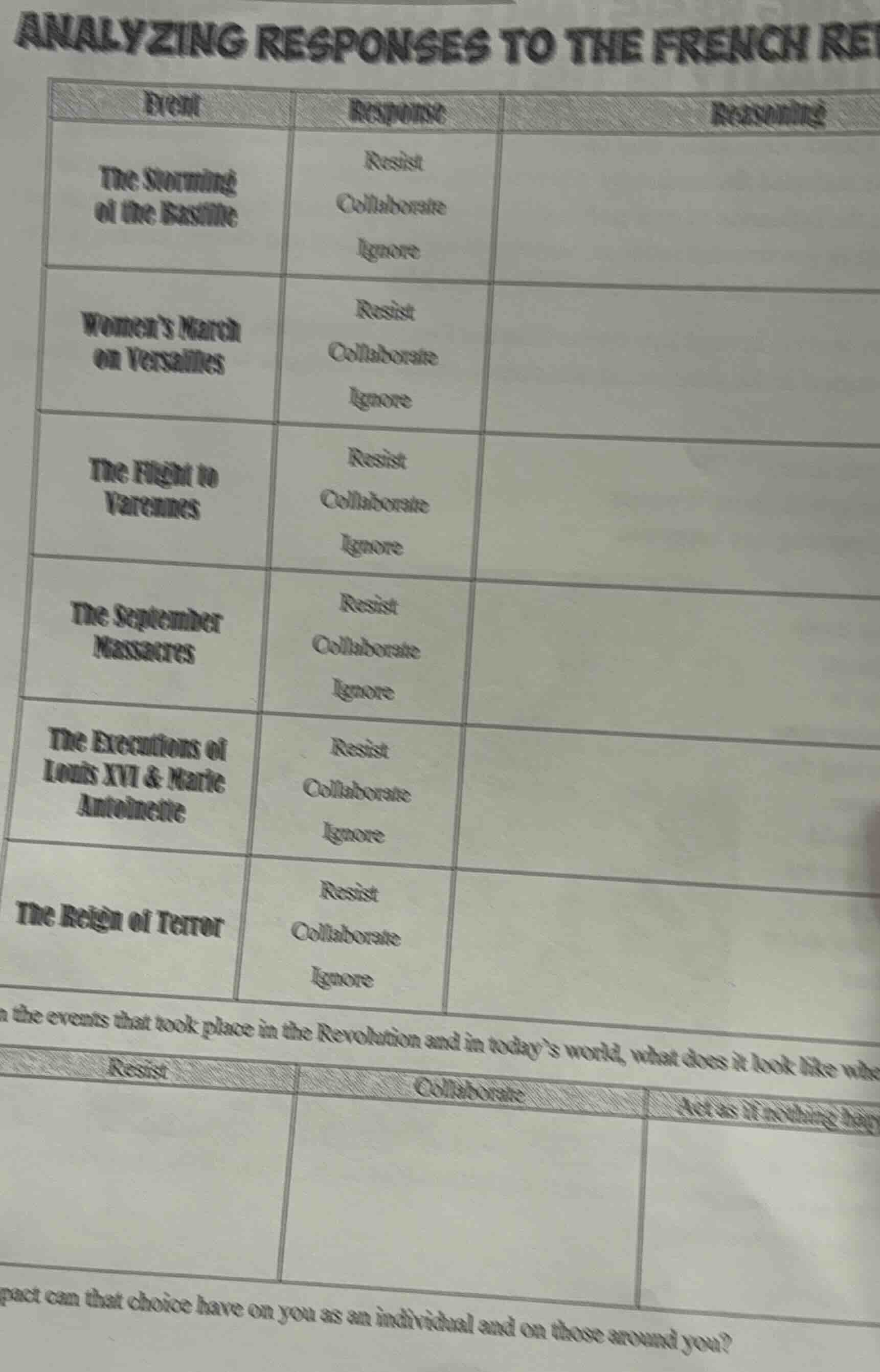
analyzing responses to the french rev| event | response | reasoning || ---- | ---- | ---- || the storming of the bastille | resist<br>collaborate<br>ignore | || womens march on versailles | resist<br>collaborate<br>ignore | || the flight to varennes | resist<br>collaborate<br>ignore | || the september massacres | resist<br>collaborate<br>ignore | || the executions of louis xvi & marie antoinette | resist<br>collaborate<br>ignore | || the reign of terror | resist<br>collaborate<br>ignore | |n the events that took place in the revolution and in todays world, what does it look like whe| resist | collaborate | act as if nothing happ || ---- | ---- | ---- || | | |pact can that choice have on you as an individual and on those around you?
Each response is selected based on the perspective of a moderate French noble/royalist sympathizer during the revolution, with reasoning tied to the event's context:
- The Storming of the Bastille: The event was a sudden, popular uprising against royal authority. A moderate royalist would resist to protect the monarchy's power and their own status.
- Women's March on Versailles: The march was driven by food shortages, a crisis affecting all classes. A moderate would collaborate to address the immediate need to avoid further unrest.
- The Flight to Varennes: The royal family's escape attempt was a private, failed action. Ignoring it avoids drawing unwanted attention from revolutionary forces.
- The September Massacres: These were violent, unregulated killings of political prisoners. Resisting would be an attempt to uphold legal order and protect innocent detainees.
- The Executions of Louis XVI & Marie Antoinette: The executions were a formal revolutionary act with overwhelming support. Ignoring it is a survival tactic to avoid being targeted as a royalist.
- The Reign of Terror: This was a period of state-sanctioned mass violence. Collaborating (e.g., complying with revolutionary committees) is necessary to avoid being labeled a counter-revolutionary and executed.
For the bottom section:
- Resist: Taking public action against unjust authority, e.g., protesting, organizing opposition. This can lead to individual danger (arrest, violence) but may inspire others to fight for change.
- Collaborate: Working with authorities to address grievances, e.g., negotiating reforms. This can lead to incremental progress but may draw criticism from hardline opponents.
- Act as if nothing happened (Ignore): Avoiding engagement with conflict. This protects individual safety but allows unjust systems or violence to continue unchallenged.

Snap & solve any problem in the app
Get step-by-step solutions on Sovi AI
Photo-based solutions with guided steps
Explore more problems and detailed explanations
Top Table (Event, Response, Reasoning)
- The Storming of the Bastille:
- Response: Resist
- Reasoning: Defend royal authority/status
- Women's March on Versailles:
- Response: Collaborate
- Reasoning: Address food crisis to calm unrest
- The Flight to Varennes:
- Response: Ignore
- Reasoning: Avoid revolutionary scrutiny
- The September Massacres:
- Response: Resist
- Reasoning: Uphold legal order, protect prisoners
- The Executions of Louis XVI & Marie Antoinette:
- Response: Ignore
- Reasoning: Survive by avoiding royalist labeling
- The Reign of Terror:
- Response: Collaborate
- Reasoning: Avoid being targeted as a counter-revolutionary
Bottom Table (Action, Definition, Impact)
- Resist: Publicly opposing unjust authority (e.g., protests). Impact: Personal risk (arrest/violence), potential to inspire collective change.
- Collaborate: Working with authorities to fix issues (e.g., negotiations). Impact: Incremental progress, criticism from hardline opponents.
- Act as if nothing happened (Ignore): Avoiding conflict engagement. Impact: Personal safety, allows injustice to persist unchallenged.