QUESTION IMAGE
Question
answer all questions in this part.
directions (1–28): for each statement or question, record on your separate answer sheet the number of the word or expression that, of those given, best completes the statement or answers the question.
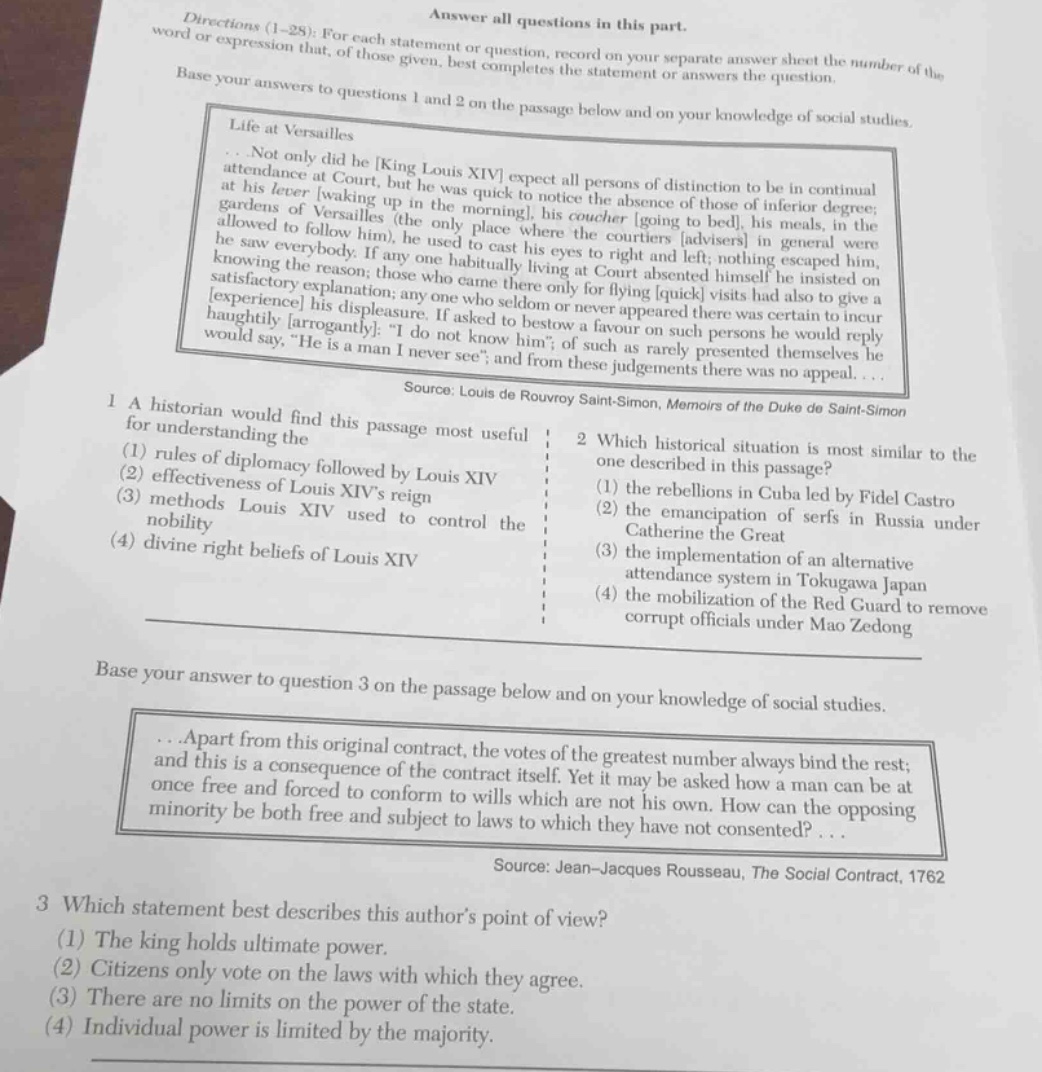
base your answers to questions 1 and 2 on the passage below and on your knowledge of social studies.
life at versailles
... not only did he king louis xiv expect all persons of distinction to be in continual attendance at court, but he was quick to notice the absence of those of inferior degree; at his lever waking up in the morning, his coucher going to bed, his meals, in the gardens of versailles (the only place where the courtiers advisers in general were allowed to follow him), he used to cast his eyes to right and left; nothing escaped him, he saw everybody: if any one habitually living at court absented himself he insisted on knowing the reason; those who came there only for flying quick visits had also to give a satisfactory explanation; any one who seldom or never appeared there was certain to incur experience his displeasure. if asked to bestow a favour on such persons he would reply haughtily arrogantly: “i do not know him”; of such as rarely presented themselves he would say, “he is a man i never see”; and from these judgements there was no appeal. ...
source: louis de rouvroy saint - simon, memoirs of the duke de saint - simon
1 a historian would find this passage most useful for understanding the
(1) rules of diplomacy followed by louis xiv
(2) effectiveness of louis xiv’s reign
(3) methods louis xiv used to control the nobility
(4) divine right beliefs of louis xiv
2 which historical situation is most similar to the one described in this passage?
(1) the rebellions in cuba led by fidel castro
(2) the emancipation of serfs in russia under catherine the great
(3) the implementation of an alternative attendance system in tokugawa japan
(4) the mobilization of the red guard to remove corrupt officials under mao zedong
base your answer to question 3 on the passage below and on your knowledge of social studies.
... apart from this original contract, the votes of the greatest number always bind the rest; and this is a consequence of the contract itself. yet it may be asked how a man can be at once free and forced to conform to wills which are not his own. how can the opposing minority be both free and subject to laws to which they have not consented? ...
source: jean - jacques rousseau, the social contract, 1762
3 which statement best describes this author’s point of view?
(1) the king holds ultimate power.
(2) citizens only vote on the laws with which they agree.
(3) there are no limits on the power of the state.
(4) individual power is limited by the majority.
Question 1
The passage describes how Louis XIV monitored the nobility's attendance at court events (lever, coucher, meals) and reacted to absences. Option (1) is incorrect as it's about diplomacy, not attendance control. Option (2) is about the reign's effectiveness, not shown here. Option (4) is about divine right, not addressed. Option (3) matches the methods (monitoring presence, reacting to absences) to control nobility.
The passage shows Louis XIV controlling nobility via attendance. Option (1) is a rebellion, not control. Option (2) is emancipation, not control. Option (3): Tokugawa Japan's alternative attendance system (like sankin - kotai, requiring daimyo to attend Edo) is similar to Louis XIV controlling nobility via attendance. Option (4) is about removing corrupt officials, not attendance - based control.
The passage from Rousseau says the majority's votes bind the rest, so individuals (minority) are subject to majority will. Option (1) is about a king's power, not Rousseau's view. Option (2) is incorrect as the passage says the majority binds, so citizens follow majority will even if they disagree. Option (3) is incorrect; Rousseau's social contract has limits (general will). Option (4) matches: individual power (minority) is limited by the majority (greatest number's votes).

Snap & solve any problem in the app
Get step-by-step solutions on Sovi AI
Photo-based solutions with guided steps
Explore more problems and detailed explanations
(3) methods Louis XIV used to control the nobility