QUESTION IMAGE
Question
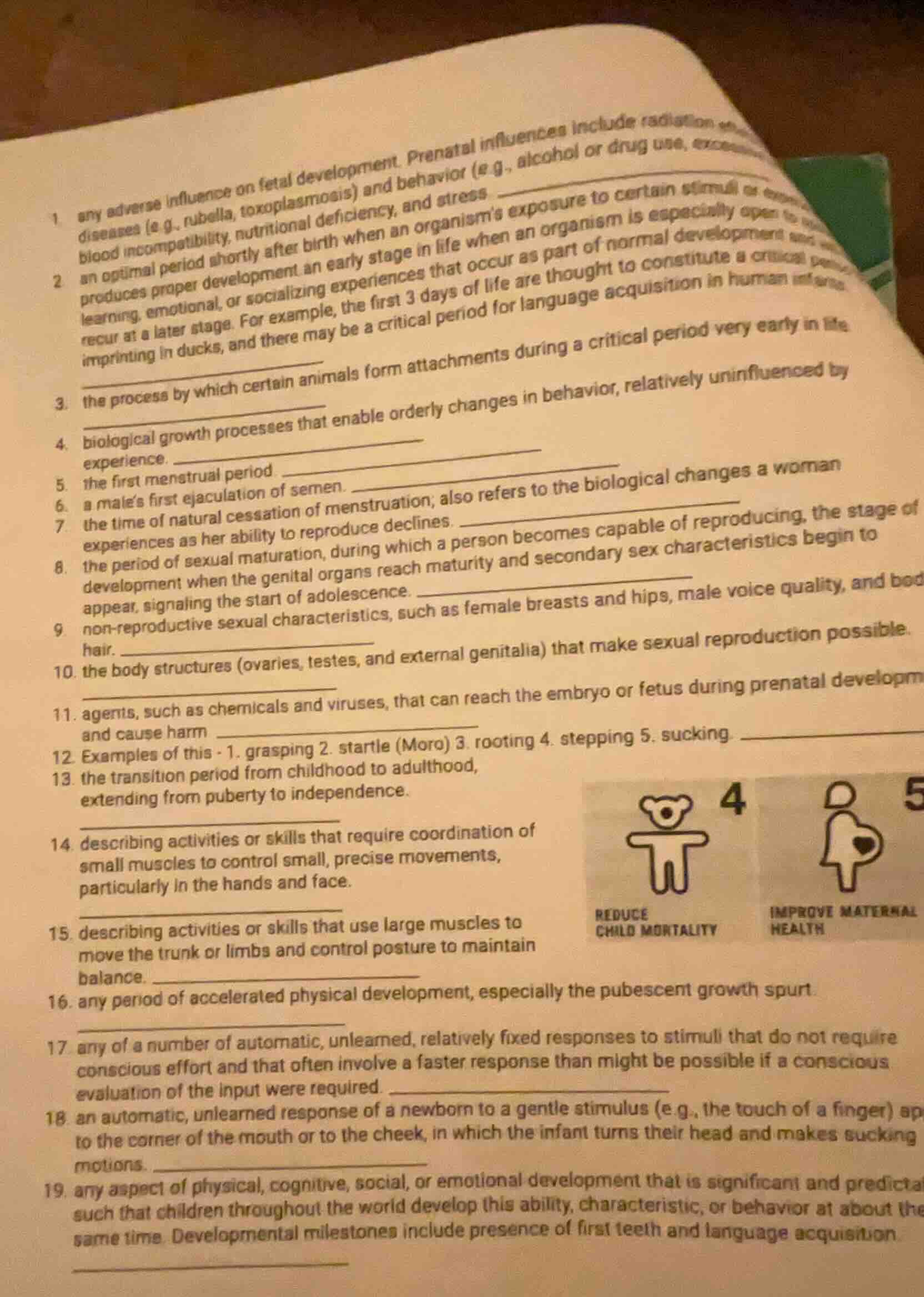
1 any adverse influence on fetal development. prenatal influences include radiation or diseases (e.g., rubella, toxoplasmosis) and behavior (e.g., alcohol or drug use, excessive blood incompatibility, nutritional deficiency, and stress
2 an optimal period shortly after birth when an organism’s exposure to certain stimuli or produces proper development. an early stage in life when an organism is especially open to learning, emotional, or socializing experiences that occur as part of normal development and recur at a later stage. for example, the first 3 days of life are thought to constitute a critical period imprinting in ducks, and there may be a critical period for language acquisition in human infants.
- the process by which certain animals form attachments during a critical period very early in life
- biological growth processes that enable orderly changes in behavior, relatively uninfluenced by experience.
- the first menstrual period
- a male’s first ejaculation of semen.
- the time of natural cessation of menstruation; also refers to the biological changes a woman experiences as her ability to reproduce declines.
- the period of sexual maturation, during which a person becomes capable of reproducing, the stage of development when the genital organs reach maturity and secondary sex characteristics begin to appear, signaling the start of adolescence.
- non - reproductive sexual characteristics, such as female breasts and hips, male voice quality, and body hair.
- the body structures (ovaries, testes, and external genitalia) that make sexual reproduction possible.
- agents, such as chemicals and viruses, that can reach the embryo or fetus during prenatal development and cause harm
- examples of this - 1. grasping 2. startle (moro) 3. rooting 4. stepping 5. sucking.
- the transition period from childhood to adulthood, extending from puberty to independence.
- describing activities or skills that require coordination of small muscles to control small, precise movements, particularly in the hands and face.
- describing activities or skills that use large muscles to move the trunk or limbs and control posture to maintain balance.
- any period of accelerated physical development, especially the pubescent growth spurt.
- any of a number of automatic, unlearned, relatively fixed responses to stimuli that do not require conscious effort and that often involve a faster response than might be possible if a conscious evaluation of the input were required.
- an automatic, unlearned response of a newborn to a gentle stimulus (e.g., the touch of a finger) applied to the corner of the mouth or to the cheek, in which the infant turns their head and makes sucking motions.
- any aspect of physical, cognitive, social, or emotional development that is significant and predictable such that children throughout the world develop this ability, characteristic, or behavior at about the same time. developmental milestones include presence of first teeth and language acquisition
Each term is matched to its standard definition in developmental psychology:
- Defines prenatal hazards that harm fetal development.
- Defines a window for critical developmental learning.
- Defines the early attachment behavior in animals.
- Defines biologically driven behavioral changes.
- Defines the first menstrual cycle.
- Defines a male's first ejaculation.
- Defines the end of a woman's reproductive cycle.
- Defines the stage of sexual maturity onset.
- Defines non-reproductive sexual traits.
- Defines reproductive anatomy.
- Defines substances that harm prenatal development.
- Defines automatic newborn reflexes.
- Defines the transition to adulthood.
- Defines small muscle coordination skills.
- Defines large muscle movement skills.
- Defines rapid physical growth periods.
- Defines automatic stimulus responses.
- Defines a specific newborn feeding reflex.
- Defines universal developmental markers.

Snap & solve any problem in the app
Get step-by-step solutions on Sovi AI
Photo-based solutions with guided steps
Explore more problems and detailed explanations
- Prenatal risk factors
- Critical period
- Imprinting
- Maturation
- Menarche
- Spermarche
- Menopause
- Puberty
- Secondary sex characteristics
- Primary sex characteristics
- Teratogens
- Neonatal reflexes
- Adolescence
- Fine motor skills
- Gross motor skills
- Growth spurt
- Reflex
- Rooting reflex
- Developmental milestone