QUESTION IMAGE
Question
applying the tools of our foreign policy
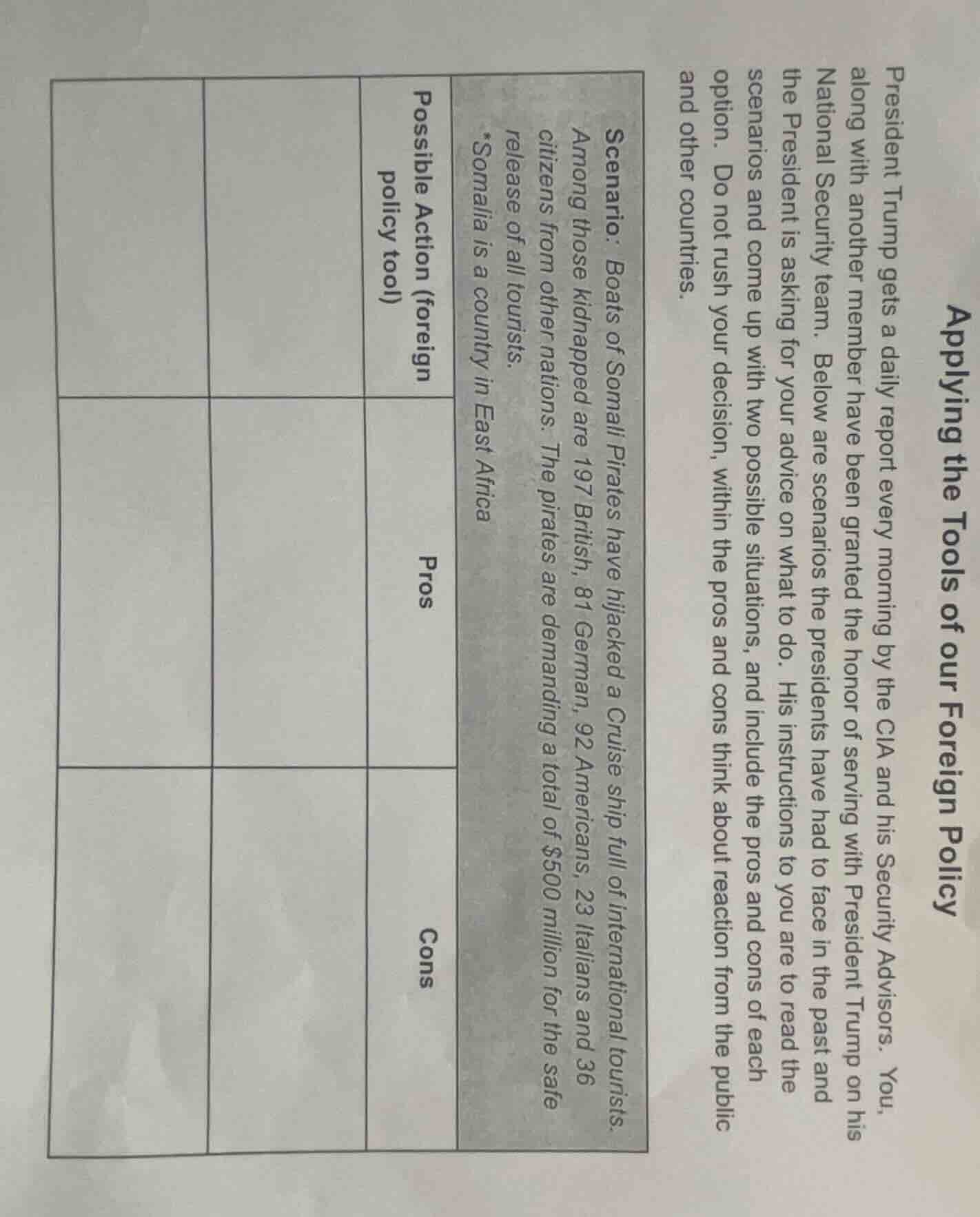
president trump gets a daily report every morning by the cia and his security advisors. you, along with another member have been granted the honor of serving with president trump on his national security team. below are scenarios the presidents have had to face in the past and the president is asking for your advice on what to do. his instructions to you are to read the scenarios and come up with two possible situations, and include the pros and cons of each option. do not rush your decision, within the pros and cons think about reaction from the public and other countries.
scenario: boats of somali pirates have hijacked a cruise ship full of international tourists. among those kidnapped are 197 british, 81 german, 92 americans, 23 italians and 36 citizens from other nations. the pirates are demanding a total of $500 million for the safe release of all tourists.
*somalia is a country in east africa
| possible action (foreign policy tool) | pros | cons |
|---|---|---|
First, two distinct foreign policy tools are selected for the scenario, then their pros and cons (including public and international reactions) are outlined:
- Military Intervention (Direct Raid): This is a coercive foreign policy tool targeting the pirates directly.
- Pros: Rescues hostages without paying ransom, sends a strong anti-piracy deterrent signal, likely receives strong domestic public support for protecting citizens, avoids empowering pirates financially.
- Cons: High risk of hostage casualties during the raid, potential diplomatic backlash from Somalia over unauthorized military incursion into its territory, may trigger retaliatory piracy or attacks on other Western targets, negative international public perception if civilian casualties occur.
- Multilateral Negotiations (with Allied Nations): This is a diplomatic foreign policy tool coordinating with other affected countries.
- Pros: Shares financial and diplomatic burden with allies, reduces risk of hostage harm through peaceful dialogue, builds positive international cooperation credibility, avoids military escalation and associated casualties.
- Cons: Negotiations can be slow, leading to prolonged hostage trauma, may require partial ransom payments (setting a precedent for future piracy), domestic public criticism for perceived weakness in addressing piracy, risk of pirates breaking negotiation terms.

Snap & solve any problem in the app
Get step-by-step solutions on Sovi AI
Photo-based solutions with guided steps
Explore more problems and detailed explanations
| Possible Action (foreign policy tool) | Pros | Cons |
|---|---|---|
| Multilateral Negotiations (Allied Coordination) | Shares burden with allies; Low hostage harm risk; Builds international cooperation | Slow process; May set ransom precedent; Domestic criticism for "weakness" |