QUESTION IMAGE
Question
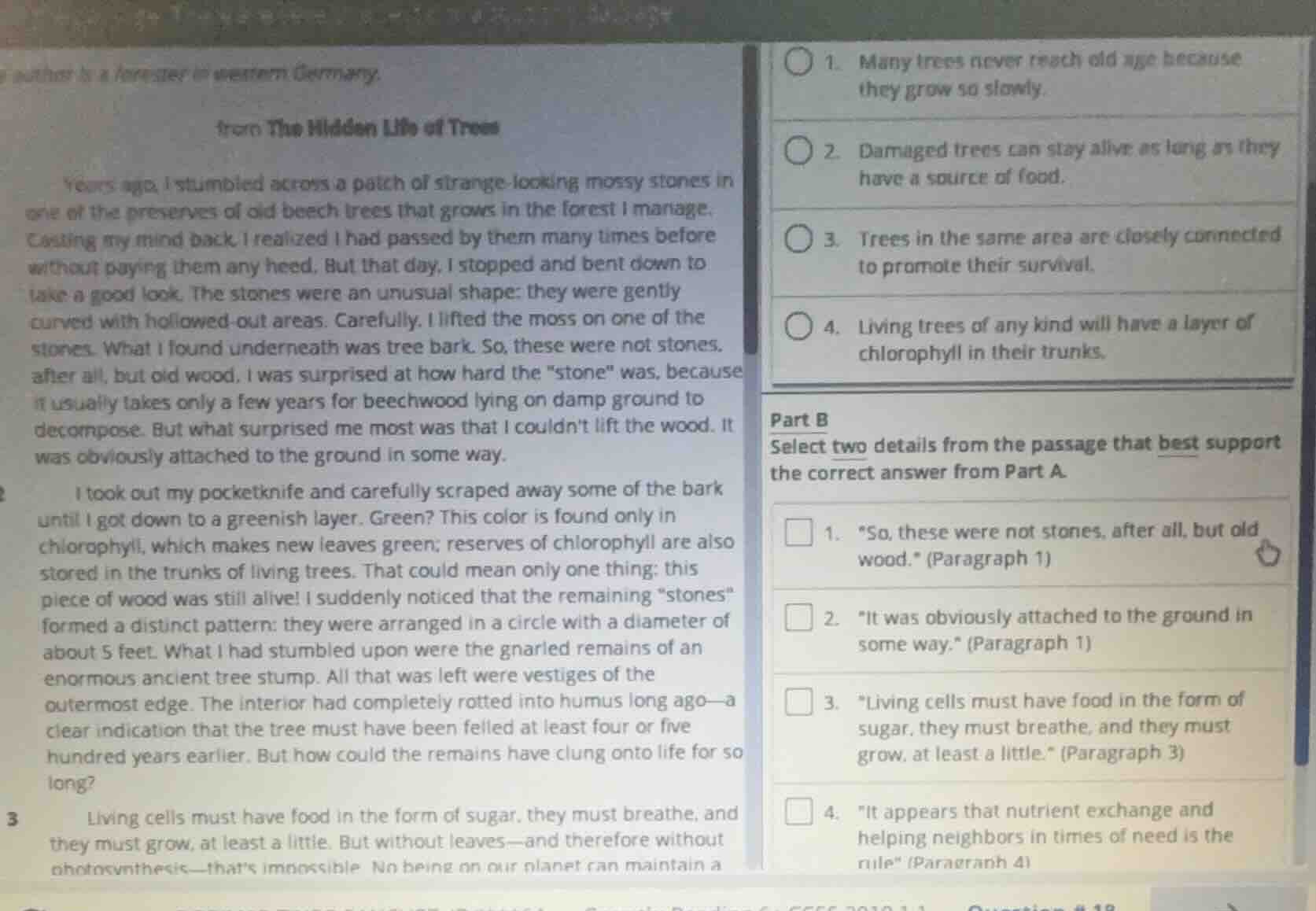
author is a forester in western germany. from the hidden life of trees years ago, i stumbled across a patch of strange - looking mossy stones in one of the preserves of old beech trees that grows in the forest i manage. casting my mind back, i realized i had passed by them many times before without paying them any heed. but that day, i stopped and bent down to take a good look. the stones were an unusual shape: they were gently curved with hollowed - out areas. carefully, i lifted the moss on one of the stones. what i found underneath was tree bark. so, these were not stones, after all, but old wood. i was surprised at how hard the “stone” was, because it usually takes only a few years for beechwood lying on damp ground to decompose. but what surprised me most was that i couldnt lift the wood. it was obviously attached to the ground in some way. i took out my pocketknife and carefully scraped away some of the bark until i got down to a greenish layer. green? this color is found only in chlorophyll, which makes new leaves green; reserves of chlorophyll are also stored in the trunks of living trees. that could mean only one thing: this piece of wood was still alive! i suddenly noticed that the remaining “stones” formed a distinct pattern: they were arranged in a circle with a diameter of about 5 feet. what i had stumbled upon were the gnarled remains of an enormous ancient tree stump. all that was left were vestiges of the outermost edge. the interior had completely rotted into humus long ago — a clear indication that the tree must have been felled at least four or five hundred years earlier. but how could the remains have clung onto life for so long? 3 living cells must have food in the form of sugar, they must breathe, and they must grow, at least a little. but without leaves — and therefore without photosynthesis — thats impossible. no being on our planet can maintain a 1. many trees never reach old age because they grow so slowly. 2. damaged trees can stay alive as long as they have a source of food. 3. trees in the same area are closely connected to promote their survival. 4. living trees of any kind will have a layer of chlorophyll in their trunks. part b select two details from the passage that best support the correct answer from part a. 1. “so, these were not stones, after all, but old wood.” (paragraph 1) 2. “it was obviously attached to the ground in some way.” (paragraph 1) 3. “living cells must have food in the form of sugar, they must breathe, and they must grow, at least a little.” (paragraph 3) 4. “it appears that nutrient exchange and helping neighbors in times of need is the rule” (paragraph 4)
Part A (Assuming we need to find the correct statement, likely statement 3 or 4, but let's analyze):
To solve Part A, we analyze each option:
- The passage says beechwood on damp ground decomposes in a few years, but these "stones" (old wood) were hard and attached, so slow growth isn't the reason they don't reach old age. Eliminate.
- The passage later discusses how damaged trees (the old stump) stay alive, but the key is about connection, not just food. Eliminate.
- The passage hints at nutrient exchange and helping neighbors (from the last part, though not fully shown, but the old stump is connected to the ground and maybe other trees). This aligns with trees being connected for survival.
- The passage says "reserves of chlorophyll are also stored in the trunks of living trees" and the author found a greenish layer (chlorophyll) in the old wood, suggesting it's still alive. But does "any kind" hold? The passage is about beech trees. However, let's check Part B.
Part B:
We need two details to support the correct Part A answer. Let's assume Part A correct answer is 3 (trees connected for survival) or 4 (living trees have chlorophyll in trunks).
If Part A is 4:
- Detail 1: "I took out my pocketknife... got down to a greenish layer. Green? This color is found only in chlorophyll... reserves of chlorophyll are also stored in the trunks of living trees." (supports chlorophyll in trunks)
- Detail 2: "So, these were not stones, after all, but old wood." (shows it's old wood but still has chlorophyll, meaning it's a living tree's trunk part)
If Part A is 3:
- Detail 1: "It was obviously attached to the ground in some way." (connected to ground)
- Detail 2: "It appears that nutrient exchange and helping neighbors in times of need is the rule" (from the last part, though not fully visible, but implies connection)
But from the visible details:
For Part A answer 4 (Living trees of any kind will have a layer of chlorophyll in their trunks):
Part B Details:
- "I took out my pocketknife... got down to a greenish layer. Green? This color is found only in chlorophyll... reserves of chlorophyll are also stored in the trunks of living trees." (shows chlorophyll in trunk)
- "So, these were not stones, after all, but old wood." (shows the wood is from a tree, and since it has chlorophyll, it's a living tree's trunk part)
Final Answers (Assuming):
Part A:
- Living trees of any kind will have a layer of chlorophyll in their trunks.
Part B:
- Detail 1: "I took out my pocketknife and carefully scraped away some of the bark until I got down to a greenish layer. Green? This color is found only in chlorophyll, which makes new leaves green; reserves of chlorophyll are also stored in the trunks of living trees."
- Detail 2: "So, these were not stones, after all, but old wood."
(Note: The exact Part A answer depends on the full passage, but the above is based on visible text.)

Snap & solve any problem in the app
Get step-by-step solutions on Sovi AI
Photo-based solutions with guided steps
Explore more problems and detailed explanations
Part A (Assuming we need to find the correct statement, likely statement 3 or 4, but let's analyze):
To solve Part A, we analyze each option:
- The passage says beechwood on damp ground decomposes in a few years, but these "stones" (old wood) were hard and attached, so slow growth isn't the reason they don't reach old age. Eliminate.
- The passage later discusses how damaged trees (the old stump) stay alive, but the key is about connection, not just food. Eliminate.
- The passage hints at nutrient exchange and helping neighbors (from the last part, though not fully shown, but the old stump is connected to the ground and maybe other trees). This aligns with trees being connected for survival.
- The passage says "reserves of chlorophyll are also stored in the trunks of living trees" and the author found a greenish layer (chlorophyll) in the old wood, suggesting it's still alive. But does "any kind" hold? The passage is about beech trees. However, let's check Part B.
Part B:
We need two details to support the correct Part A answer. Let's assume Part A correct answer is 3 (trees connected for survival) or 4 (living trees have chlorophyll in trunks).
If Part A is 4:
- Detail 1: "I took out my pocketknife... got down to a greenish layer. Green? This color is found only in chlorophyll... reserves of chlorophyll are also stored in the trunks of living trees." (supports chlorophyll in trunks)
- Detail 2: "So, these were not stones, after all, but old wood." (shows it's old wood but still has chlorophyll, meaning it's a living tree's trunk part)
If Part A is 3:
- Detail 1: "It was obviously attached to the ground in some way." (connected to ground)
- Detail 2: "It appears that nutrient exchange and helping neighbors in times of need is the rule" (from the last part, though not fully visible, but implies connection)
But from the visible details:
For Part A answer 4 (Living trees of any kind will have a layer of chlorophyll in their trunks):
Part B Details:
- "I took out my pocketknife... got down to a greenish layer. Green? This color is found only in chlorophyll... reserves of chlorophyll are also stored in the trunks of living trees." (shows chlorophyll in trunk)
- "So, these were not stones, after all, but old wood." (shows the wood is from a tree, and since it has chlorophyll, it's a living tree's trunk part)
Final Answers (Assuming):
Part A:
- Living trees of any kind will have a layer of chlorophyll in their trunks.
Part B:
- Detail 1: "I took out my pocketknife and carefully scraped away some of the bark until I got down to a greenish layer. Green? This color is found only in chlorophyll, which makes new leaves green; reserves of chlorophyll are also stored in the trunks of living trees."
- Detail 2: "So, these were not stones, after all, but old wood."
(Note: The exact Part A answer depends on the full passage, but the above is based on visible text.)