QUESTION IMAGE
Question
background essay
what was the underlying cause of world war i?
at the turn of the 20th century europe was
feeling pretty darned good. it controlled empires
that circled the globe. its technology was
unsurpassed. its art and music were the envy
of the world. in 1900, europeans believed the
world was their oyster.
but this feeling was not to last. by the
end of 1918, after four long years of war, euro-
pean confidence was badly shaken. ten million
soldiers had died; another 20 million had been
wounded. empires that had lasted for centuries
lay in tatters. writers wrote of broken dreams.
europe had entered the great war riding on a
song. now, in november of 1918, no one was
singing. what had gone wrong?
in the late 19th century european leaders
believed that by creating a balance of power
they could prevent such a horror. the idea was
that if the major powers of europe - countries
like england, france, russia, and germany -
were balanced in strength, no one country could
dominate the rest. war could be avoided.
but otto von bismarck, the chancellor of
prussia who led the unification of the german
states, did not like the fact that germany was
sandwiched between russia and france. to
counter this uncomfortable situation, bismarck
created an alliance with austria - hungary and
italy. he did try to reassure russia and great
britain, but after 1890, france, russia, and
britain formed their own entente. the great
players were picking between sides.
the tension within countries was
matched by tension between countries. especially
in southeastern europe, in an area known as the
balkans, the spirit of nationalism and indepen-
dence ran high. some ethnic groups revolted.
the region was a powder keg. all it lacked was
a spark to set it off. that spark was provided
by a serbian nationalist group called the black
hand. they wanted independence from their
mother country, austria - hungary. their
solution? assassinate the archduke of austria
when he came to visit.
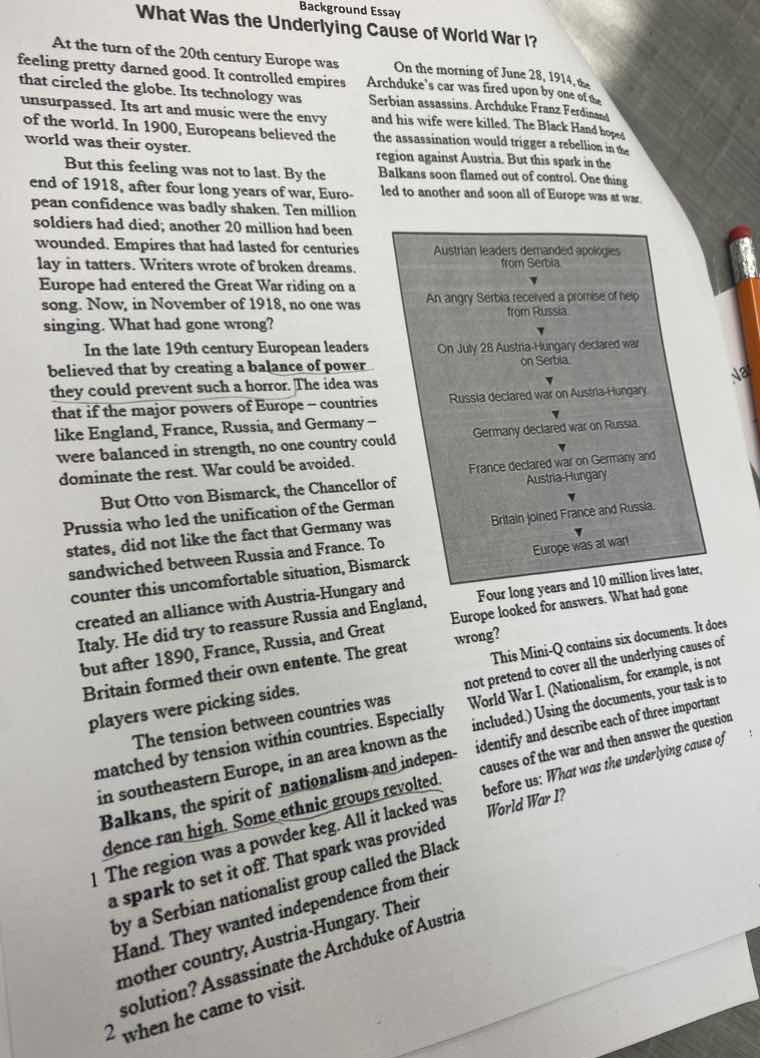
on the morning of june 28, 1914, the
archdukes car was fired upon by one of the
serbian assassins. archduke franz ferdinand
and his wife were killed. the black hand hoped
the assassination would trigger a rebellion in the
region against austria. but this spark in the
balkans soon flamed out of control. one thing
led to another and soon all of europe was at war.
austrian leaders demanded apologies
from serbia
an angry serbia received a promise of help
from russia
on july 28 austria - hungary declared war
on serbia
russia declared war on austria - hungary
germany declared war on russia
france declared war on germany and
austria - hungary
britain joined france and russia.
europe was at war
four long years and 10 million lives later,
europe looked for answers. what had gone
wrong?
this mini - q contains six documents. it does
not pretend to cover all the underlying causes of
world war i (nationalism, for example, is not
included.) using the documents, your task is to
identify and describe each of three important
causes of the war and then answer the question
before us: what was the underlying cause of
world war i?
Since the problem is about analyzing the underlying cause of World War I, which involves historical analysis, the subfield under Social Science is History.
To determine the underlying cause of World War I, we analyze the historical context:
- Power Balance & Alliances: European powers (e.g., Britain, France, Russia, Germany, Austria - Hungary) formed rival alliances (Triple Alliance, Triple Entente) due to fears of domination, creating tension.
- Nationalism in the Balkans: In southeastern Europe (Balkans), ethnic groups sought independence from Austria - Hungary. Serbian nationalists (Black Hand) assassinated Archduke Franz Ferdinand, triggering a chain of declarations of war.
- Tension Between Countries: Germany’s rise, Bismarck’s alliance strategies, and competition for power (colonies, military strength) escalated conflicts. The assassination was the “spark,” but underlying causes were long - term tensions from alliance systems, nationalism, and power struggles.

Snap & solve any problem in the app
Get step-by-step solutions on Sovi AI
Photo-based solutions with guided steps
Explore more problems and detailed explanations
The underlying cause of World War I was a combination of long - term factors: the complex system of alliances (Triple Alliance vs. Triple Entente) that created a delicate power balance prone to collapse, intense nationalism (especially in the Balkans, where ethnic groups sought independence from Austria - Hungary), and competitive power struggles between European nations over territory, influence, and military dominance. The assassination of Archduke Franz Ferdinand was the immediate spark, but the underlying tensions from alliance rivalries, nationalist movements, and power competition among European states led to the war.