QUESTION IMAGE
Question
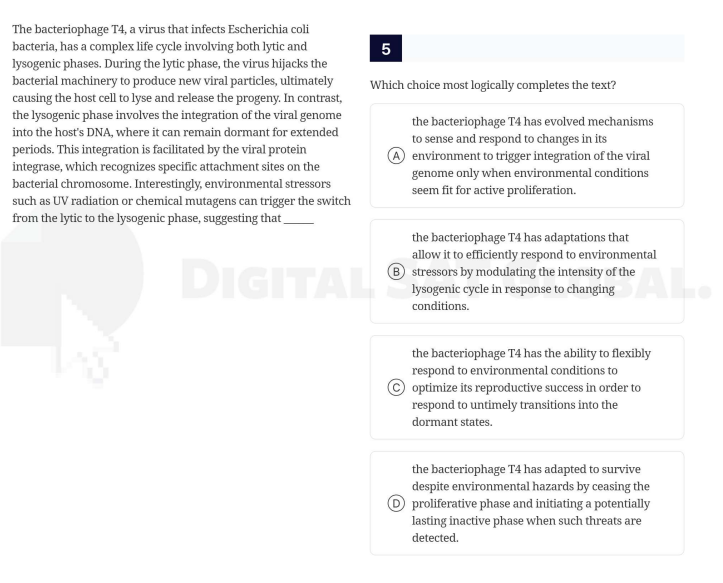
the bacteriophage t4, a virus that infects escherichia coli bacteria, has a complex life cycle involving both lytic and lysogenic phases. during the lytic phase, the virus hijacks the bacterial machinery to produce new viral particles, ultimately causing the host cell to lyse and release the progeny. in contrast, the lysogenic phase involves the integration of the viral genome into the host’s dna, where it can remain dormant for extended periods. this integration is facilitated by the viral protein integrase, which recognizes specific attachment sites on the bacterial chromosome. interestingly, environmental stressors such as uv radiation or chemical mutagens can trigger the switch from the lytic to the lysogenic phase, suggesting that ______
5 which choice most logically completes the text?
a the bacteriophage t4 has evolved mechanisms to sense and respond to changes in its environment to trigger integration of the viral genome only when environmental conditions seem fit for active proliferation.
b the bacteriophage t4 has adaptations that allow it to efficiently respond to environmental stressors by modulating the intensity of the lysogenic cycle in response to changing conditions.
c the bacteriophage t4 has the ability to flexibly respond to environmental conditions to optimize its reproductive success in order to respond to untimely transitions into the dormant states.
d the bacteriophage t4 has adapted to survive despite environmental hazards by ceasing the proliferative phase and initiating a potentially lasting inactive phase when such threats are detected.
- Option A: The text shows the switch is from lytic to lysogenic (dormant), not integration triggered by "fit for active proliferation" conditions. So A is illogical.
- Option B: The text is about switching between lytic (proliferation) and lysogenic (dormant), not "modulating the intensity of the lysogenic cycle". B misinterprets the process.
- Option C: Environmental stressors trigger the switch from lytic (active proliferation) to lysogenic (dormant). This allows the bacteriophage to optimize reproductive success by avoiding threats during stress (staying dormant) and reproducing when conditions are better (lytic phase). It logically connects the stressor - induced switch to optimizing reproductive success.
- Option D: The switch is from lytic to lysogenic (not ceasing the proliferative phase to start inactive; the lytic is proliferative, lysogenic is dormant, and the switch is triggered by stress to go to dormant, but the option's wording implies ceasing proliferative to start inactive, which is not the full picture as the lytic is for proliferation and lysogenic for survival during stress, and the option also says "potentially lasting inactive phase" which is not accurate as the lysogenic can switch back, and the focus is on reproductive success optimization, not just survival despite hazards.

Snap & solve any problem in the app
Get step-by-step solutions on Sovi AI
Photo-based solutions with guided steps
Explore more problems and detailed explanations
C. the bacteriophage T4 has the ability to flexibly respond to environmental conditions to optimize its reproductive success in order to respond to untimely transitions into the dormant states.