QUESTION IMAGE
Question
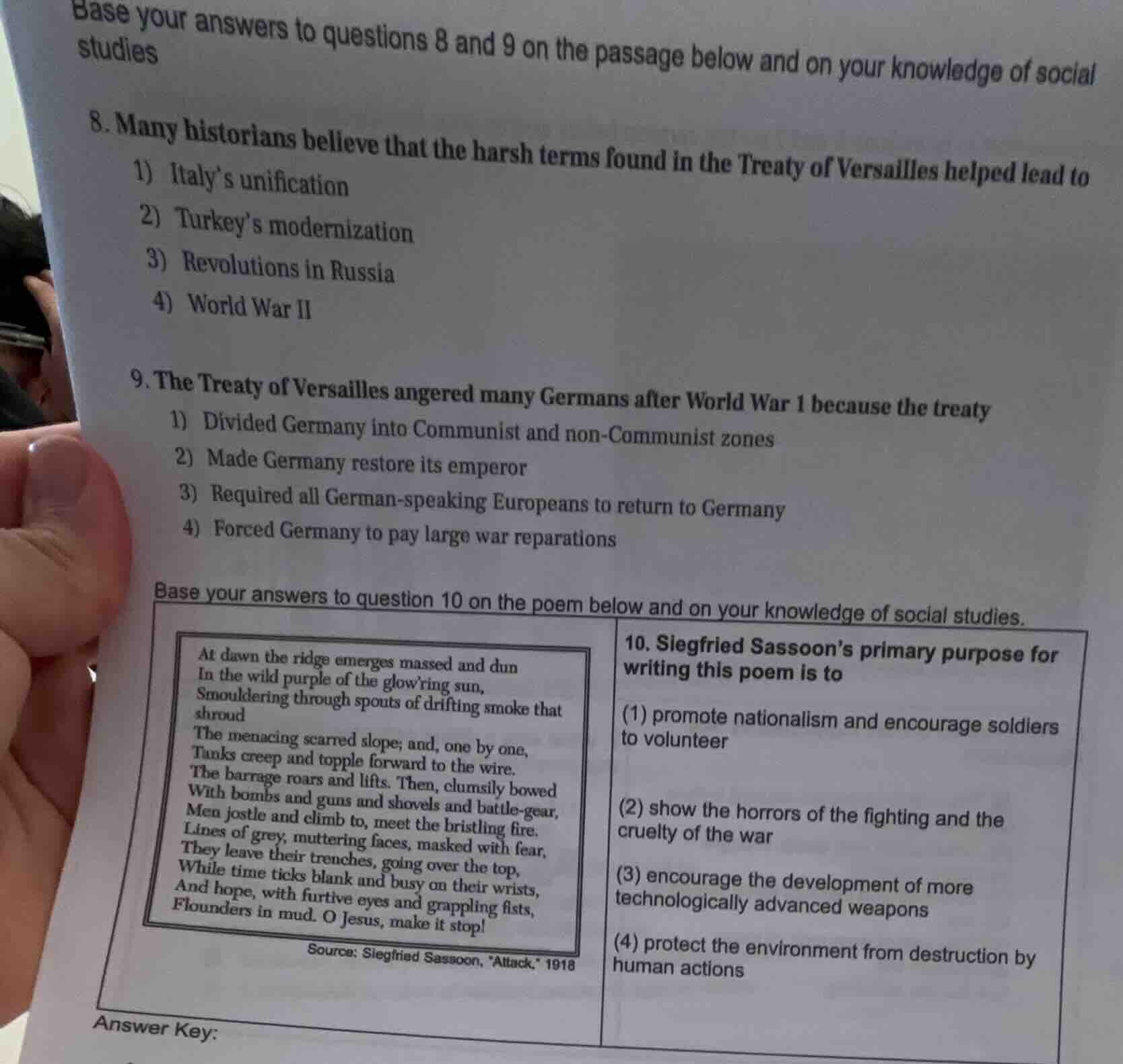
base your answers to questions 8 and 9 on the passage below and on your knowledge of social studies
- many historians believe that the harsh terms found in the treaty of versailles helped lead to
- italys unification
- turkeys modernization
- revolutions in russia
- world war ii
- the treaty of versailles angered many germans after world war 1 because the treaty
- divided germany into communist and non-communist zones
- made germany restore its emperor
- required all german-speaking europeans to return to germany
- forced germany to pay large war reparations
base your answers to question 10 on the poem below and on your knowledge of social studies.
at dawn the ridge emerges massed and dun
in the wild purple of the glowring sun,
smouldering through spouts of drifting smoke that
shroud
the menacing scarred slope; and, one by one,
tanks creep and topple forward to the wire.
the barrage roars and lifts. then, clumsily bowed
with bombs and guns and shovels and battle-gear,
men jostle and climb to, meet the bristling fire.
lines of grey, muttering faces, masked with fear,
they leave their trenches, going over the top,
while time ticks blank and busy on their wrists,
and hope, with furtive eyes and grappling fists,
flounders in mud. o jesus, make it stop!
source: siegfried sassoon, \attack,\ 1918
- siegfried sassoons primary purpose for writing this poem is to
(1) promote nationalism and encourage soldiers to volunteer
(2) show the horrors of the fighting and the cruelty of the war
(3) encourage the development of more technologically advanced weapons
(4) protect the environment from destruction by human actions
answer key:
For Question 8:
The Treaty of Versailles imposed severe penalties on Germany, including massive reparations, territorial losses, and military restrictions. These harsh terms fostered widespread resentment and economic instability in Germany, which helped create conditions that allowed the rise of the Nazi Party and ultimately led to World War II. The other events predate the treaty or are unrelated.
For Question 9:
A key provision of the Treaty of Versailles was forcing Germany to accept full blame for World War I and pay crippling war reparations. This was a major source of anger for Germans, as it drained the country's economy and humiliated its population. The other options are incorrect: Germany was divided into zones after WWII, the treaty did not restore the emperor, and it did not require German-speakers to return to Germany.
For Question 10:
Siegfried Sassoon was a war poet who wrote about the brutal realities of trench warfare in WWI. The poem describes soldiers' fear, the chaos of battle, and the horrific conditions of the front lines, with a plea for the violence to stop. This clearly reflects a purpose of exposing the horrors and cruelty of war, not promoting nationalism, encouraging weapons development, or environmental protection.

Snap & solve any problem in the app
Get step-by-step solutions on Sovi AI
Photo-based solutions with guided steps
Explore more problems and detailed explanations
- 4) World War II
- 4) Forced Germany to pay large war reparations
- (2) show the horrors of the fighting and the cruelty of the war