QUESTION IMAGE
Question
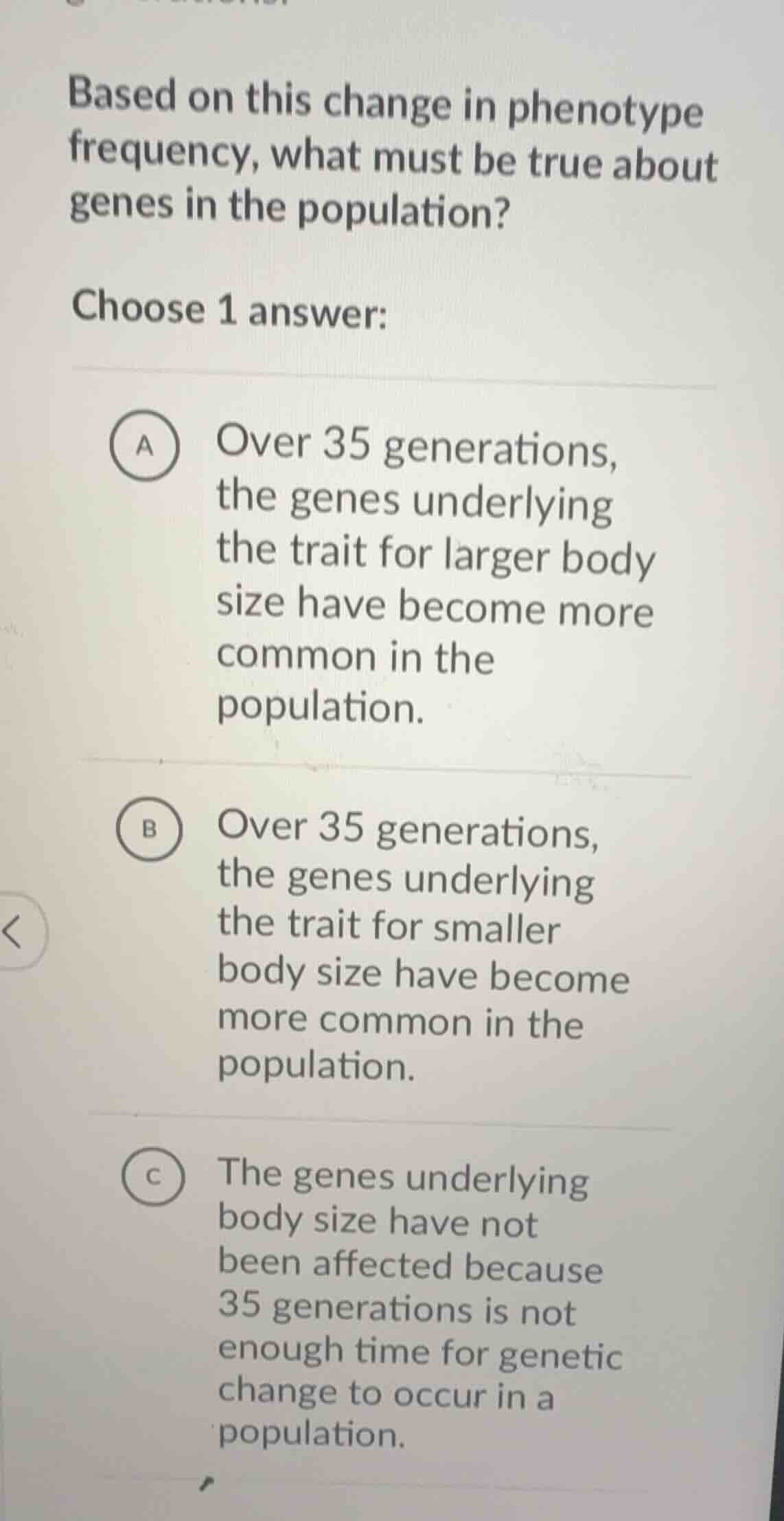
based on this change in phenotype frequency, what must be true about genes in the population? choose 1 answer: a over 35 generations, the genes underlying the trait for larger body size have become more common in the population. b over 35 generations, the genes underlying the trait for smaller body size have become more common in the population. c the genes underlying body size have not been affected because 35 generations is not enough time for genetic change to occur in a population.
To solve this, we analyze each option:
- Option A: If there's a change in phenotype frequency (e.g., larger body size becomes more common), the genes for that trait (larger body size) would become more common over generations. This aligns with evolutionary genetics principles (changes in phenotype frequency reflect changes in underlying gene frequencies).
- Option B: If the phenotype for smaller body size isn't increasing in frequency (implied by the question's context of a change favoring larger, likely), this is incorrect.
- Option C: 35 generations is sufficient for genetic change (evolution can occur over generations), so this is wrong.

Snap & solve any problem in the app
Get step-by-step solutions on Sovi AI
Photo-based solutions with guided steps
Explore more problems and detailed explanations
A. Over 35 generations, the genes underlying the trait for larger body size have become more common in the population.