QUESTION IMAGE
Question
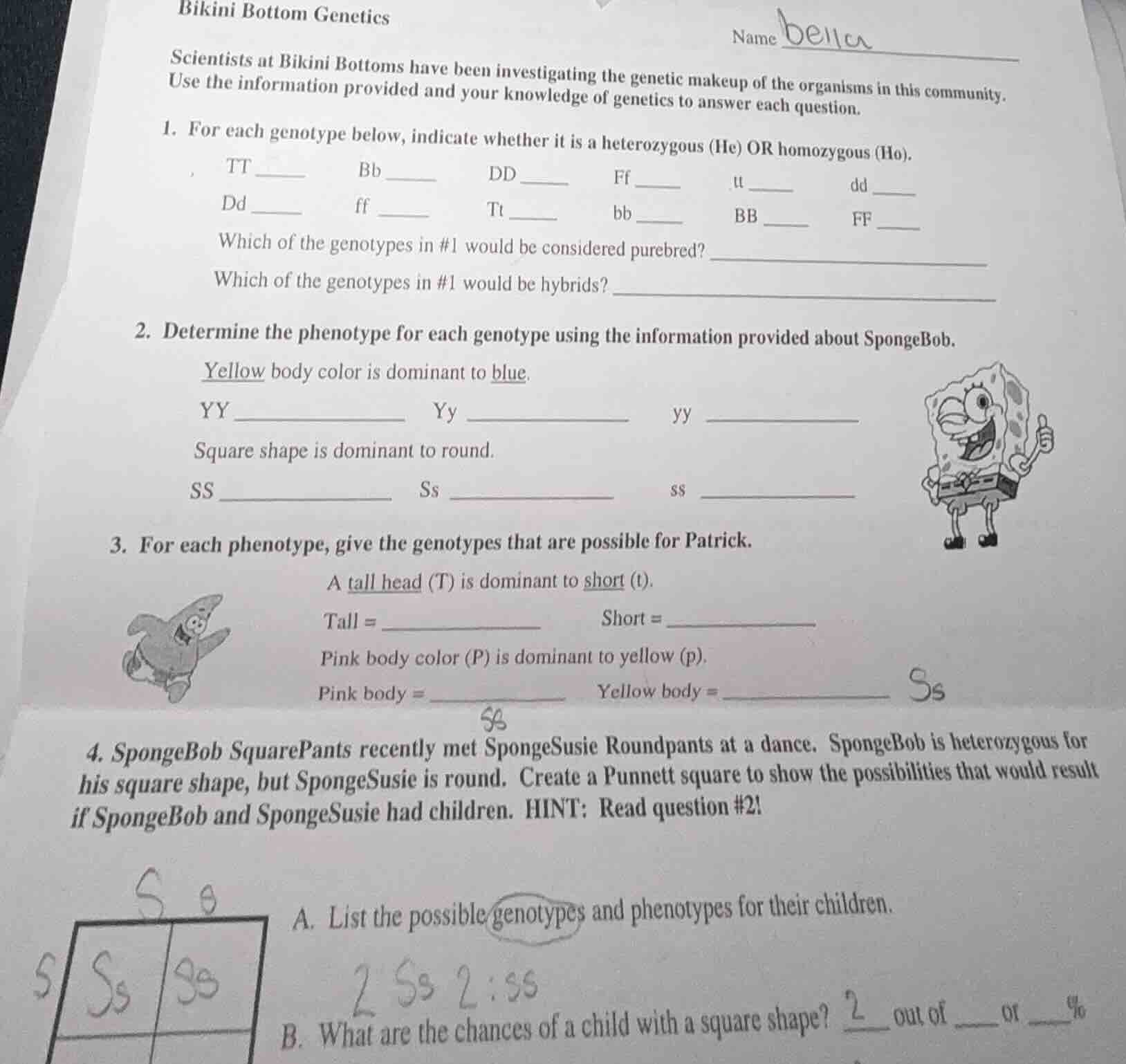
bikini bottom genetics
name bella
scientists at bikini bottoms have been investigating the genetic makeup of the organisms in this community.
use the information provided and your knowledge of genetics to answer each question.
- for each genotype below, indicate whether it is a heterozygous (he) or homozygous (ho).
tt __ bb dd ff tt dd __
dd __ ff tt bb bb ff __
which of the genotypes in #1 would be considered purebred? ____
which of the genotypes in #1 would be hybrids? ____
- determine the phenotype for each genotype using the information provided about spongebob.
yellow body color is dominant to blue.
yy __ yy yy __
square shape is dominant to round.
ss __ ss ss __
- for each phenotype, give the genotypes that are possible for patrick.
a tall head (t) is dominant to short (t).
tall = __ short = __
pink body color (p) is dominant to yellow (p).
pink body = __ yellow body = __
- spongebob squarepants recently met spongesusie roundpants at a dance. spongebob is heterozygous for
his square shape, but spongesusie is round. create a punnett square to show the possibilities that would result
if spongebob and spongesusie had children. hint: read question #2!
a. list the possible genotypes and phenotypes for their children.
b. what are the chances of a child with a square shape? __ out of or __%
Question 1
Step 1: Define Heterozygous (He) and Homozygous (Ho)
- Heterozygous: Genotype with two different alleles (e.g., Bb, Dd).
- Homozygous: Genotype with two identical alleles (e.g., TT, bb).
Step 2: Classify Each Genotype
- \( TT \): Ho (both alleles \( T \))
- \( Bb \): He (alleles \( B \) and \( b \))
- \( DD \): Ho (both alleles \( D \))
- \( Ff \): He (alleles \( F \) and \( f \))
- \( tt \): Ho (both alleles \( t \))
- \( dd \): Ho (both alleles \( d \))
- \( Dd \): He (alleles \( D \) and \( d \))
- \( ff \): Ho (both alleles \( f \))
- \( Tt \): He (alleles \( T \) and \( t \))
- \( bb \): Ho (both alleles \( b \))
- \( BB \): Ho (both alleles \( B \))
- \( FF \): Ho (both alleles \( F \))
Step 3: Identify Purebred (Homozygous) Genotypes
Purebred (homozygous) genotypes have identical alleles: \( TT, DD, tt, dd, ff, bb, BB, FF \).
Step 4: Identify Hybrid (Heterozygous) Genotypes
Hybrid (heterozygous) genotypes have different alleles: \( Bb, Ff, Dd, Tt \).
Question 2
Step 1: Determine Phenotype from Genotype (Body Color)
- Yellow is dominant (\( Y \)), blue is recessive (\( y \)).
- \( YY \): Yellow (homozygous dominant)
- \( Yy \): Yellow (heterozygous, dominant allele expressed)
- \( yy \): Blue (homozygous recessive)
Step 2: Determine Phenotype from Genotype (Shape)
- Square is dominant (\( S \)), round is recessive (\( s \)).
- \( SS \): Square (homozygous dominant)
- \( Ss \): Square (heterozygous, dominant allele expressed)
- \( ss \): Round (homozygous recessive)
Question 3
Step 1: Possible Genotypes for Tall Head (Dominant \( T \))
Tall head can be homozygous dominant (\( TT \)) or heterozygous (\( Tt \)) (since dominant allele \( T \) is present). Short head must be homozygous recessive (\( tt \)) (only recessive allele \( t \) present).
Step 2: Possible Genotypes for Pink Body (Dominant \( P \))
Pink body can be homozygous dominant (\( PP \)) or heterozygous (\( Pp \)) (dominant allele \( P \) present). Yellow body must be homozygous recessive (\( pp \)) (only recessive allele \( p \) present).
Question 4
Step 1: Determine Parental Genotypes
- SpongeBob: Heterozygous for square shape (\( Ss \))
- SpongeSusie: Round shape (\( ss \)) (recessive, so homozygous recessive)
Step 2: Create Punnett Square
| \( S \) | \( s \) | |
|---|---|---|
| \( s \) | \( Ss \) | \( ss \) |
Step 3: Analyze Punnett Square
- Genotypes: \( Ss \) (50%) and \( ss \) (50%)
- Phenotypes: Square (\( Ss \)) (50%) and Round (\( ss \)) (50%)
Final Answers
Question 1
- Heterozygous (He) / Homozygous (Ho):
\( TT \): Ho; \( Bb \): He; \( DD \): Ho; \( Ff \): He; \( tt \): Ho; \( dd \): Ho; \( Dd \): He; \( ff \): Ho; \( Tt \): He; \( bb \): Ho; \( BB \): Ho; \( FF \): Ho
- Purebred (Homozygous): \( TT, DD, tt, dd, ff, bb, BB, FF \)
- Hybrids (Heterozygous): \( Bb, Ff, Dd, Tt \)
Question 2
- Body Color Phenotypes:
\( YY \): Yellow; \( Yy \): Yellow; \( yy \): Blue
- Shape Phenotypes:
\( SS \): Square; \( Ss \): Square; \( ss \): Round
Question 3
- Tall Head: \( TT, Tt \); Short Head: \( tt \)
- Pink Body: \( PP, Pp \); Yellow Body: \( pp \)
Question 4
- A. Genotypes & Phenotypes:
Genotypes: \( Ss \) (square), \( ss \) (round)
Phenotypes: 50% Square (\( Ss \)), 50% Round (\( ss \))
- B. Chances of Square Shape: 2 out of 4 (or 50%)

Snap & solve any problem in the app
Get step-by-step solutions on Sovi AI
Photo-based solutions with guided steps
Explore more problems and detailed explanations
Question 1
Step 1: Define Heterozygous (He) and Homozygous (Ho)
- Heterozygous: Genotype with two different alleles (e.g., Bb, Dd).
- Homozygous: Genotype with two identical alleles (e.g., TT, bb).
Step 2: Classify Each Genotype
- \( TT \): Ho (both alleles \( T \))
- \( Bb \): He (alleles \( B \) and \( b \))
- \( DD \): Ho (both alleles \( D \))
- \( Ff \): He (alleles \( F \) and \( f \))
- \( tt \): Ho (both alleles \( t \))
- \( dd \): Ho (both alleles \( d \))
- \( Dd \): He (alleles \( D \) and \( d \))
- \( ff \): Ho (both alleles \( f \))
- \( Tt \): He (alleles \( T \) and \( t \))
- \( bb \): Ho (both alleles \( b \))
- \( BB \): Ho (both alleles \( B \))
- \( FF \): Ho (both alleles \( F \))
Step 3: Identify Purebred (Homozygous) Genotypes
Purebred (homozygous) genotypes have identical alleles: \( TT, DD, tt, dd, ff, bb, BB, FF \).
Step 4: Identify Hybrid (Heterozygous) Genotypes
Hybrid (heterozygous) genotypes have different alleles: \( Bb, Ff, Dd, Tt \).
Question 2
Step 1: Determine Phenotype from Genotype (Body Color)
- Yellow is dominant (\( Y \)), blue is recessive (\( y \)).
- \( YY \): Yellow (homozygous dominant)
- \( Yy \): Yellow (heterozygous, dominant allele expressed)
- \( yy \): Blue (homozygous recessive)
Step 2: Determine Phenotype from Genotype (Shape)
- Square is dominant (\( S \)), round is recessive (\( s \)).
- \( SS \): Square (homozygous dominant)
- \( Ss \): Square (heterozygous, dominant allele expressed)
- \( ss \): Round (homozygous recessive)
Question 3
Step 1: Possible Genotypes for Tall Head (Dominant \( T \))
Tall head can be homozygous dominant (\( TT \)) or heterozygous (\( Tt \)) (since dominant allele \( T \) is present). Short head must be homozygous recessive (\( tt \)) (only recessive allele \( t \) present).
Step 2: Possible Genotypes for Pink Body (Dominant \( P \))
Pink body can be homozygous dominant (\( PP \)) or heterozygous (\( Pp \)) (dominant allele \( P \) present). Yellow body must be homozygous recessive (\( pp \)) (only recessive allele \( p \) present).
Question 4
Step 1: Determine Parental Genotypes
- SpongeBob: Heterozygous for square shape (\( Ss \))
- SpongeSusie: Round shape (\( ss \)) (recessive, so homozygous recessive)
Step 2: Create Punnett Square
| \( S \) | \( s \) | |
|---|---|---|
| \( s \) | \( Ss \) | \( ss \) |
Step 3: Analyze Punnett Square
- Genotypes: \( Ss \) (50%) and \( ss \) (50%)
- Phenotypes: Square (\( Ss \)) (50%) and Round (\( ss \)) (50%)
Final Answers
Question 1
- Heterozygous (He) / Homozygous (Ho):
\( TT \): Ho; \( Bb \): He; \( DD \): Ho; \( Ff \): He; \( tt \): Ho; \( dd \): Ho; \( Dd \): He; \( ff \): Ho; \( Tt \): He; \( bb \): Ho; \( BB \): Ho; \( FF \): Ho
- Purebred (Homozygous): \( TT, DD, tt, dd, ff, bb, BB, FF \)
- Hybrids (Heterozygous): \( Bb, Ff, Dd, Tt \)
Question 2
- Body Color Phenotypes:
\( YY \): Yellow; \( Yy \): Yellow; \( yy \): Blue
- Shape Phenotypes:
\( SS \): Square; \( Ss \): Square; \( ss \): Round
Question 3
- Tall Head: \( TT, Tt \); Short Head: \( tt \)
- Pink Body: \( PP, Pp \); Yellow Body: \( pp \)
Question 4
- A. Genotypes & Phenotypes:
Genotypes: \( Ss \) (square), \( ss \) (round)
Phenotypes: 50% Square (\( Ss \)), 50% Round (\( ss \))
- B. Chances of Square Shape: 2 out of 4 (or 50%)