QUESTION IMAGE
Question
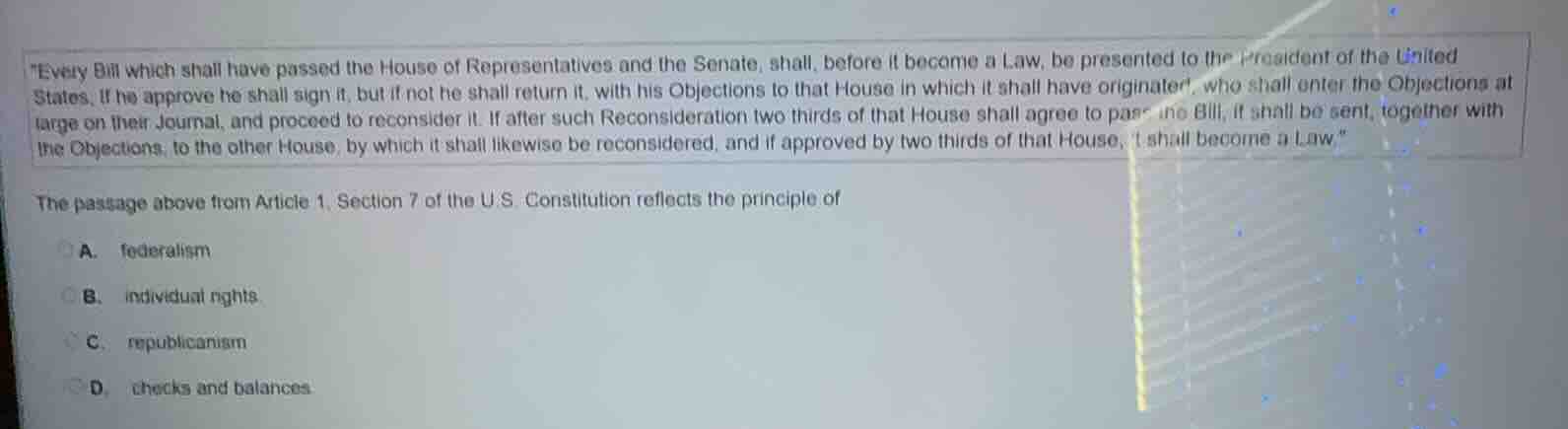
\every bill which shall have passed the house of representatives and the senate, shall, before it become a law, be presented to the president of the united states. if he approve he shall sign it, but if not he shall return it, with his objections to that house in which it shall have originated, who shall enter the objections at large on their journal, and proceed to reconsider it. if after such reconsideration two thirds of that house shall agree to pass the bill, it shall be sent, together with the objections, to the other house, by which it shall likewise be reconsidered, and if approved by two thirds of that house, it shall become a law.\the passage above from article 1, section 7 of the u.s. constitution reflects the principle ofa. federalismb. individual rightsc. republicanismd. checks and balances
The passage describes how a bill passed by Congress must be approved by the President, and how Congress can override a presidential veto with a two-thirds vote. This system ensures that no single branch (legislative or executive) has absolute power over lawmaking, which is the core of the checks and balances principle. Federalism focuses on power between federal and state governments, individual rights protect personal freedoms, and republicanism centers on representative government, none of which match the described process.

Snap & solve any problem in the app
Get step-by-step solutions on Sovi AI
Photo-based solutions with guided steps
Explore more problems and detailed explanations
D. checks and balances.