QUESTION IMAGE
Question
biogeography is the study of the relationship between living organisms and the lands in which they live now and in the past. scientists who study this field have determined that organisms are more similar to other organisms that live nearby.
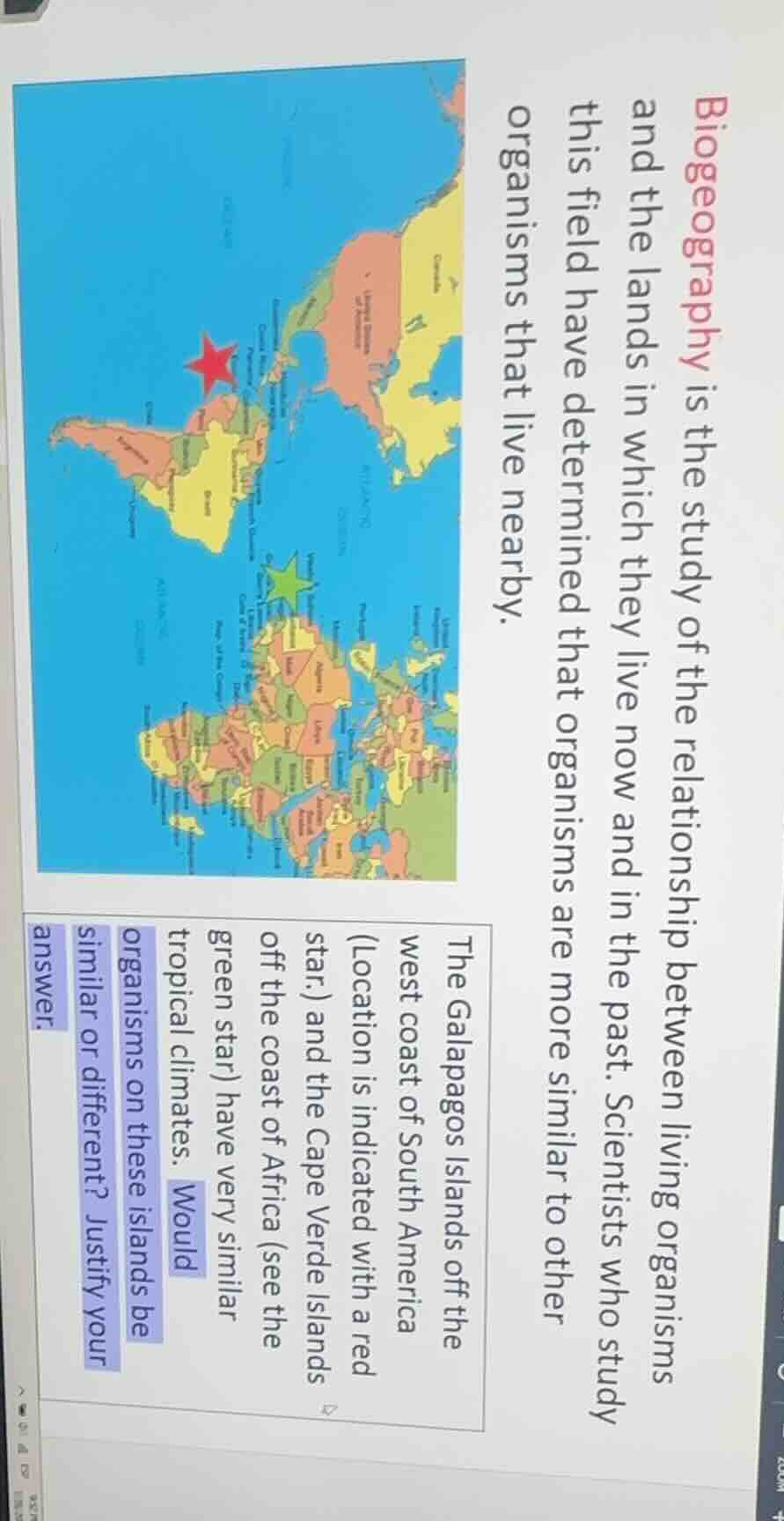
the galapagos islands off the west coast of south america (location is indicated with a red star.) and the cape verde islands off the coast of africa (see the green star) have very similar tropical climates. would organisms on these islands be similar or different? justify your answer.
The Galapagos Islands (red star) are near South America, and the Cape Verde Islands (green star) are near Africa. Biogeography considers geographic proximity and climate. Galapagos organisms likely share more recent common ancestors with South American species due to closer location, while Cape Verde organisms are more related to African species. Even with similar tropical climates, geographic isolation and dispersal patterns (e.g., ocean currents, land bridges) make organisms on Galapagos more similar to South American ones, and Cape Verde to African ones. So organisms on these islands are different because their nearby mainlands (South America vs. Africa) have distinct biota, and dispersal between Galapagos - South America and Cape Verde - Africa is more likely than between the two island groups.

Snap & solve any problem in the app
Get step-by-step solutions on Sovi AI
Photo-based solutions with guided steps
Explore more problems and detailed explanations
The organisms on the Galapagos Islands (near South America) and the Cape Verde Islands (near Africa) are different. This is because each island group is geographically closer to a different mainland (South America for Galapagos, Africa for Cape Verde), so organisms on each island group are more likely to share evolutionary histories and dispersal patterns with the biota of their respective nearby mainlands. Even with similar tropical climates, the distinct biotic sources from South America and Africa lead to differences in the island organisms.