QUESTION IMAGE
Question
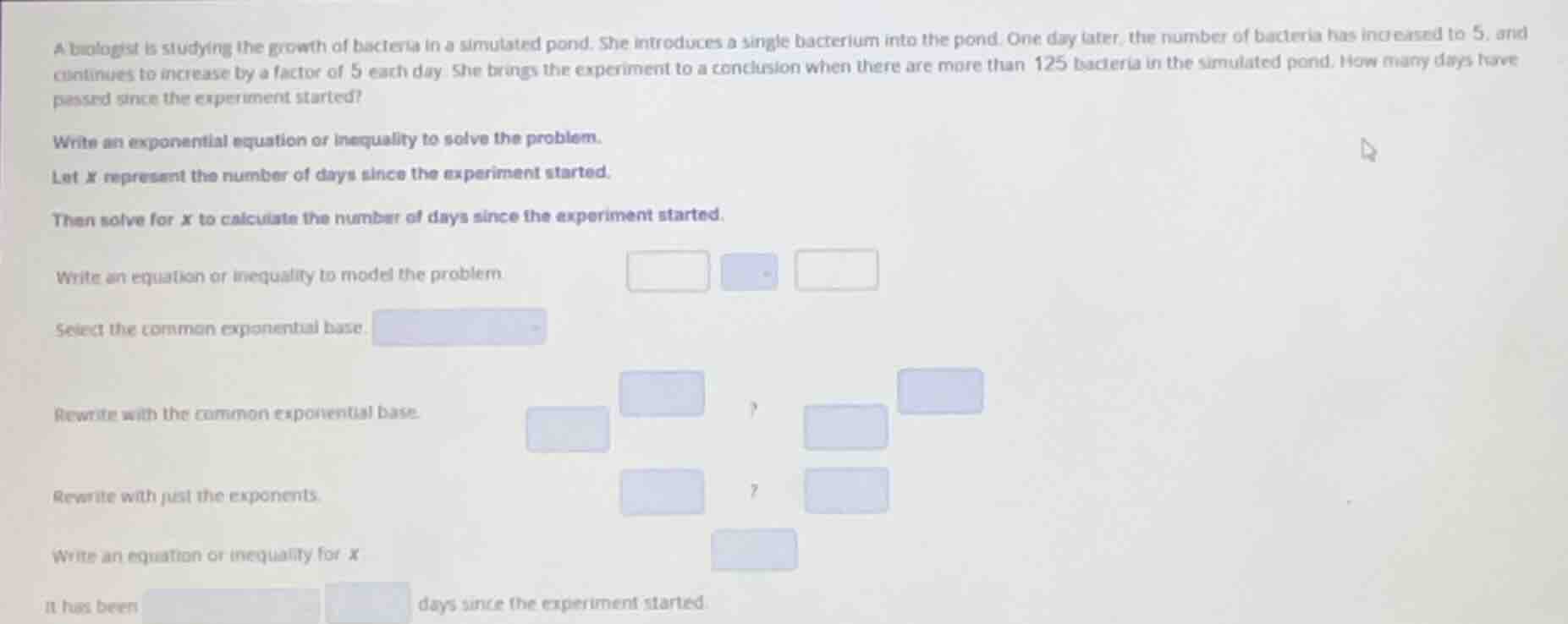
a biologist is studying the growth of bacteria in a simulated pond. she introduces a single bacterium into the pond. one day later, the number of bacteria has increased to 5, and continues to increase by a factor of 5 each day. she brings the experiment to a conclusion when there are more than 125 bacteria in the simulated pond. how many days have passed since the experiment started?
write an exponential equation or inequality to solve the problem.
let x represent the number of days since the experiment started.
then solve for x to calculate the number of days since the experiment started.
write an equation or inequality to model the problem
select the common exponential base.
rewrite with the common exponential base.
rewrite with just the exponents.
write an equation or inequality for x
it has been ____ days since the experiment started.
Step1: Model growth with inequality
The bacteria grow by a factor of 5 each day, starting from 1. We need the population to exceed 125.
$5^x > 125$
Step2: Identify common exponential base
125 is a power of 5, so the common base is 5.
$\text{Common base: } 5$
Step3: Rewrite with common base
Express 125 as $5^3$.
$5^x > 5^3$
Step4: Compare exponents directly
For equal positive bases, we can set exponents against each other.
$x > 3$
Step5: Determine smallest integer x
Since we need more than 125 bacteria, the smallest integer x satisfying this is 4.
$x = 4$

Snap & solve any problem in the app
Get step-by-step solutions on Sovi AI
Photo-based solutions with guided steps
Explore more problems and detailed explanations
Write an equation or inequality to model the problem: $\boldsymbol{5^x > 125}$
Select the common exponential base: $\boldsymbol{5}$
Rewrite with the common exponential base: $\boldsymbol{5^x > 5^3}$
Rewrite with just the exponents: $\boldsymbol{x > 3}$
Write an equation or inequality for x: $\boldsymbol{x > 3}$
It has been $\boldsymbol{4}$ days since the experiment started.