QUESTION IMAGE
Question
biology
date ______
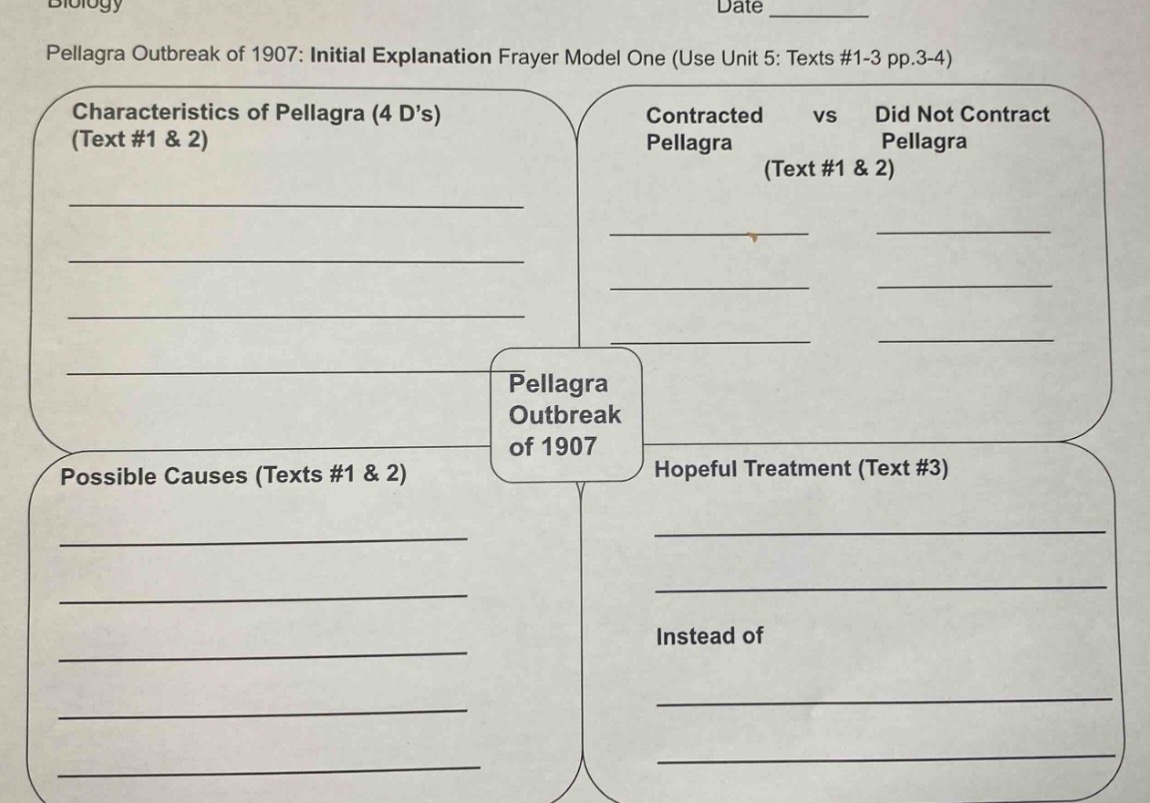
pellagra outbreak of 1907: initial explanation frayer model one (use unit 5: texts #1-3 pp.3-4)
characteristics of pellagra (4 d’s)
(text #1 & 2)
___________________________
___________________________
___________________________
___________________________
contracted vs did not contract
pellagra pellagra
(text #1 & 2)
_______ _______
_______ _______
_______ _______
pellagra
outbreak
of 1907
possible causes (texts #1 & 2)
___________________________
___________________________
___________________________
___________________________
___________________________
hopeful treatment (text #3)
___________________________
___________________________
instead of
___________________________
___________________________
To complete this Frayer Model for the Pellagra Outbreak of 1907, we analyze the texts (Unit 5: Texts #1 - 3, pp. 3 - 4) as follows:
1. Characteristics of Pellagra (4 D’s)
From historical and medical texts on pellagra, the 4 D’s are:
- Dermatitis: Skin rashes (often symmetric, photosensitive).
- Diarrhea: Chronic, watery stools.
- Dementia: Neurological symptoms (confusion, memory loss).
- Death: Untreated cases progress to fatality.
2. Contracted vs. Did Not Contract Pellagra
Contracted Pellagra (Text #1 & 2):
- Lived in poverty - stricken Southern US (early 1900s).
- Diet high in corn (maize) and low in protein/niacin - rich foods.
- Worked in rural, malnourished communities.
Did Not Contract Pellagra:
- Ate diverse diets (meat, dairy, fresh veggies, niacin - rich foods).
- Affluent or had access to balanced nutrition.
- Lived in regions with better food security.
3. Possible Causes (Texts #1 & 2)
- Dietary Deficiency: Lack of niacin (vitamin B3) or tryptophan (precursor to niacin) in diet (corn - based diets, common in poverty).
- Infectious Theory (early belief): Some hypothesized germs, but later disproven.
- Socioeconomic Factors: Poverty, poor sanitation, and limited access to nutritious food.
4. Hopeful Treatment (Text #3)
- Dietary Intervention: Adding niacin - rich foods (meat, fish, nuts, fortified grains) or niacin supplements.
- Balanced Nutrition: Emphasizing protein - rich foods (to supply tryptophan) and diverse diets.
Instead of:
- Traditional “rest” or “isolation” (ineffective for nutritional deficiency).
- Ignoring dietary roots (e.g., blaming “poor hygiene” alone).
Fill these details into the Frayer Model sections based on your text’s specific evidence!

Snap & solve any problem in the app
Get step-by-step solutions on Sovi AI
Photo-based solutions with guided steps
Explore more problems and detailed explanations
To complete this Frayer Model for the Pellagra Outbreak of 1907, we analyze the texts (Unit 5: Texts #1 - 3, pp. 3 - 4) as follows:
1. Characteristics of Pellagra (4 D’s)
From historical and medical texts on pellagra, the 4 D’s are:
- Dermatitis: Skin rashes (often symmetric, photosensitive).
- Diarrhea: Chronic, watery stools.
- Dementia: Neurological symptoms (confusion, memory loss).
- Death: Untreated cases progress to fatality.
2. Contracted vs. Did Not Contract Pellagra
Contracted Pellagra (Text #1 & 2):
- Lived in poverty - stricken Southern US (early 1900s).
- Diet high in corn (maize) and low in protein/niacin - rich foods.
- Worked in rural, malnourished communities.
Did Not Contract Pellagra:
- Ate diverse diets (meat, dairy, fresh veggies, niacin - rich foods).
- Affluent or had access to balanced nutrition.
- Lived in regions with better food security.
3. Possible Causes (Texts #1 & 2)
- Dietary Deficiency: Lack of niacin (vitamin B3) or tryptophan (precursor to niacin) in diet (corn - based diets, common in poverty).
- Infectious Theory (early belief): Some hypothesized germs, but later disproven.
- Socioeconomic Factors: Poverty, poor sanitation, and limited access to nutritious food.
4. Hopeful Treatment (Text #3)
- Dietary Intervention: Adding niacin - rich foods (meat, fish, nuts, fortified grains) or niacin supplements.
- Balanced Nutrition: Emphasizing protein - rich foods (to supply tryptophan) and diverse diets.
Instead of:
- Traditional “rest” or “isolation” (ineffective for nutritional deficiency).
- Ignoring dietary roots (e.g., blaming “poor hygiene” alone).
Fill these details into the Frayer Model sections based on your text’s specific evidence!