QUESTION IMAGE
Question
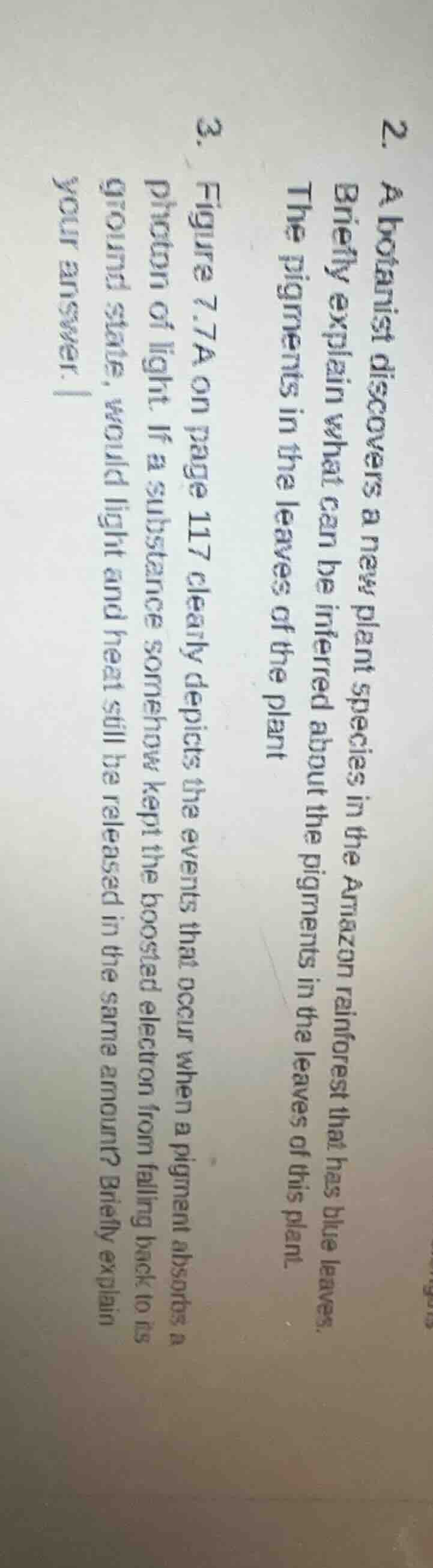
- a botanist discovers a new plant species in the amazon rainforest that has blue leaves. briefly explain what can be inferred about the pigments in the leaves of this plant.
- figure 7.7a on page 117 clearly depicts the events that occur when a pigment absorbs a photon of light. if a substance somehow kept the boosted electron from falling back to its ground state, would light and heat still be released in the same amount? briefly explain your answer.
For Question 2:
Plant leaf color comes from the wavelengths of light that pigments reflect (not absorb). Blue leaves mean the pigments reflect blue light, so they absorb other visible wavelengths (like red, orange, yellow, green) for photosynthesis. This is an adaptation to the low-light understory of the Amazon rainforest, where blue light is more available than red light.
For Question 3:
When a pigment absorbs a photon, the electron gains energy (equal to the photon's energy) and moves to an excited state. When the electron returns to the ground state, the total energy released must match the energy gained. If the electron is prevented from falling back, no energy is released as light/heat in that pathway. Instead, the trapped energy would likely be dissipated through alternative routes, or the molecule could undergo chemical changes, so the same amount of light and heat would NOT be released.

Snap & solve any problem in the app
Get step-by-step solutions on Sovi AI
Photo-based solutions with guided steps
Explore more problems and detailed explanations
- Question 2: The plant's leaf pigments reflect blue wavelengths of visible light, and absorb non-blue wavelengths (such as red, orange, yellow, and green) to use for photosynthesis. This pigment profile is likely an adaptation to the low-light conditions of the Amazon rainforest understory, where blue light is more prevalent.
- Question 3: No, the same amount of light and heat would not be released. If the excited electron is prevented from returning to the ground state, the energy from the absorbed photon cannot be dissipated through the usual pathway of light/heat release; the energy would either be used for chemical reactions or lost through alternative, non-matching energy release routes.