QUESTION IMAGE
Question
b = brown
b = white
explain why this crossing could result in white hedgehogs even though brown is dominant.
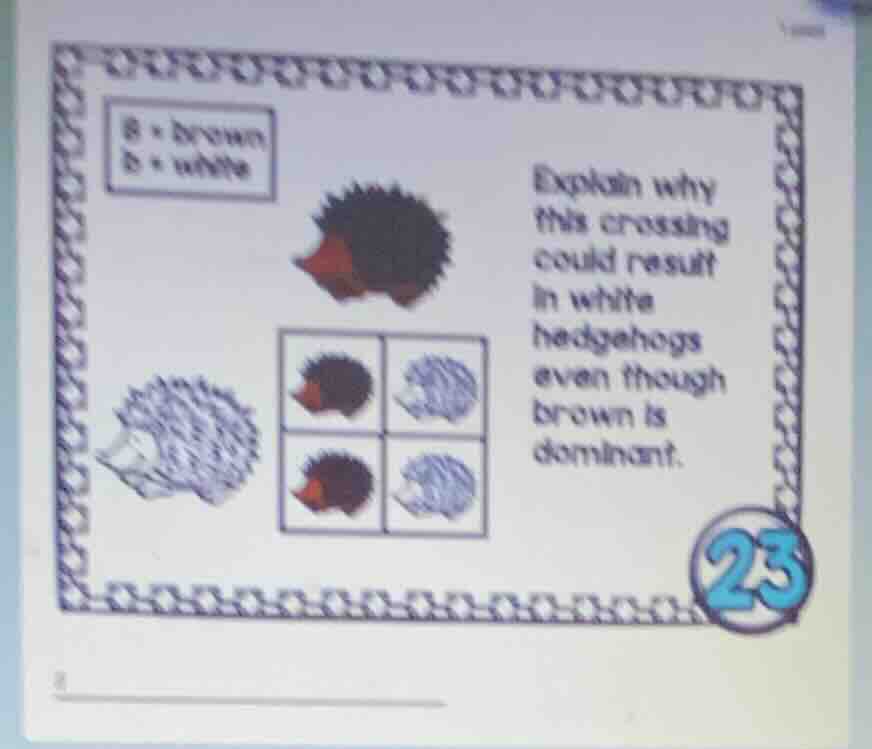
To determine why white hedgehogs (recessive trait) can appear when brown (dominant) is present, we analyze the genetics. Let's assume the brown hedgehog has genotype \( Bb \) (since it's dominant but can carry the recessive allele) and the white hedgehog has genotype \( bb \). When we do a Punnett square for \( Bb \times bb \):
- The brown hedgehog (\( Bb \)) can produce two types of gametes: \( B \) and \( b \).
- The white hedgehog (\( bb \)) can only produce \( b \) gametes.
When we combine these gametes:
- \( B \) (from brown) and \( b \) (from white) gives \( Bb \) (brown, since \( B \) is dominant).
- \( b \) (from brown) and \( b \) (from white) gives \( bb \) (white, as both recessive alleles are present).
So even with brown being dominant, if the brown parent carries the recessive allele (\( b \)) and the white parent contributes \( b \), the offspring can inherit \( bb \) and be white.

Snap & solve any problem in the app
Get step-by-step solutions on Sovi AI
Photo-based solutions with guided steps
Explore more problems and detailed explanations
Even though brown (\( B \)) is dominant, if the brown - colored hedgehog has a genotype of \( Bb \) (meaning it carries the recessive white - allele \( b \)) and the white - colored hedgehog has a genotype of \( bb \) (and thus can only contribute the \( b \) allele), when their gametes combine, there is a chance for the offspring to inherit two \( b \) alleles (one from each parent), resulting in a genotype of \( bb \). Since the \( bb \) genotype expresses the white phenotype, white hedgehogs can be produced from this crossing.