QUESTION IMAGE
Question
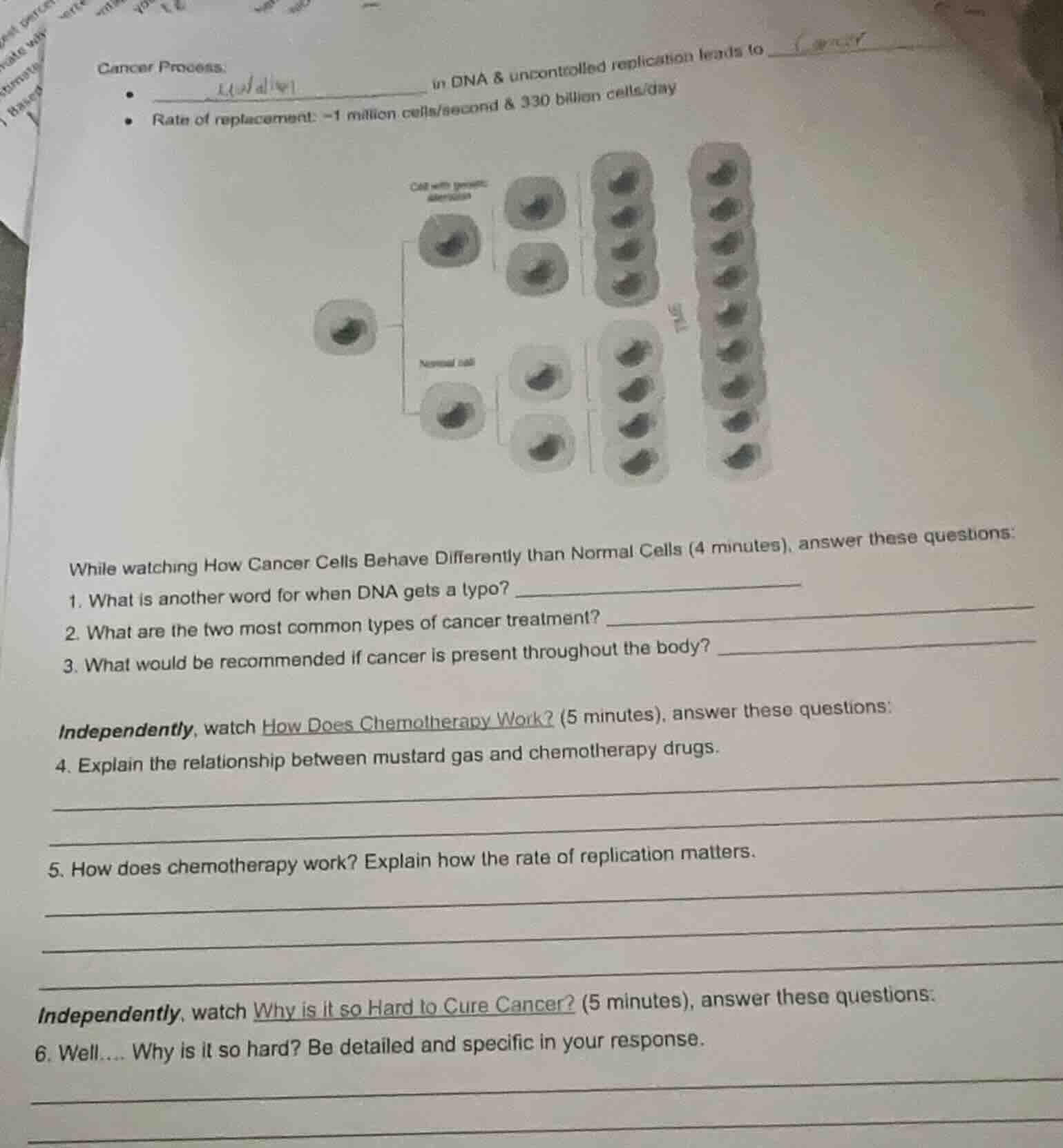
cancer process.• ____ in dna & uncontrolled replication leads to __• rate of replacement: ~1 million cells/second & 330 billion cells/daywhile watching how cancer cells behave differently than normal cells (4 minutes), answer these questions:1. what is another word for when dna gets a typo? ___________2. what are the two most common types of cancer treatment? ___________3. what would be recommended if cancer is present throughout the body? ___________independently, watch how does chemotherapy work? (5 minutes), answer these questions:4. explain the relationship between mustard gas and chemotherapy drugs._________________________________________________________________5. how does chemotherapy work? explain how the rate of replication matters.______________________________________________________________________________________________________________________________________independently, watch why is it so hard to cure cancer? (5 minutes), answer these questions:6. well..... why is it so hard? be detailed and specific in your response.___________________________________________________________________
- A DNA "typo" refers to a change in the DNA sequence, which is a mutation.
- The two most common standard cancer treatments are surgery to remove tumors and chemotherapy to kill cancer cells.
- When cancer is widespread throughout the body (metastatic), systemic treatment like chemotherapy is recommended as it acts on cells across the whole body.
- Mustard gas was observed to damage fast-dividing white blood cells during WWII; this led to the development of chemotherapy drugs that target fast-dividing cancer cells using similar mechanisms of damaging cell DNA to stop replication.
- Chemotherapy works by targeting and killing fast-dividing cells. Cancer cells replicate at a much faster rate than most healthy cells, so the drugs are more likely to affect cancer cells. The high replication rate makes cancer cells more vulnerable to the drugs that disrupt cell division processes.
- Cancer is hard to cure for multiple reasons: Cancer cells mutate rapidly, developing resistance to treatments. They can hide in the body (e.g., in bone marrow) to avoid detection. Cancer cells can evade the immune system. Additionally, since they are derived from the body's own cells, treatments often damage healthy fast-dividing cells (like hair, gut cells) limiting treatment intensity. Different cancers have unique genetic profiles, so there is no one-size-fits-all cure, and metastatic cancer spreads to distant organs making complete removal or eradication nearly impossible.

Snap & solve any problem in the app
Get step-by-step solutions on Sovi AI
Photo-based solutions with guided steps
Explore more problems and detailed explanations
- Mutation
- Surgery and Chemotherapy
- Chemotherapy (or systemic therapy)
- Mustard gas inspired early chemotherapy: its ability to damage fast-dividing blood cells led to the creation of chemo drugs that target fast-dividing cancer cells by disrupting their DNA.
- Chemotherapy kills fast-dividing cells. Cancer cells replicate far faster than most healthy cells, so the drugs target them more effectively; their high replication rate makes them vulnerable to agents that disrupt cell division.
- Cancer is hard to cure due to: rapid genetic mutations that cause drug resistance, the ability of cancer cells to evade the immune system and hide in the body, the fact that cancer cells are the body's own cells (so treatments harm healthy fast-dividing cells, limiting treatment strength), unique genetic profiles across different cancers requiring personalized care, and metastatic spread that makes full eradication of all cancer cells nearly impossible.