QUESTION IMAGE
Question
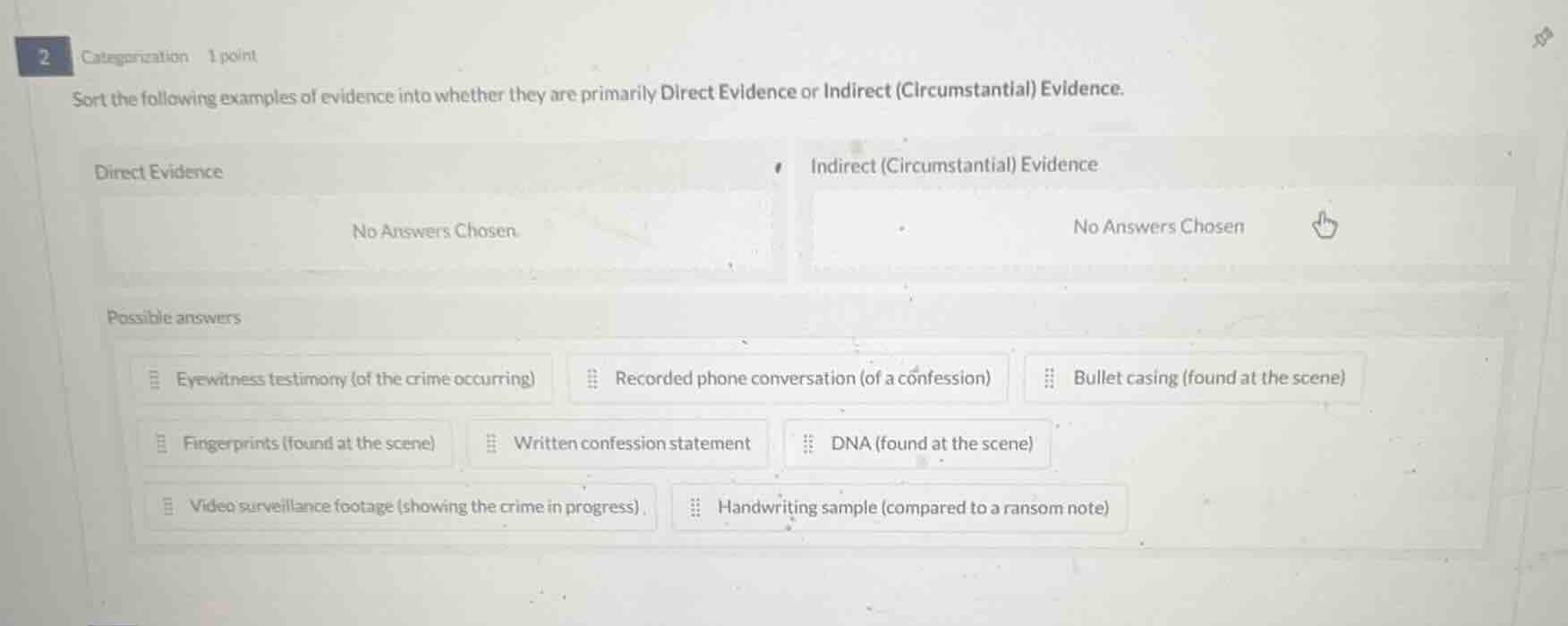
2 categorization 1 point sort the following examples of evidence into whether they are primarily direct evidence or indirect (circumstantial) evidence. direct evidence indirect (circumstantial) evidence no answers chosen no answers chosen possible answers eyewitness testimony (of the crime occurring) recorded phone conversation (of a confession) bullet casing (found at the scene) fingerprints (found at the scene) written confession statement dna (found at the scene) video surveillance footage (showing the crime in progress) handwriting sample (compared to a ransom note)
To determine direct vs. indirect evidence: Direct evidence proves a fact directly (e.g., testimony/confessions showing the crime or guilt). Indirect (circumstantial) evidence requires inference (e.g., physical evidence like bullet casings, fingerprints, DNA, handwriting samples that suggest but don't directly prove guilt).
- Direct Evidence: Eyewitness testimony (of crime), Recorded phone conversation (confession), Written confession statement, Video surveillance (crime in progress) – these directly show the crime or guilt.
- Indirect (Circumstantial) Evidence: Bullet casing (scene), Fingerprints (scene), DNA (scene), Handwriting sample (ransom note) – these require inference to connect to the crime/guilt.

Snap & solve any problem in the app
Get step-by-step solutions on Sovi AI
Photo-based solutions with guided steps
Explore more problems and detailed explanations
Direct Evidence:
- Eyewitness testimony (of the crime occurring)
- Recorded phone conversation (of a confession)
- Written confession statement
- Video surveillance footage (showing the crime in progress)
Indirect (Circumstantial) Evidence:
- Bullet casing (found at the scene)
- Fingerprints (found at the scene)
- DNA (found at the scene)
- Handwriting sample (compared to a ransom note)