QUESTION IMAGE
Question
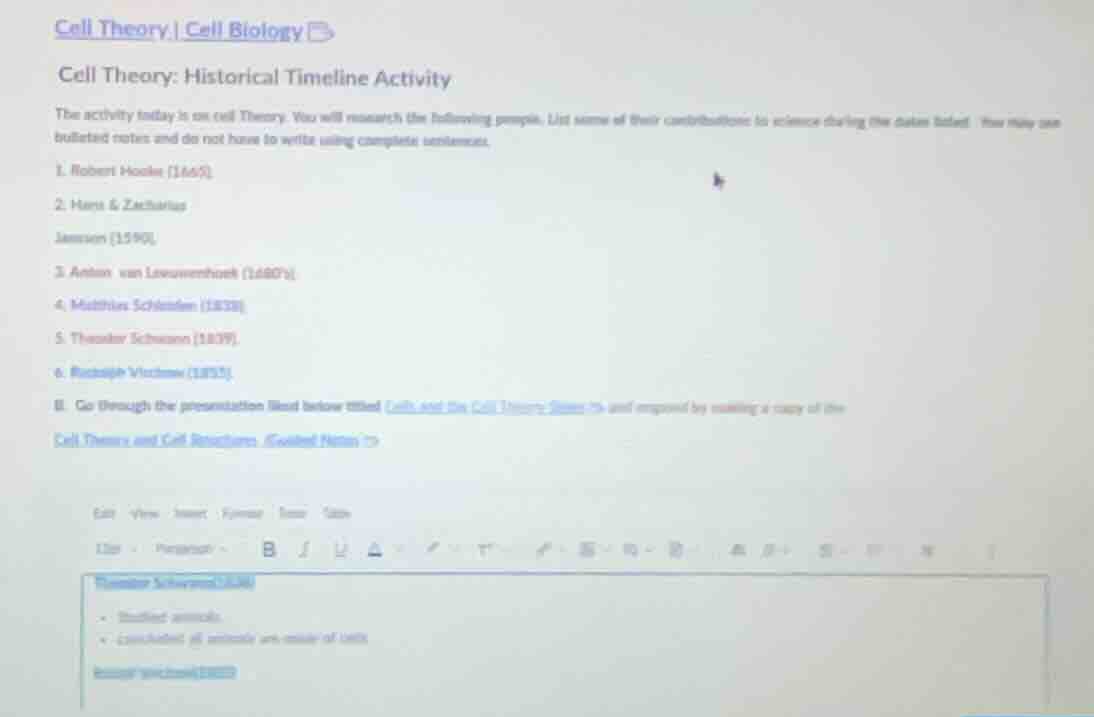
cell theory | cell biology
cell theory: historical timeline activity
the activity today is on cell theory. you will research the following people. list some of their contributions to science during the dates listed. you may use bulleted notes and do not have to write using complete sentences.
- robert hooke (1665)
- hans & zacharias
janssen (1590)
- anton van leeuwenhoek (1680s)
- matthias schleiden (1838)
- theodor schwann (1839)
- rudolph virchow (1855)
ii. go through the presentation linked below titled cells and the cell theory (made by and owned by) by making a copy of the
cell theory and cell structures guided notes
theodor schwann (1839)
- studied animals
- concluded all animals are made of cells
rudolph virchow (1855)
To solve this activity, we'll research each person's contribution to cell theory:
1. Robert Hooke (1665)
- Used a compound microscope to examine cork.
- Observed small, box - like structures and named them “cells” (because they resembled small rooms or “cellulae” in Latin).
2. Hans & Zacharias Janssen (1590)
- Credited with inventing the first compound microscope.
- Their invention allowed for the magnification of small objects, which was crucial for later cell discoveries.
3. Anton van Leeuwenhoek (1680s)
- Made improvements to the microscope, creating more powerful single - lens microscopes.
- Observed living microorganisms (like bacteria, which he called “animalcules”) in pond water, saliva, and other samples.
4. Matthias Schleiden (1838)
- Studied plant tissues.
- Concluded that all plants are composed of cells.
5. Theodor Schwann (1839)
- Studied animal tissues.
- Concluded that all animals are composed of cells.
- Also worked on unifying the cell theory with Schleiden’s work, stating that cells are the basic unit of structure in organisms.
6. Rudolf Virchow (1855)
- Proposed that all cells arise from pre - existing cells (“Omnis cellula e cellula”).
- This completed the cell theory by addressing the origin of cells.
For the second part (the presentation and guided notes), you would access the provided link, make a copy of the guided notes, and fill them out as you go through the “Cells and the Cell Theory (2024)” presentation, likely adding more detailed information about cell structure and the cell theory based on the content of the presentation.

Snap & solve any problem in the app
Get step-by-step solutions on Sovi AI
Photo-based solutions with guided steps
Explore more problems and detailed explanations
To solve this activity, we'll research each person's contribution to cell theory:
1. Robert Hooke (1665)
- Used a compound microscope to examine cork.
- Observed small, box - like structures and named them “cells” (because they resembled small rooms or “cellulae” in Latin).
2. Hans & Zacharias Janssen (1590)
- Credited with inventing the first compound microscope.
- Their invention allowed for the magnification of small objects, which was crucial for later cell discoveries.
3. Anton van Leeuwenhoek (1680s)
- Made improvements to the microscope, creating more powerful single - lens microscopes.
- Observed living microorganisms (like bacteria, which he called “animalcules”) in pond water, saliva, and other samples.
4. Matthias Schleiden (1838)
- Studied plant tissues.
- Concluded that all plants are composed of cells.
5. Theodor Schwann (1839)
- Studied animal tissues.
- Concluded that all animals are composed of cells.
- Also worked on unifying the cell theory with Schleiden’s work, stating that cells are the basic unit of structure in organisms.
6. Rudolf Virchow (1855)
- Proposed that all cells arise from pre - existing cells (“Omnis cellula e cellula”).
- This completed the cell theory by addressing the origin of cells.
For the second part (the presentation and guided notes), you would access the provided link, make a copy of the guided notes, and fill them out as you go through the “Cells and the Cell Theory (2024)” presentation, likely adding more detailed information about cell structure and the cell theory based on the content of the presentation.