QUESTION IMAGE
Question
cell theory
cytology=
what is a cell?
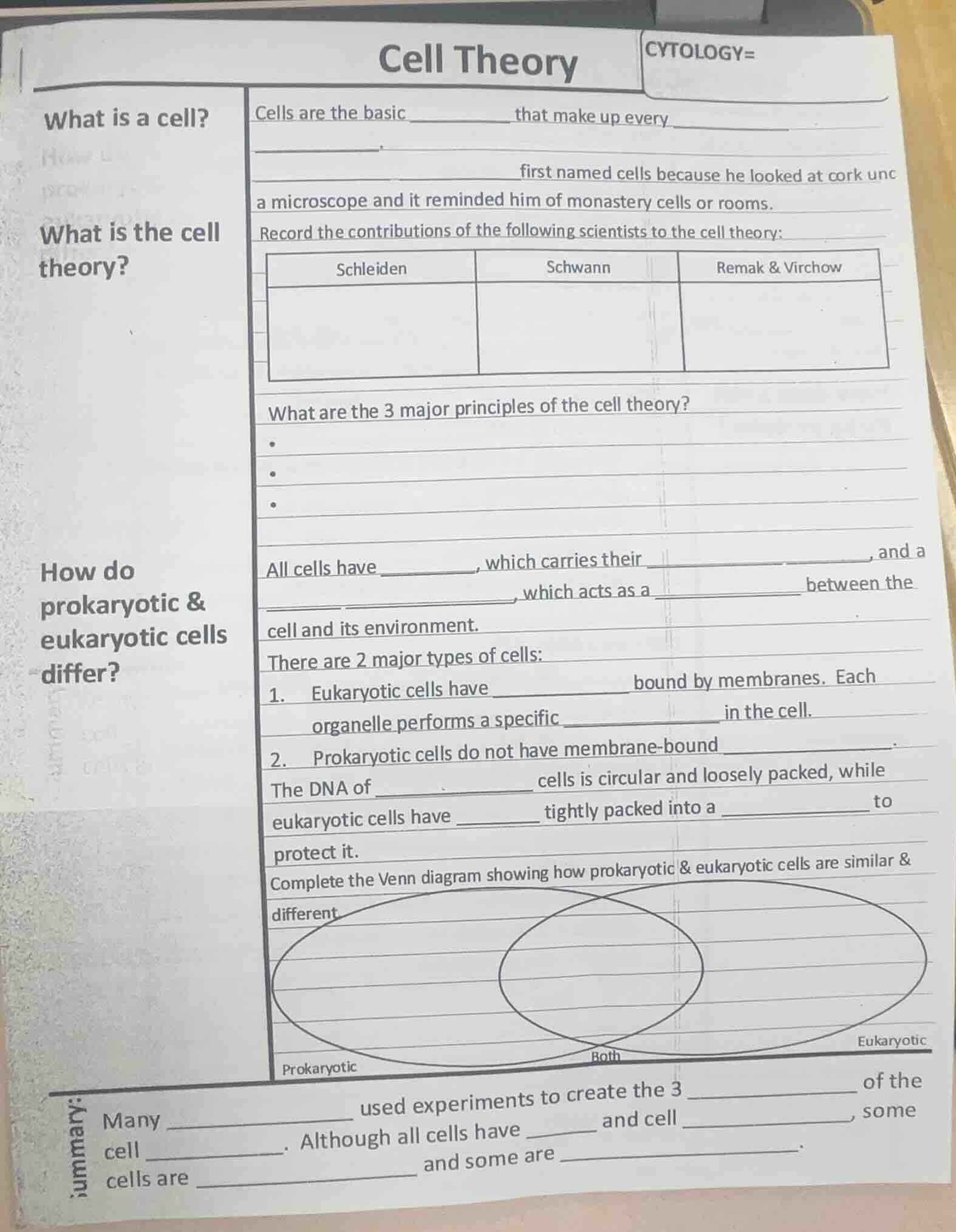
cells are the basic ____ that make up every __ ____.
______ first named cells because he looked at cork unc
a microscope and it reminded him of monastery cells or rooms.
what is the cell theory?
record the contributions of the following scientists to the cell theory:
schleiden schwann remak & virchow
what are the 3 major principles of the cell theory?
•
•
•
how do prokaryotic & eukaryotic cells differ?
all cells have ____, which carries their __ ____, and a
____ __, which acts as a ____ between the
cell and its environment.
there are 2 major types of cells:
- eukaryotic cells have ______ bound by membranes. each
organelle performs a specific ______ in the cell.
- prokaryotic cells do not have membrane - bound ______.
the dna of ______ cells is circular and loosely packed, while
eukaryotic cells have ____ tightly packed into a ____ to
protect it.
complete the venn diagram showing how prokaryotic & eukaryotic cells are similar &
different.
prokaryotic both eukaryotic
summary:
many ____ used experiments to create the 3 ____ of the
cell ____. although all cells have __ and cell ____, some
cells are ____ and some are ____.
1. "What is a cell?" section:
- Cells are the basic units of structure and function that make up every living organism.
- Robert Hooke first named cells because he looked at cork under a microscope and it reminded him of monastery cells or rooms.
2. Contributions of scientists to cell theory:
- Schleiden: Concluded that all plants are made of cells.
- Schwann: Concluded that all animals are made of cells.
- Remak & Virchow: Remak observed cell division, and Virchow proposed that all cells come from pre - existing cells (often stated as "omnis cellula e cellula").
3. 3 major principles of cell theory:
- All living organisms are composed of one or more cells.
- The cell is the basic unit of structure and function in living organisms.
- All cells arise from pre - existing cells.
4. "How do prokaryotic & eukaryotic cells differ?" section:
- All cells have DNA, which carries their genetic information, and a cell membrane, which acts as a barrier between the cell and its environment.
- There are 2 major types of cells:
- 1. Eukaryotic cells have organelles bound by membranes. Each organelle performs a specific function in the cell.
- 2. Prokaryotic cells do not have membrane - bound organelles.
- The DNA of prokaryotic cells is circular and loosely packed, while eukaryotic cells have DNA tightly packed into a nucleus to protect it.
- Venn diagram (Prokaryotic, Both, Eukaryotic):
- Prokaryotic only: No nucleus, no membrane - bound organelles, circular DNA, smaller in size (e.g., bacteria).
- Both: Have DNA, have a cell membrane, have ribosomes (for protein synthesis), are the basic unit of life.
- Eukaryotic only: Have a nucleus, have membrane - bound organelles (e.g., mitochondria, endoplasmic reticulum), linear DNA, larger in size (e.g., plant and animal cells).
5. Summary:
Many scientists used experiments to create the 3 principles of the cell theory. Although all cells have DNA and cell membranes, some cells are prokaryotic and some are eukaryotic. And "CYTOLOGY = the study of cells" (from the top right of the worksheet).

Snap & solve any problem in the app
Get step-by-step solutions on Sovi AI
Photo-based solutions with guided steps
Explore more problems and detailed explanations
1. "What is a cell?" section:
- Cells are the basic units of structure and function that make up every living organism.
- Robert Hooke first named cells because he looked at cork under a microscope and it reminded him of monastery cells or rooms.
2. Contributions of scientists to cell theory:
- Schleiden: Concluded that all plants are made of cells.
- Schwann: Concluded that all animals are made of cells.
- Remak & Virchow: Remak observed cell division, and Virchow proposed that all cells come from pre - existing cells (often stated as "omnis cellula e cellula").
3. 3 major principles of cell theory:
- All living organisms are composed of one or more cells.
- The cell is the basic unit of structure and function in living organisms.
- All cells arise from pre - existing cells.
4. "How do prokaryotic & eukaryotic cells differ?" section:
- All cells have DNA, which carries their genetic information, and a cell membrane, which acts as a barrier between the cell and its environment.
- There are 2 major types of cells:
- 1. Eukaryotic cells have organelles bound by membranes. Each organelle performs a specific function in the cell.
- 2. Prokaryotic cells do not have membrane - bound organelles.
- The DNA of prokaryotic cells is circular and loosely packed, while eukaryotic cells have DNA tightly packed into a nucleus to protect it.
- Venn diagram (Prokaryotic, Both, Eukaryotic):
- Prokaryotic only: No nucleus, no membrane - bound organelles, circular DNA, smaller in size (e.g., bacteria).
- Both: Have DNA, have a cell membrane, have ribosomes (for protein synthesis), are the basic unit of life.
- Eukaryotic only: Have a nucleus, have membrane - bound organelles (e.g., mitochondria, endoplasmic reticulum), linear DNA, larger in size (e.g., plant and animal cells).
5. Summary:
Many scientists used experiments to create the 3 principles of the cell theory. Although all cells have DNA and cell membranes, some cells are prokaryotic and some are eukaryotic. And "CYTOLOGY = the study of cells" (from the top right of the worksheet).