QUESTION IMAGE
Question
chapter 7 – cell structure & function
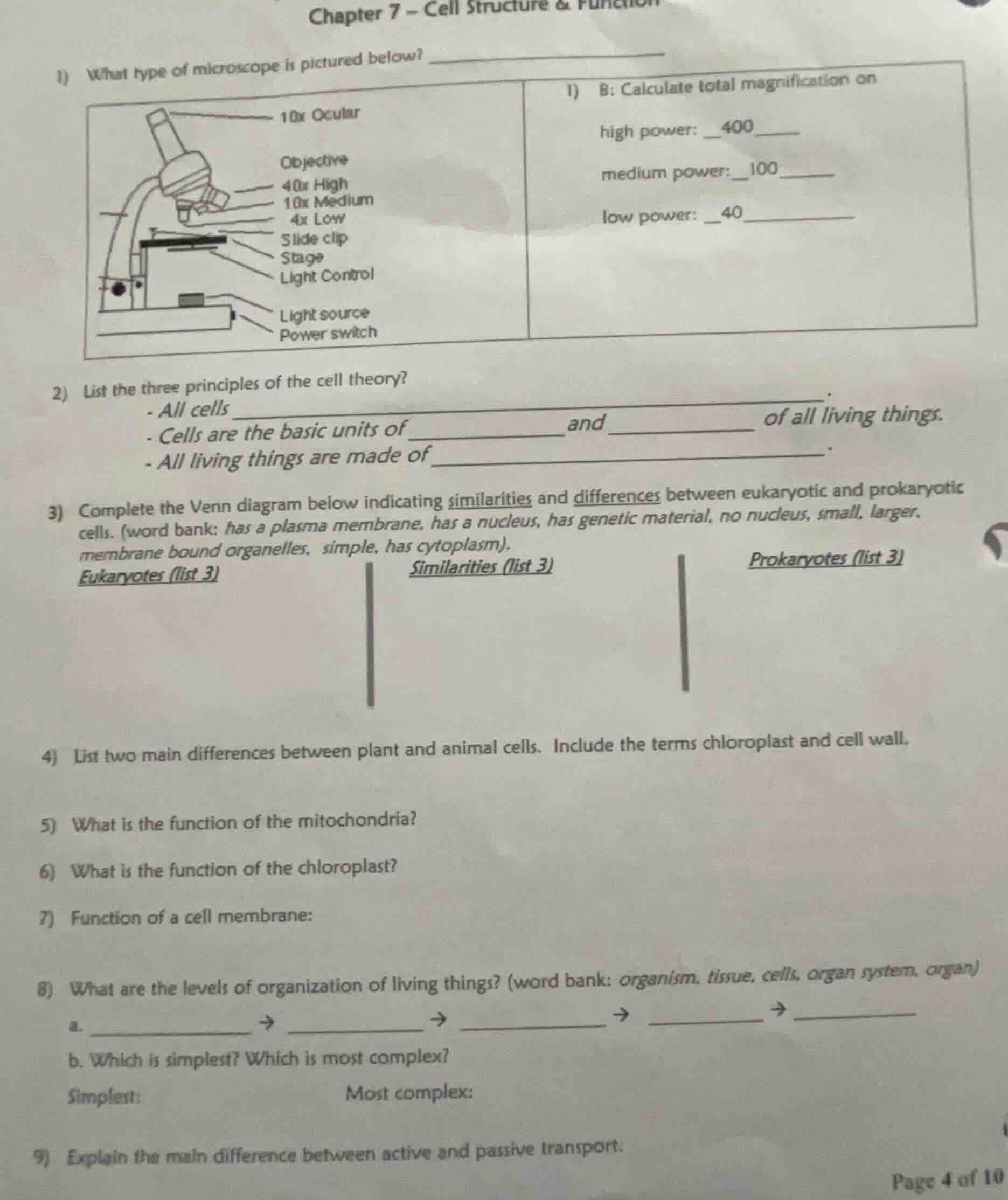
- what type of microscope is pictured below?
- b: calculate total magnification on
high power: 400__
medium power:100__
low power: 40_______
- list the three principles of the cell theory?
- all cells _____________________________
- cells are the basic units of __________ and __________ of all living things.
- all living things are made of ____________________________________.
- complete the venn diagram below indicating similarities and differences between eukaryotic and prokaryotic cells. (word bank: has a plasma membrane, has a nucleus, has genetic material, no nucleus, small, larger, membrane bound organelles, simple, has cytoplasm).
eukaryotes (list 3) \t\t similarities (list 3) \t\t prokaryotes (list 3)
- list two main differences between plant and animal cells. include the terms chloroplast and cell wall.
- what is the function of the mitochondria?
- what is the function of the chloroplast?
- function of a cell membrane:
- what are the levels of organization of living things? (word bank: organism, tissue, cells, organ system, organ)
a. ____________ → __________ → __________ → _____ → ________
b. which is simplest? which is most complex?
simplest: \t\t most complex:
- explain the main difference between active and passive transport.
Question 1
Part A: What type of microscope is pictured?
The microscope has a light source, ocular lens, and objective lenses (4x, 10x, 40x), typical of a compound light microscope.
Total magnification is ocular (10x) times objective.
Step1: High power (40x objective)
$10\times40 = 400$
Step2: Medium power (10x objective)
$10\times10 = 100$
Step3: Low power (4x objective)
$10\times4 = 40$
Cell theory states: 1. All cells come from pre - existing cells. 2. Cells are the basic units of structure and function of all living things. 3. All living things are made of one or more cells.

Snap & solve any problem in the app
Get step-by-step solutions on Sovi AI
Photo-based solutions with guided steps
Explore more problems and detailed explanations
Compound light microscope