QUESTION IMAGE
Question
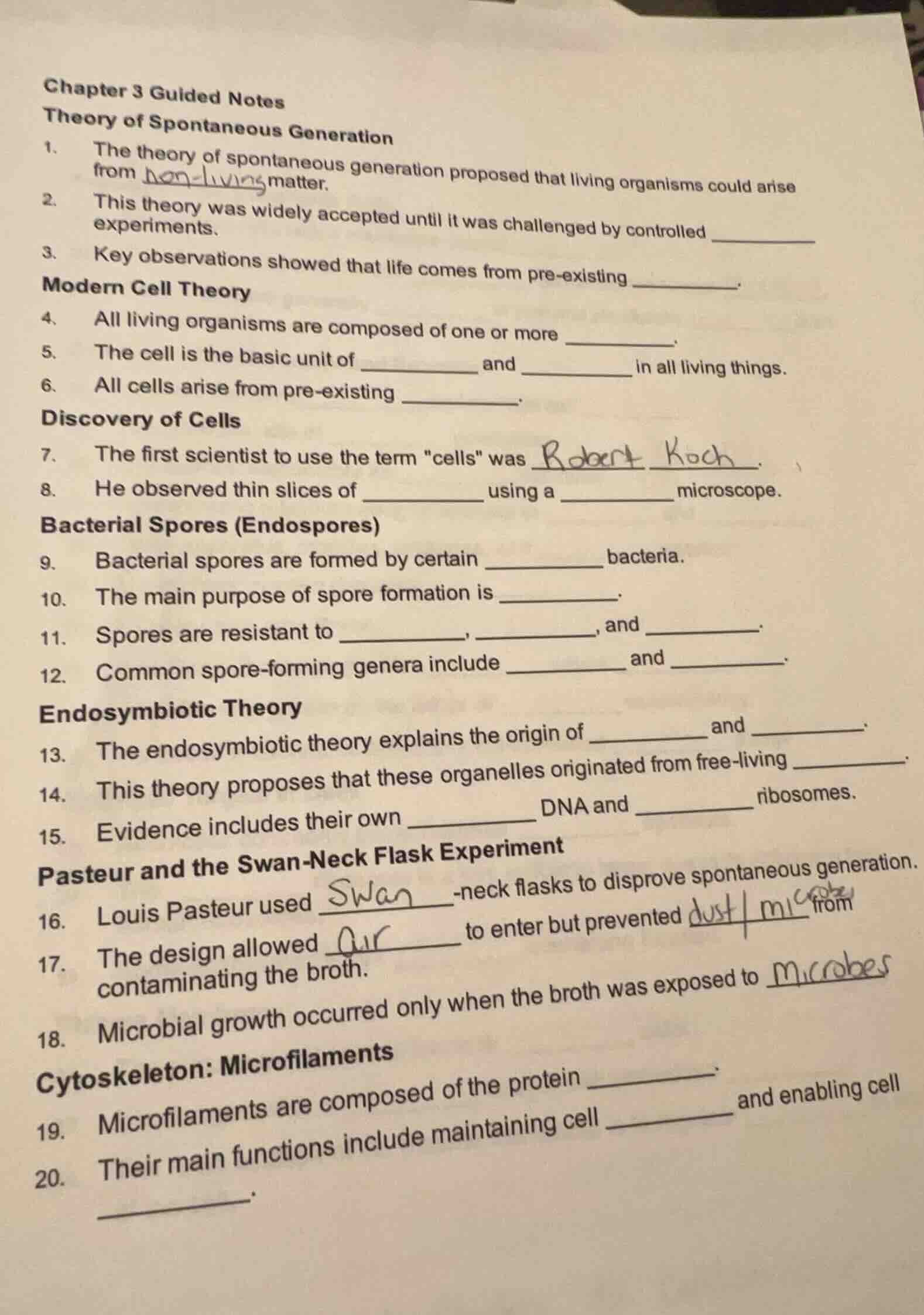
chapter 3 guided notes
theory of spontaneous generation
- the theory of spontaneous generation proposed that living organisms could arise from non - living matter.
- this theory was widely accepted until it was challenged by controlled _______ experiments.
- key observations showed that life comes from pre - existing _______.
modern cell theory
- all living organisms are composed of one or more _______.
- the cell is the basic unit of _____ and _____ in all living things.
- all cells arise from pre - existing _______.
discovery of cells
- the first scientist to use the term \cells\ was _____ _____.
- he observed thin slices of _____ using a _____ microscope.
bacterial spores (endospores)
- bacterial spores are formed by certain _______ bacteria.
- the main purpose of spore formation is _______.
- spores are resistant to _____, ___, and _____.
- common spore - forming genera include _____ and _____.
endosymbiotic theory
- the endosymbiotic theory explains the origin of _____ and _____.
- this theory proposes that these organelles originated from free - living _______.
- evidence includes their own _____ dna and _____ ribosomes.
pasteur and the swan - neck flask experiment
- louis pasteur used swan - neck flasks to disprove spontaneous generation.
- the design allowed air to enter but prevented dust/microbes from contaminating the broth.
- microbial growth occurred only when the broth was exposed to microbes.
cytoskeleton: microfilaments
- microfilaments are composed of the protein _______.
- their main functions include maintaining cell _____ and enabling cell _____.
Brief Explanations
Fills in the missing terms based on core concepts in cell biology and microbiology, correcting the incorrect pre-filled answer for question 7.

Snap & solve any problem in the app
Get step-by-step solutions on Sovi AI
Photo-based solutions with guided steps
Explore more problems and detailed explanations
- non-living
- experiments
- life
- cells
- structure; function
- cells
- Robert Hooke
- cork; compound
- Gram-positive
- survival (in harsh conditions)
- heat; desiccation; chemicals
- Bacillus; Clostridium
- mitochondria; chloroplasts
- prokaryotes
- circular; prokaryotic
- swan
- air; dust/microbes
- microbes
- actin
- shape; movement