QUESTION IMAGE
Question
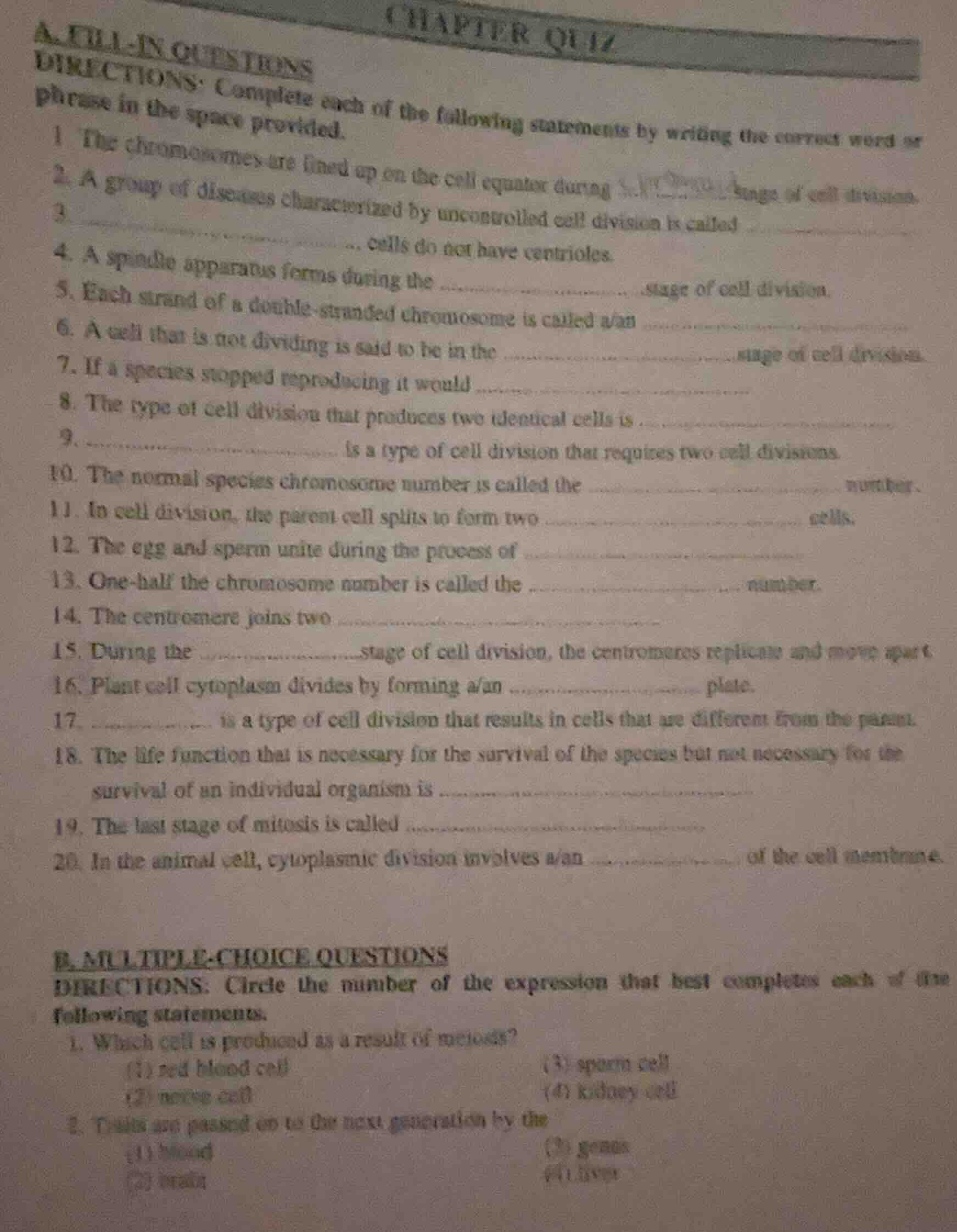
chapter quiz
a. fill-in questions
directions: complete each of the following statements by writing the correct word or phrase in the space provided.
- the chromosomes are lined up on the cell equator during ______ stage of cell division.
- a group of diseases characterized by uncontrolled cell division is called ______.
- ______ cells do not have centrioles.
- a spindle apparatus forms during the ______ stage of cell division.
- each strand of a double - stranded chromosome is called a/an ______.
- a cell that is not dividing is said to be in the ______ stage of cell division.
- if a species stopped reproducing it would ______.
- the type of cell division that produces two identical cells is ______.
- ______ is a type of cell division that requires two cell divisions.
- the normal species chromosome number is called the ______ number.
- in cell division, the parent cell splits to form two ______ cells.
- the egg and sperm unite during the process of ______.
- one - half the chromosome number is called the ______ number.
- the centromere joins two ______.
- during the ______ stage of cell division, the centromeres replicate and move apart.
- plant cell cytoplasm divides by forming a/an ______ plate.
- ______ is a type of cell division that results in cells that are different from the parent.
- the life function that is necessary for the survival of the species but not necessary for the survival of an individual organism is ______.
- the last stage of mitosis is called ______.
- in the animal cell, cytoplasmic division involves a/an ______ of the cell membrane.
b. multiple - choice questions
directions: circle the number of the expression that best completes each of the following statements.
- which cell is produced as a result of meiosis?
(1) red blood cell (3) sperm cell
(2) nerve cell (4) kidney cell
- traits are passed on to the next generation by the
(1) blood (3) genes
(2) brain (4) liver
Response
A. Fill - in Questions
- Question 1
- Brief Explanations: In mitosis, chromosomes line up on the cell equator during metaphase.
- Answer: metaphase
- Question 2
- Brief Explanations: Diseases with uncontrolled cell division are called cancer.
- Answer: cancer
- Question 3
- Brief Explanations: Plant cells do not have centrioles.
- Answer: Plant
- Question 4
- Brief Explanations: The spindle apparatus forms during prophase of cell division.
- Answer: prophase
- Question 5
- Brief Explanations: Each strand of a double - stranded chromosome is a chromatid.
- Answer: chromatid
- Question 6
- Brief Explanations: A non - dividing cell is in the interphase stage.
- Answer: interphase
- Question 7
- Brief Explanations: If a species stops reproducing, it will become extinct.
- Answer: become extinct
- Question 8
- Brief Explanations: Mitosis produces two identical daughter cells.
- Answer: mitosis
- Question 9
- Brief Explanations: Meiosis requires two cell divisions.
- Answer: Meiosis
- Question 10
- Brief Explanations: The normal species chromosome number is the diploid number.
- Answer: diploid
- Question 11
- Brief Explanations: In cell division, the parent cell splits into two daughter cells.
- Answer: daughter
- Question 12
- Brief Explanations: Egg and sperm unite during fertilization.
- Answer: fertilization
- Question 13
- Brief Explanations: Half the chromosome number is the haploid number.
- Answer: haploid
- Question 14
- Brief Explanations: The centromere joins two chromatids.
- Answer: chromatids
- Question 15
- Brief Explanations: During prophase, centromeres replicate and move apart.
- Answer: prophase
- Question 16
- Brief Explanations: Plant cell cytoplasm divides by forming a cell plate.
- Answer: cell
- Question 17
- Brief Explanations: Meiosis results in cells different from the parent (gametes with half the chromosome number).
- Answer: Meiosis
- Question 18
- Brief Explanations: Reproduction is necessary for species survival but not individual survival.
- Answer: reproduction
- Question 19
- Brief Explanations: The last stage of mitosis is telophase.
- Answer: telophase
- Question 20
- Brief Explanations: Animal cell cytoplasmic division involves a cleavage furrow.
- Answer: cleavage furrow
B. Multiple - Choice Questions
- Question 1
- Brief Explanations: Meiosis produces gametes (sperm and egg cells). Red blood cells, nerve cells, and kidney cells are produced by mitosis. So the sperm cell is produced by meiosis.
- Answer: (3) sperm cell
- Question 2 (partially visible)
- Since the question is about traits passed to the next generation, traits are passed by genes. But as the options are partially visible, if the options are (1) blood, (2) traits, (3) genes, (4) liver, the correct answer is (3) genes.

Snap & solve any problem in the app
Get step-by-step solutions on Sovi AI
Photo-based solutions with guided steps
Explore more problems and detailed explanations
A. Fill - in Questions
- Question 1
- Brief Explanations: In mitosis, chromosomes line up on the cell equator during metaphase.
- Answer: metaphase
- Question 2
- Brief Explanations: Diseases with uncontrolled cell division are called cancer.
- Answer: cancer
- Question 3
- Brief Explanations: Plant cells do not have centrioles.
- Answer: Plant
- Question 4
- Brief Explanations: The spindle apparatus forms during prophase of cell division.
- Answer: prophase
- Question 5
- Brief Explanations: Each strand of a double - stranded chromosome is a chromatid.
- Answer: chromatid
- Question 6
- Brief Explanations: A non - dividing cell is in the interphase stage.
- Answer: interphase
- Question 7
- Brief Explanations: If a species stops reproducing, it will become extinct.
- Answer: become extinct
- Question 8
- Brief Explanations: Mitosis produces two identical daughter cells.
- Answer: mitosis
- Question 9
- Brief Explanations: Meiosis requires two cell divisions.
- Answer: Meiosis
- Question 10
- Brief Explanations: The normal species chromosome number is the diploid number.
- Answer: diploid
- Question 11
- Brief Explanations: In cell division, the parent cell splits into two daughter cells.
- Answer: daughter
- Question 12
- Brief Explanations: Egg and sperm unite during fertilization.
- Answer: fertilization
- Question 13
- Brief Explanations: Half the chromosome number is the haploid number.
- Answer: haploid
- Question 14
- Brief Explanations: The centromere joins two chromatids.
- Answer: chromatids
- Question 15
- Brief Explanations: During prophase, centromeres replicate and move apart.
- Answer: prophase
- Question 16
- Brief Explanations: Plant cell cytoplasm divides by forming a cell plate.
- Answer: cell
- Question 17
- Brief Explanations: Meiosis results in cells different from the parent (gametes with half the chromosome number).
- Answer: Meiosis
- Question 18
- Brief Explanations: Reproduction is necessary for species survival but not individual survival.
- Answer: reproduction
- Question 19
- Brief Explanations: The last stage of mitosis is telophase.
- Answer: telophase
- Question 20
- Brief Explanations: Animal cell cytoplasmic division involves a cleavage furrow.
- Answer: cleavage furrow
B. Multiple - Choice Questions
- Question 1
- Brief Explanations: Meiosis produces gametes (sperm and egg cells). Red blood cells, nerve cells, and kidney cells are produced by mitosis. So the sperm cell is produced by meiosis.
- Answer: (3) sperm cell
- Question 2 (partially visible)
- Since the question is about traits passed to the next generation, traits are passed by genes. But as the options are partially visible, if the options are (1) blood, (2) traits, (3) genes, (4) liver, the correct answer is (3) genes.