QUESTION IMAGE
Question
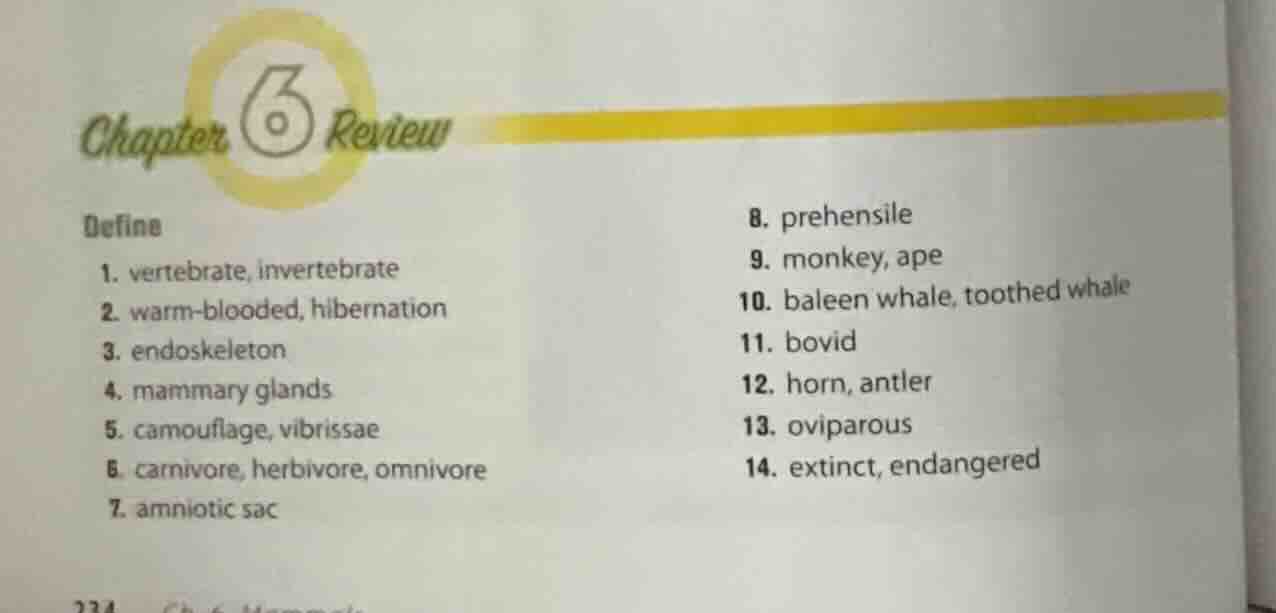
chapter 6 review define 1. vertebrate, invertebrate 2. warm - blooded, hibernation 3. endoskeleton 4. mammary glands 5. camouflage, vibrissae 6. carnivore, herbivore, omnivore 7. amniotic sac 8. prehensile 9. monkey, ape 10. baleen whale, toothed whale 11. bovid 12. horn, antler 13. oviparous 14. extinct, endangered
To solve this, we'll define each term:
1. Vertebrate, Invertebrate
- Vertebrate: Animals with a backbone (e.g., mammals, birds).
- Invertebrate: Animals without a backbone (e.g., insects, mollusks).
2. Warm - blooded, Hibernation
- Warm - blooded: Animals (like mammals, birds) that maintain a constant body temperature internally.
- Hibernation: A state of inactivity and reduced metabolism in animals (e.g., bears) during cold months to conserve energy.
3. Endoskeleton
An internal skeleton (e.g., bones in humans, cartilage in sharks) that supports and protects the body.
4. Mammary Glands
Glands in female mammals that produce milk to nourish offspring (e.g., human breasts, cow udders).
5. Camouflage, Vibrissae
- Camouflage: Coloration/patterns that help an animal blend into its environment (e.g., a chameleon matching its background).
- Vibrissae: Long, stiff hairs (whiskers) on animals (e.g., cats, seals) that sense touch and surroundings.
6. Carnivore, Herbivore, Omnivore
- Carnivore: Animals that eat other animals (e.g., lions, eagles).
- Herbivore: Animals that eat plants (e.g., cows, rabbits).
- Omnivore: Animals that eat both plants and animals (e.g., humans, bears).
7. Amniotic Sac
A fluid - filled sac that surrounds and protects a developing embryo/fetus (in mammals, reptiles, birds) during gestation.
8. Prehensile
Capable of grasping (e.g., a monkey’s prehensile tail, an octopus’s tentacles).
9. Monkey, Ape
- Monkey: Primates with tails (e.g., capuchin monkeys), often arboreal.
- Ape: Primates without tails (e.g., chimpanzees, gorillas), more closely related to humans, larger - brained.
10. Baleen Whale, Toothed Whale
- Baleen Whale: Whales with baleen plates (e.g., blue whales) to filter food (krill, plankton) from water.
- Toothed Whale: Whales with teeth (e.g., orcas, dolphins) to catch prey.
11. Bovid
A family of hoofed mammals (e.g., cows, sheep, goats) with horns (permanent) or related features.
12. Horn, Antler
- Horn: Permanent, keratin - based structures (e.g., cow horns) attached to the skull.
- Antler: Temporary, bone - based structures (e.g., deer antlers) shed and regrown yearly.
13. Oviparous
Animals that lay eggs (e.g., birds, reptiles) from which offspring hatch.
14. Extinct, Endangered
- Extinct: A species with no living individuals (e.g., dinosaurs, dodo).
- Endangered: A species at risk of becoming extinct (e.g., pandas, tigers).
These definitions fall under the Biology (Natural Science) subfield, focusing on animal anatomy, behavior, and classification.

Snap & solve any problem in the app
Get step-by-step solutions on Sovi AI
Photo-based solutions with guided steps
Explore more problems and detailed explanations
To solve this, we'll define each term:
1. Vertebrate, Invertebrate
- Vertebrate: Animals with a backbone (e.g., mammals, birds).
- Invertebrate: Animals without a backbone (e.g., insects, mollusks).
2. Warm - blooded, Hibernation
- Warm - blooded: Animals (like mammals, birds) that maintain a constant body temperature internally.
- Hibernation: A state of inactivity and reduced metabolism in animals (e.g., bears) during cold months to conserve energy.
3. Endoskeleton
An internal skeleton (e.g., bones in humans, cartilage in sharks) that supports and protects the body.
4. Mammary Glands
Glands in female mammals that produce milk to nourish offspring (e.g., human breasts, cow udders).
5. Camouflage, Vibrissae
- Camouflage: Coloration/patterns that help an animal blend into its environment (e.g., a chameleon matching its background).
- Vibrissae: Long, stiff hairs (whiskers) on animals (e.g., cats, seals) that sense touch and surroundings.
6. Carnivore, Herbivore, Omnivore
- Carnivore: Animals that eat other animals (e.g., lions, eagles).
- Herbivore: Animals that eat plants (e.g., cows, rabbits).
- Omnivore: Animals that eat both plants and animals (e.g., humans, bears).
7. Amniotic Sac
A fluid - filled sac that surrounds and protects a developing embryo/fetus (in mammals, reptiles, birds) during gestation.
8. Prehensile
Capable of grasping (e.g., a monkey’s prehensile tail, an octopus’s tentacles).
9. Monkey, Ape
- Monkey: Primates with tails (e.g., capuchin monkeys), often arboreal.
- Ape: Primates without tails (e.g., chimpanzees, gorillas), more closely related to humans, larger - brained.
10. Baleen Whale, Toothed Whale
- Baleen Whale: Whales with baleen plates (e.g., blue whales) to filter food (krill, plankton) from water.
- Toothed Whale: Whales with teeth (e.g., orcas, dolphins) to catch prey.
11. Bovid
A family of hoofed mammals (e.g., cows, sheep, goats) with horns (permanent) or related features.
12. Horn, Antler
- Horn: Permanent, keratin - based structures (e.g., cow horns) attached to the skull.
- Antler: Temporary, bone - based structures (e.g., deer antlers) shed and regrown yearly.
13. Oviparous
Animals that lay eggs (e.g., birds, reptiles) from which offspring hatch.
14. Extinct, Endangered
- Extinct: A species with no living individuals (e.g., dinosaurs, dodo).
- Endangered: A species at risk of becoming extinct (e.g., pandas, tigers).
These definitions fall under the Biology (Natural Science) subfield, focusing on animal anatomy, behavior, and classification.