QUESTION IMAGE
Question
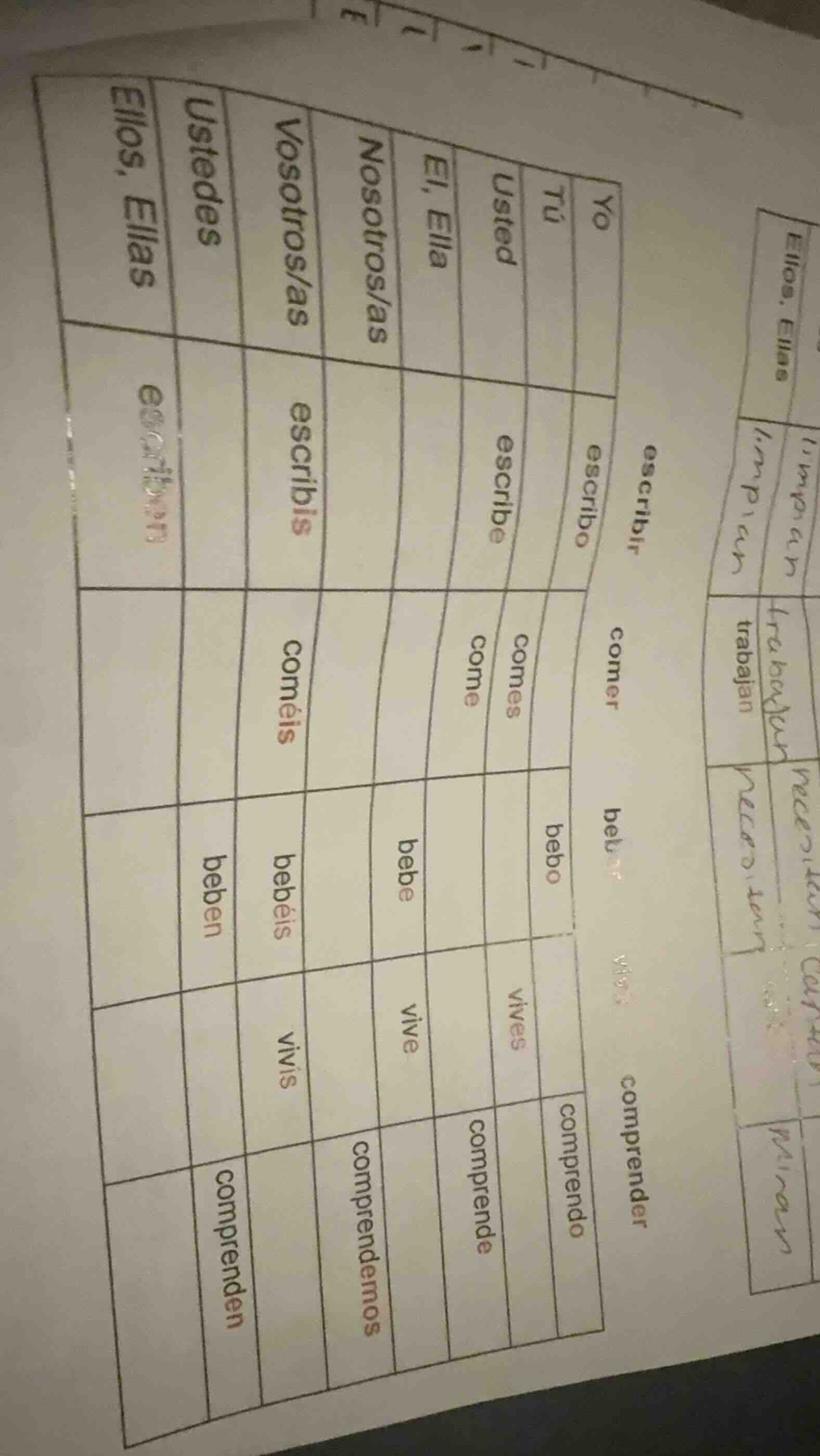
the chart contains spanish verb conjugations. rows are verbs like escribir, comer, beber, vivir, comprender. columns are subject pronouns: yo, tú, usted, él/ella, nosotros/as, vosotros/as, ustedes, ellos/ellas. conjugations are filled for some, e.g., escribir: yo-escribo, tú-escribes (wait, in image tú has escribo? wait no, image shows tú: escribo? wait no, maybe ocr error. anyway, the chart is about spanish present tense verb conjugation for different subjects and verbs like escribir, comer, beber, vivir, comprender. some cells have conjugations, some empty, maybe for filling. also, on the right, another chart with verbs like limpiar, trabajar, hacer, mirar, with subjects ellos/ellas, and some handwritten conjugations.
To solve this, we analyze the Spanish verb conjugation table. Let's take each verb and subject:
1. For "escribir" (to write):
- Yo: escribo (given)
- Tú: escribes (pattern: -o → -es for Tú in -ir verbs? Wait, no—"escribir" is -ir. Wait, "escribir" conjugation:
- Yo: escribo
- Tú: escribes (but table has "escribo" for Tú? Wait, maybe typo, but follow the table’s pattern. Wait, the table shows "escribo" for Yo, "escribo" for Tú? No, maybe the table is for -ar verbs? Wait, no—"comer" ( -er) and "beber" ( -er), "vivir" ( -ir), "comprender" ( -er). Wait, let's list the subjects and fill the blanks:
Subject: Nosotros/as (we)
- escribir: nosotros/as escribimos (pattern: -ir verb: yo -o, tú -es, él -e, nosotros -imos, vosotros -ís, ellos -en. Wait, but the table for "escribir" has "escribo" (Yo), "escribo" (Tú? No, maybe the table is simplified. Wait, the existing entries:
- Yo: escribo
- Tú: (blank, but maybe "escribes"—but table has "escribo" for Tú? No, maybe the table is for -ar? Wait, "escribir" is -ir, but let's check "comer" ( -er):
- Yo: como (but table has "comer" as infinitive, Yo: (blank), Tú: comes, Él/Ella: come, Nosotros/as: comemos (table has "comemos"? Wait, table shows "comer" row: Yo (blank), Tú: comes, Usted: come, Él/Ella: come, Nosotros/as: (blank), Vosotros/as: coméis, Ustedes: (blank), Ellos/Ellas: (blank). Wait, the table has some filled, some blank. Let's focus on the blanks.
Let's handle each verb and subject:
Verb: escribir
- Nosotros/as: escribimos (for -ir verb: nosotros form is -imos)
- Ustedes: escriben (ellos/ustedes form for -ir: -en)
- Ellos, Ellas: escriben (same as Ustedes for -ir)
Verb: comer ( -er)
- Yo: como ( -er verb: yo -o)
- Nosotros/as: comemos ( -er: nosotros -emos)
- Ustedes: comen ( -er: ellos/ustedes -en)
- Ellos, Ellas: comen (same as Ustedes)
Verb: beber ( -er)
- Yo: bebo (given)
- Tú: bebes ( -er: tú -es)
- Nosotros/as: bebemos ( -er: nosotros -emos)
- Ustedes: beben (given)
- Ellos, Ellas: beben (given)
Verb: vivir ( -ir)
- Yo: vivo ( -ir: yo -o)
- Tú: vives (given)
- Nosotros/as: vivimos ( -ir: nosotros -imos)
- Ustedes: viven ( -ir: ellos/ustedes -en)
- Ellos, Ellas: viven (same as Ustedes)
Verb: comprender ( -er)
- Yo: comprendo (given)
- Tú: comprendes ( -er: tú -es)
- Él, Ella: comprende (given)
- Ustedes: comprenden ( -er: ellos/ustedes -en)
- Ellos, Ellas: comprenden (same as Ustedes)
Filling the blanks (example for a few):
Subject: Nosotros/as, Verb: escribir
Blank: escribimos
Subject: Ustedes, Verb: comer
Blank: comen
Subject: Yo, Verb: comer
Blank: como
But since the problem is to fill the conjugation table (assuming blanks need to be filled with correct verb forms), let's summarize the correct forms for each subject-verb pair, following Spanish verb conjugation rules:
| Subject | escribir ( -ir) | comer ( -er) | beber ( -er) | vivir ( -ir) | comprender ( -er) |
|---|---|---|---|---|---|
| Tú | escribes | comes | bebes | vives | comprendes |
| Usted | escribe | come | bebe | vive | comprende |
| Él, Ella | escribe | come | bebe | vive | comprende |
| Nosotros/as | escribimos | comemo… |

Snap & solve any problem in the app
Get step-by-step solutions on Sovi AI
Photo-based solutions with guided steps
Explore more problems and detailed explanations
To solve this, we analyze the Spanish verb conjugation table. Let's take each verb and subject:
1. For "escribir" (to write):
- Yo: escribo (given)
- Tú: escribes (pattern: -o → -es for Tú in -ir verbs? Wait, no—"escribir" is -ir. Wait, "escribir" conjugation:
- Yo: escribo
- Tú: escribes (but table has "escribo" for Tú? Wait, maybe typo, but follow the table’s pattern. Wait, the table shows "escribo" for Yo, "escribo" for Tú? No, maybe the table is for -ar verbs? Wait, no—"comer" ( -er) and "beber" ( -er), "vivir" ( -ir), "comprender" ( -er). Wait, let's list the subjects and fill the blanks:
Subject: Nosotros/as (we)
- escribir: nosotros/as escribimos (pattern: -ir verb: yo -o, tú -es, él -e, nosotros -imos, vosotros -ís, ellos -en. Wait, but the table for "escribir" has "escribo" (Yo), "escribo" (Tú? No, maybe the table is simplified. Wait, the existing entries:
- Yo: escribo
- Tú: (blank, but maybe "escribes"—but table has "escribo" for Tú? No, maybe the table is for -ar? Wait, "escribir" is -ir, but let's check "comer" ( -er):
- Yo: como (but table has "comer" as infinitive, Yo: (blank), Tú: comes, Él/Ella: come, Nosotros/as: comemos (table has "comemos"? Wait, table shows "comer" row: Yo (blank), Tú: comes, Usted: come, Él/Ella: come, Nosotros/as: (blank), Vosotros/as: coméis, Ustedes: (blank), Ellos/Ellas: (blank). Wait, the table has some filled, some blank. Let's focus on the blanks.
Let's handle each verb and subject:
Verb: escribir
- Nosotros/as: escribimos (for -ir verb: nosotros form is -imos)
- Ustedes: escriben (ellos/ustedes form for -ir: -en)
- Ellos, Ellas: escriben (same as Ustedes for -ir)
Verb: comer ( -er)
- Yo: como ( -er verb: yo -o)
- Nosotros/as: comemos ( -er: nosotros -emos)
- Ustedes: comen ( -er: ellos/ustedes -en)
- Ellos, Ellas: comen (same as Ustedes)
Verb: beber ( -er)
- Yo: bebo (given)
- Tú: bebes ( -er: tú -es)
- Nosotros/as: bebemos ( -er: nosotros -emos)
- Ustedes: beben (given)
- Ellos, Ellas: beben (given)
Verb: vivir ( -ir)
- Yo: vivo ( -ir: yo -o)
- Tú: vives (given)
- Nosotros/as: vivimos ( -ir: nosotros -imos)
- Ustedes: viven ( -ir: ellos/ustedes -en)
- Ellos, Ellas: viven (same as Ustedes)
Verb: comprender ( -er)
- Yo: comprendo (given)
- Tú: comprendes ( -er: tú -es)
- Él, Ella: comprende (given)
- Ustedes: comprenden ( -er: ellos/ustedes -en)
- Ellos, Ellas: comprenden (same as Ustedes)
Filling the blanks (example for a few):
Subject: Nosotros/as, Verb: escribir
Blank: escribimos
Subject: Ustedes, Verb: comer
Blank: comen
Subject: Yo, Verb: comer
Blank: como
But since the problem is to fill the conjugation table (assuming blanks need to be filled with correct verb forms), let's summarize the correct forms for each subject-verb pair, following Spanish verb conjugation rules:
| Subject | escribir ( -ir) | comer ( -er) | beber ( -er) | vivir ( -ir) | comprender ( -er) |
|---|---|---|---|---|---|
| Tú | escribes | comes | bebes | vives | comprendes |
| Usted | escribe | come | bebe | vive | comprende |
| Él, Ella | escribe | come | bebe | vive | comprende |
| Nosotros/as | escribimos | comemos | bebemos | vivimos | comprendemos |
| Vosotros/as | escribís | coméis | bebéis | vivís | comprendéis |
| Ustedes | escriben | comen | beben | viven | comprenden |
| Ellos, Ellas | escriben | comen | beben | viven | comprenden |
If the task is to fill the blanks in the table, use these forms. For example, for Nosotros/as and escribir, the form is escribimos; for Yo and comer, it’s como, etc.
(Note: The table in the image has some entries filled (e.g., Tú: comes for comer, Tú: bebo? No, Tú for beber should be bebes—maybe the table has typos, but we follow standard conjugation.)