QUESTION IMAGE
Question
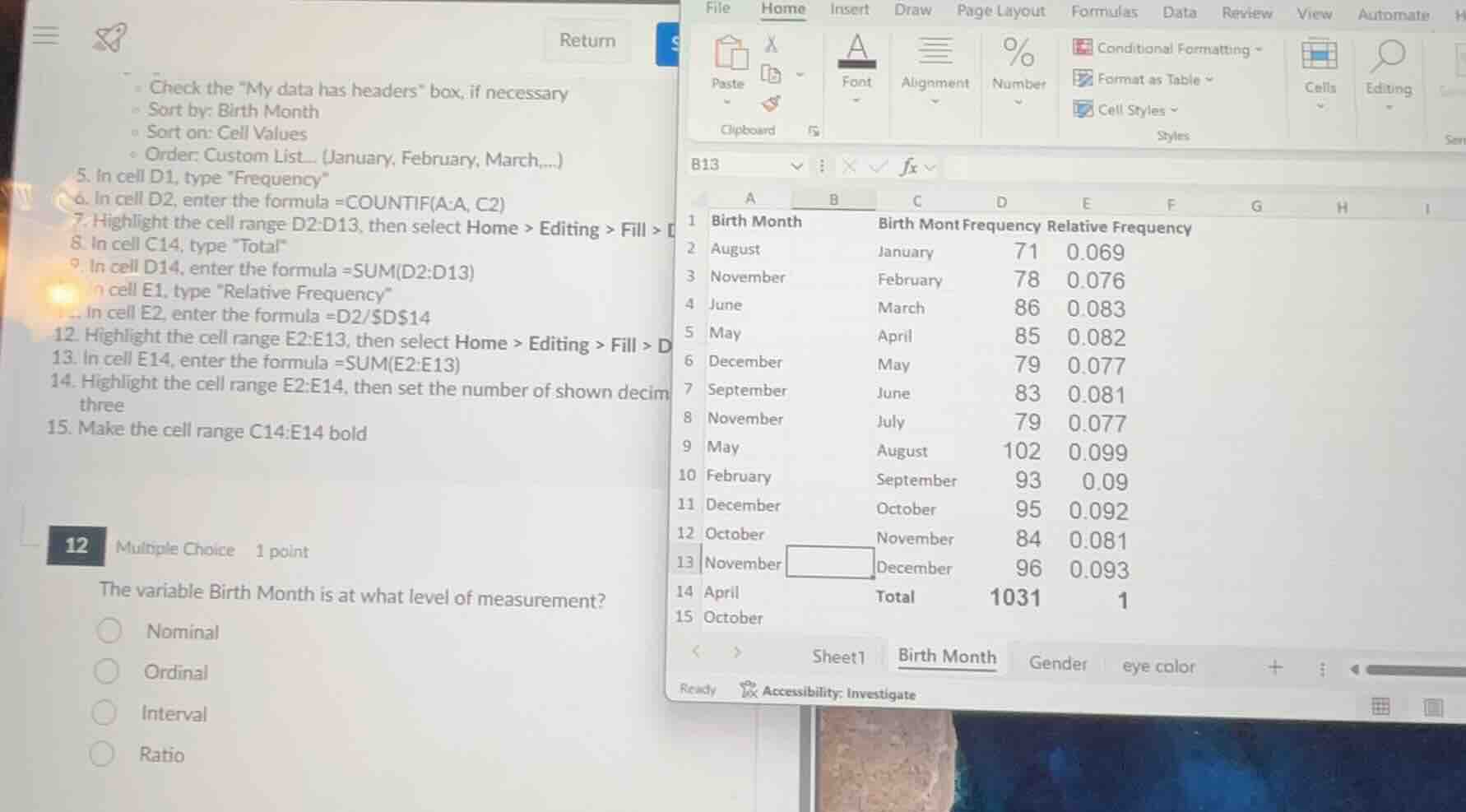
check the \my data has headers\ box, if necessary
sort by: birth month
sort on: cell values
order: custom list... (january, february, march,...)
- in cell d1, type \frequency\
- in cell d2, enter the formula =countif(a:a, c2)
- highlight the cell range d2:d13, then select home > editing > fill >
- in cell c14, type \total\
- in cell d14, enter the formula =sum(d2:d13)
cell e1, type
elative frequency\
in cell e2, enter the formula =d2/$d$14
- highlight the cell range e2:e13, then select home > editing > fill > d
- in cell e14, enter the formula =sum(e2:e13)
- highlight the cell range e2:e14, then set the number of shown decim three
- make the cell range c14:e14 bold
12 multiple choice 1 point
the variable birth month is at what level of measurement?
nominal
ordinal
interval
ratio
Ordinal level of measurement categorizes data that has a meaningful order or ranking. Birth months have a clear sequential order (January → February → ... → December) where each month comes before/after another in a logical sequence, which fits the ordinal level. Nominal data has no order, interval has equal intervals but no true zero, and ratio has a true zero, which do not apply here.

Snap & solve any problem in the app
Get step-by-step solutions on Sovi AI
Photo-based solutions with guided steps
Explore more problems and detailed explanations
Ordinal