QUESTION IMAGE
Question
chelsea pd 8 1/21
lesson 4: why is there a higher frequency of sickle cell disease in some parts of the world?
sickle cell disease storyline student handout
part 1: analyzing data
watch clip 3 and observe figure 1.
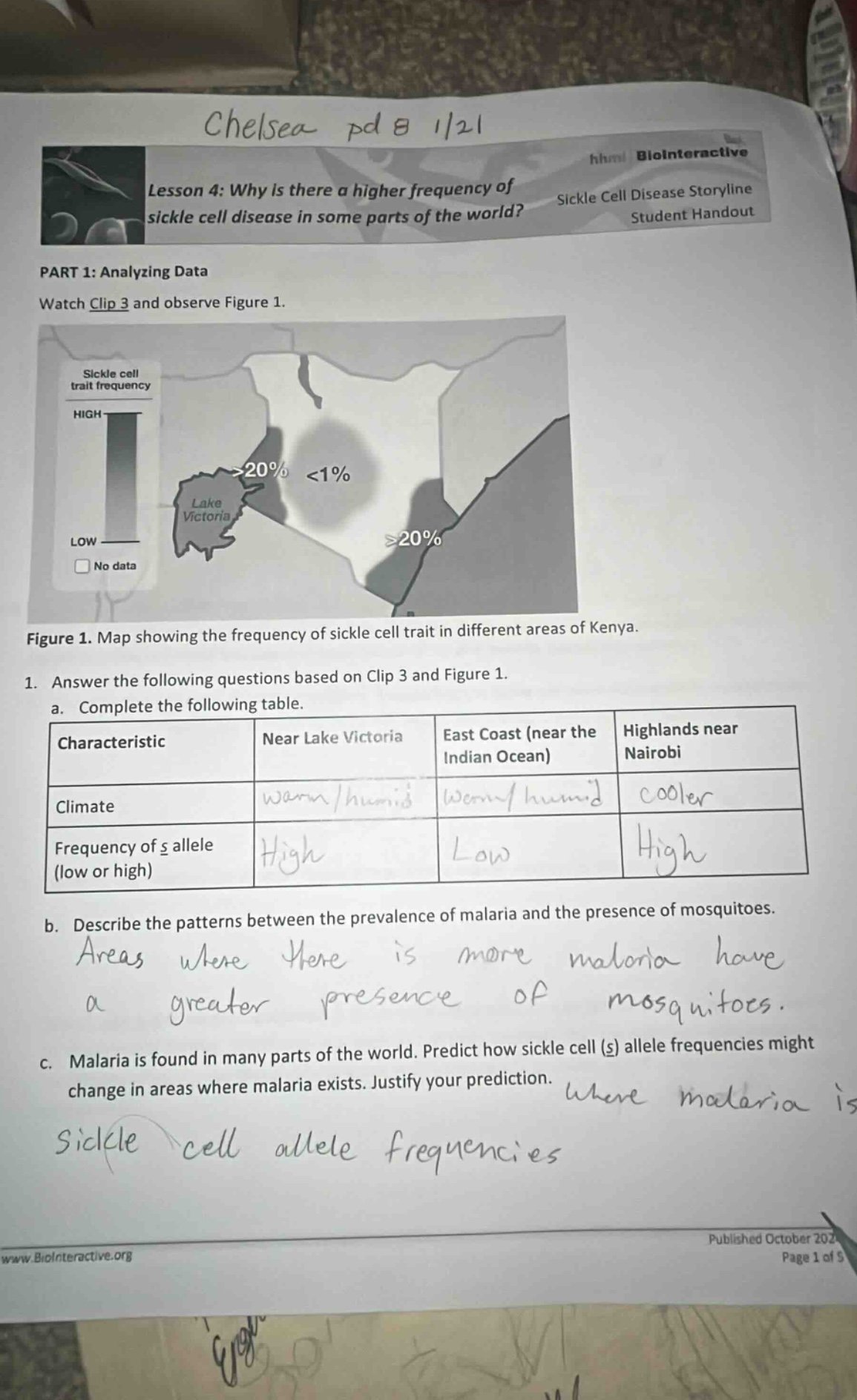
figure 1. map showing the frequency of sickle cell trait in different areas of kenya.
- answer the following questions based on clip 3 and figure 1.
a. complete the following table.
| characteristic | near lake victoria | east coast (near the indian ocean) | highlands near nairobi |
|---|---|---|---|
| frequency of s allele (low or high) | high | low | high |
b. describe the patterns between the prevalence of malaria and the presence of mosquitoes.
areas where there is more malaria have a greater presence of mosquitoes.
c. malaria is found in many parts of the world. predict how sickle cell (s) allele frequencies might change in areas where malaria exists. justify your prediction.
where malaria is sickle cell allele frequencies
1a.
- For Near Lake Victoria: Warm, humid climate matches the region's conditions, and the map shows >20% sickle cell trait frequency, so high $\boldsymbol{s}$ allele frequency is correct.
- For East Coast: Warm, humid climate is accurate, but the map shows >20% sickle cell trait frequency, so $\boldsymbol{s}$ allele frequency should be high (not low as written).
- For Highlands near Nairobi: Cooler climate is correct, and the map shows <1% sickle cell trait frequency, so $\boldsymbol{s}$ allele frequency should be low (not high as written).
1b.
Mosquitoes (Anopheles species) are the vector that transmits the malaria parasite. Warm, humid environments (like near Lake Victoria and the East Coast) provide ideal breeding conditions for these mosquitoes. More mosquitoes mean more opportunities for malaria transmission, so malaria prevalence is directly tied to mosquito presence: higher mosquito abundance correlates with higher malaria rates.
1c.
Individuals who are heterozygous for the sickle cell trait (carry one $\boldsymbol{s}$ allele) have increased resistance to malaria. In areas with malaria, natural selection favors the $\boldsymbol{s}$ allele: people with the trait are more likely to survive malaria, reproduce, and pass the $\boldsymbol{s}$ allele to their offspring. This leads to a higher frequency of the $\boldsymbol{s}$ allele in populations living in malaria-endemic regions over time.

Snap & solve any problem in the app
Get step-by-step solutions on Sovi AI
Photo-based solutions with guided steps
Explore more problems and detailed explanations
1a.
| Characteristic | Near Lake Victoria | East Coast (near the Indian Ocean) | Highlands near Nairobi |
|---|---|---|---|
| Frequency of $\boldsymbol{s}$ allele (low or high) | High | High | Low |
1b. Higher mosquito presence correlates with higher malaria prevalence, as mosquitoes are the malaria-transmitting vector, and warm/humid areas (ideal for mosquitoes) have more malaria.
1c. The frequency of the sickle cell ($\boldsymbol{s}$) allele will be higher in areas with malaria. This is because people carrying the $\boldsymbol{s}$ allele (heterozygous) have increased resistance to malaria, so natural selection favors the allele, leading to its higher frequency in these populations.