QUESTION IMAGE
Question
choose the best answers.
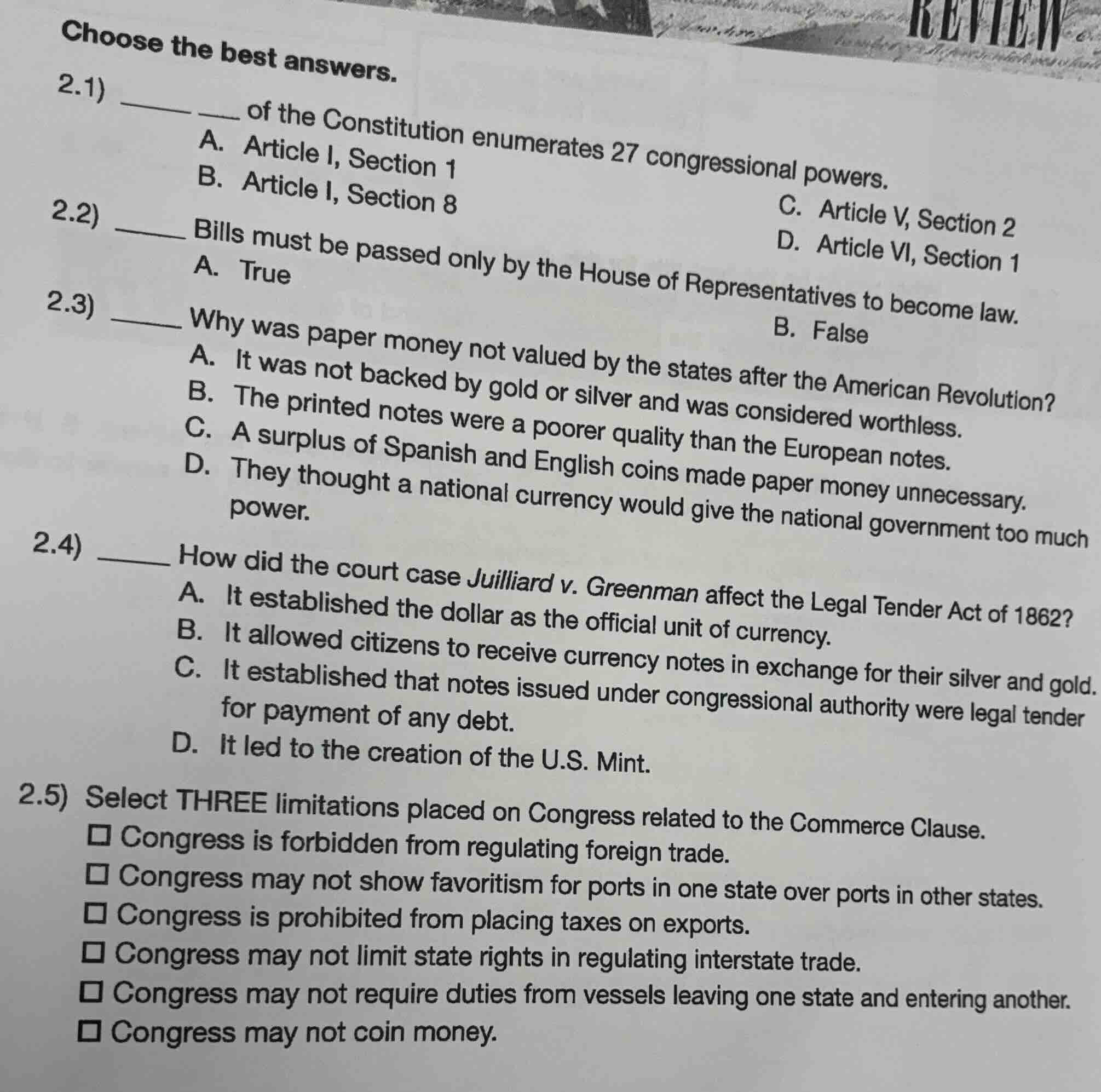
2.1) __ of the constitution enumerates 27 congressional powers.
a. article i, section 1 \t\t\tc. article v, section 2
b. article i, section 8 \t\t\td. article vi, section 1
2.2) ____ bills must be passed only by the house of representatives to become law.
a. true \t\t\t\t\tb. false
2.3) ____ why was paper money not valued by the states after the american revolution?
a. it was not backed by gold or silver and was considered worthless.
b. the printed notes were a poorer quality than the european notes.
c. a surplus of spanish and english coins made paper money unnecessary.
d. they thought a national currency would give the national government too much power.
2.4) ____ how did the court case juilliard v. greenman affect the legal tender act of 1862?
a. it established the dollar as the official unit of currency.
b. it allowed citizens to receive currency notes in exchange for their silver and gold.
c. it established that notes issued under congressional authority were legal tender for payment of any debt.
d. it led to the creation of the u.s. mint.
2.5) select three limitations placed on congress related to the commerce clause.
☐ congress is forbidden from regulating foreign trade.
☐ congress may not show favoritism for ports in one state over ports in other states.
☐ congress is prohibited from placing taxes on exports.
☐ congress may not limit state rights in regulating interstate trade.
☐ congress may not require duties from vessels leaving one state and entering another.
☐ congress may not coin money.
2.1) Article I, Section 8 of the U.S. Constitution lists the enumerated powers of Congress, which include 27 distinct powers.
2.2) For a bill to become law, it must be passed by both the House of Representatives and the Senate, then signed by the President (or passed by a 2/3 override of a veto).
2.3) Post-American Revolution, the paper money issued by the states lacked backing in gold or silver, leading to it being seen as worthless and unvalued.
2.4) The Juilliard v. Greenman case upheld the constitutionality of the Legal Tender Act, confirming that congressional-issued notes were legal tender for all debts.
2.5) Under the Commerce Clause, Congress has specific limitations: it cannot favor ports of one state over others, cannot tax exports, and cannot impose duties on vessels moving between states.

Snap & solve any problem in the app
Get step-by-step solutions on Sovi AI
Photo-based solutions with guided steps
Explore more problems and detailed explanations
2.1) B. Article I, Section 8
2.2) B. False
2.3) A. It was not backed by gold or silver and was considered worthless.
2.4) C. It established that notes issued under congressional authority were legal tender for payment of any debt.
2.5)
- Congress may not show favoritism for ports in one state over ports in other states.
- Congress is prohibited from placing taxes on exports.
- Congress may not require duties from vessels leaving one state and entering another.