QUESTION IMAGE
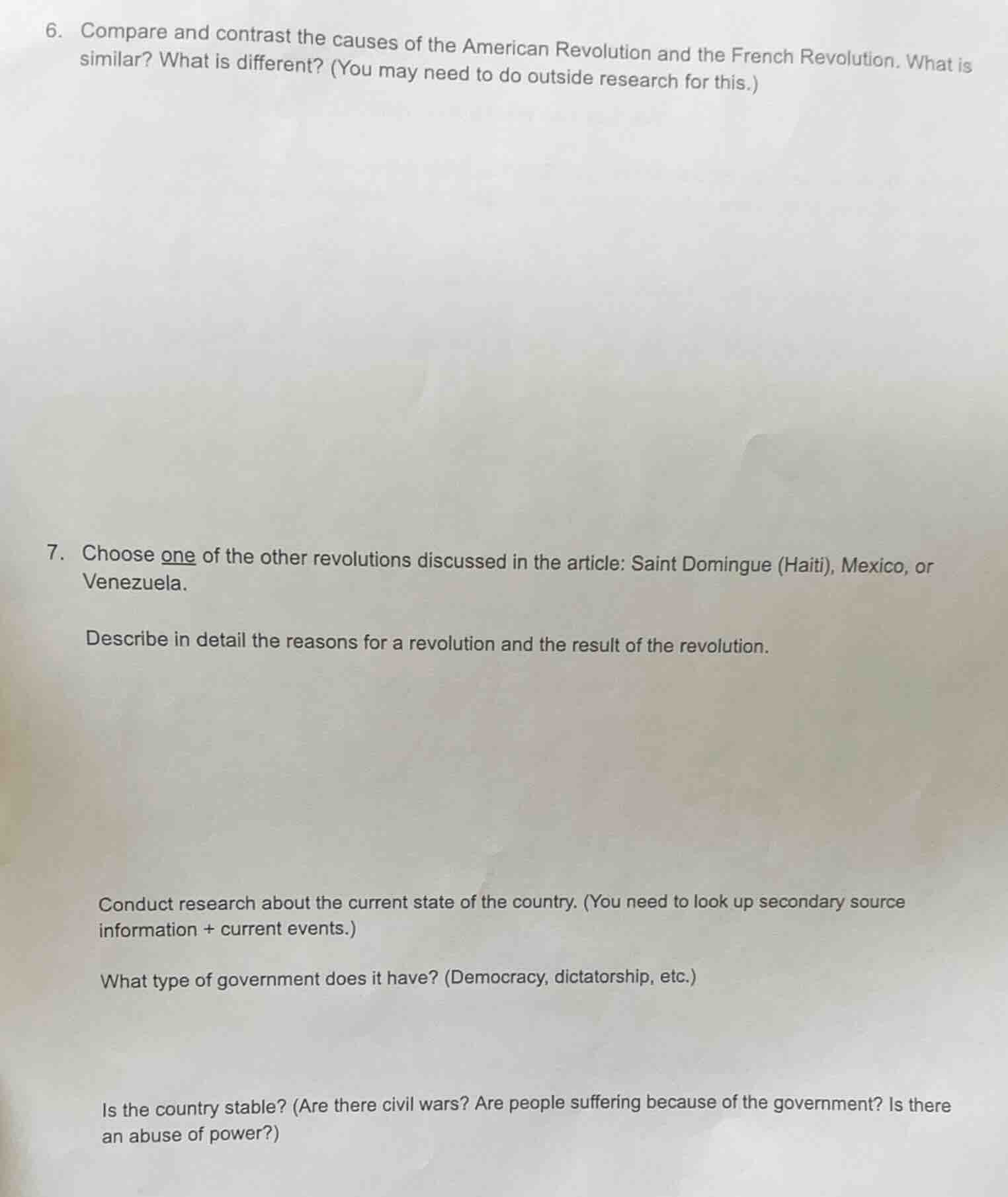
Question
- compare and contrast the causes of the american revolution and the french revolution. what is similar? what is different? (you may need to do outside research for this.)
- choose one of the other revolutions discussed in the article: saint domingue (haiti), mexico, or venezuela.
describe in detail the reasons for a revolution and the result of the revolution.
conduct research about the current state of the country. (you need to look up secondary source information + current events.)
what type of government does it have? (democracy, dictatorship, etc.)
is the country stable? (are there civil wars? are people suffering because of the government? is there an abuse of power?)
Response
For Question 6
Brief Explanations
Similar Causes:
- Enlightenment Ideals: Both revolutions were driven by ideas of popular sovereignty, individual rights, and opposition to absolute authority (from philosophers like Locke for the American Revolution, Rousseau for the French Revolution).
- Fiscal Grievances: The American colonies resented British taxes (e.g., Stamp Act, Tea Act) without representation; France faced a crippling national debt from wars and lavish royal spending, leading to new taxes on the Third Estate.
- Unrepresentative Governance: The American colonies had no direct representation in British Parliament; France's Estates-General gave disproportionate power to the First and Second Estates, ignoring the majority Third Estate.
Different Causes:
- Social Structure: The American Revolution was a conflict between a colony and its imperial power, with a relatively unified colonial population (excluding enslaved people). The French Revolution was an internal class conflict, sparked by the extreme inequality of the feudal estate system, where the 98% Third Estate (peasants, workers, bourgeoisie) was oppressed by the aristocracy and clergy.
- Economic Base: The American colonies had a growing, self-sustaining economy focused on trade and agriculture; France's economy was stagnant, with feudal obligations (e.g., tithes, corvée labor) suppressing peasant productivity.
- Trigger Event: The American Revolution was triggered by specific imperial actions (Boston Massacre, Intolerable Acts); the French Revolution was triggered by a failed attempt at tax reform, a severe famine in 1788-1789, and the storming of the Bastille as a symbol of royal tyranny.
Brief Explanations
Reasons for the Haitian Revolution:
- Chattel Slavery: Over 90% of the population was enslaved, subjected to brutal conditions on sugar, coffee, and indigo plantations—high mortality rates, forced labor, and violent punishment were standard.
- Social Inequality: The colony's rigid caste system placed white planters at the top, followed by free people of color (who faced legal discrimination despite wealth), and enslaved people at the bottom.
- Enlightenment and Revolutionary Spillover: Ideas of liberty from the American and French Revolutions, plus the French Revolution's 1794 abolition of slavery, inspired enslaved people to demand their own freedom.
- Leadership: Figures like Toussaint Louverture organized enslaved rebels into a disciplined military force to fight both French planters and later, invading forces from Britain and Spain.
Results of the Haitian Revolution:
- Abolition of Slavery: Haiti became the first independent nation in Latin America and the first country to permanently abolish slavery through revolution (1804).
- Independence: It gained full independence from France after defeating Napoleon's invading army, which sought to reimpose slavery.
- International Isolation: Western powers (including the U.S. and European nations) shunned Haiti for decades due to fear of inspiring slave revolts in their own territories, imposing economic blockades.
- Economic Decline: Plantations were destroyed during the revolution, and the new nation was forced to pay crippling reparations to France until 1947, which drained its economy for over a century.
Current State of Haiti:
- Government Type: Haiti is a semi-presidential republic, with a president as head of state and a prime minister as head of government. However, governance has been marked by instability, with frequent leadership vacuums and contested elections.
- Stability: Haiti is deeply unstable. Since 2021, the assassination of President Jovenel Moïse has led to a power vacuum, and violent gangs now control large swathes of the country, including parts of the capital Port-au-Prince. There is no active civil war, but widespread gang violence, extrajudicial killings, and displacement of over 2 million people have created a humanitarian crisis.
- Suffering and Government Abuse: The population faces severe food insecurity (over 40% of Haitians face acute hunger), lack of access to healthcare and clean water, and arbitrary violence from gangs and some security forces. Corruption has long plagued the government, with embezzlement of public funds and failure to provide basic services contributing to public suffering.

Snap & solve any problem in the app
Get step-by-step solutions on Sovi AI
Photo-based solutions with guided steps
Explore more problems and detailed explanations
Similar Causes:
- Shared influence of Enlightenment ideals of liberty and self-rule
- Fiscal burdens and unfair taxation imposed by unrepresentative authorities
- Opposition to distant/unequal governance without input from the governed
Different Causes:
- American Revolution: A colonial-imperial conflict with a relatively unified colonial society, focused on ending British control; triggered by specific British tax and control policies.
- French Revolution: An internal class revolution rooted in extreme feudal inequality, focused on overthrowing the entire estate system; triggered by national debt, famine, and systemic class oppression.
---