QUESTION IMAGE
Question
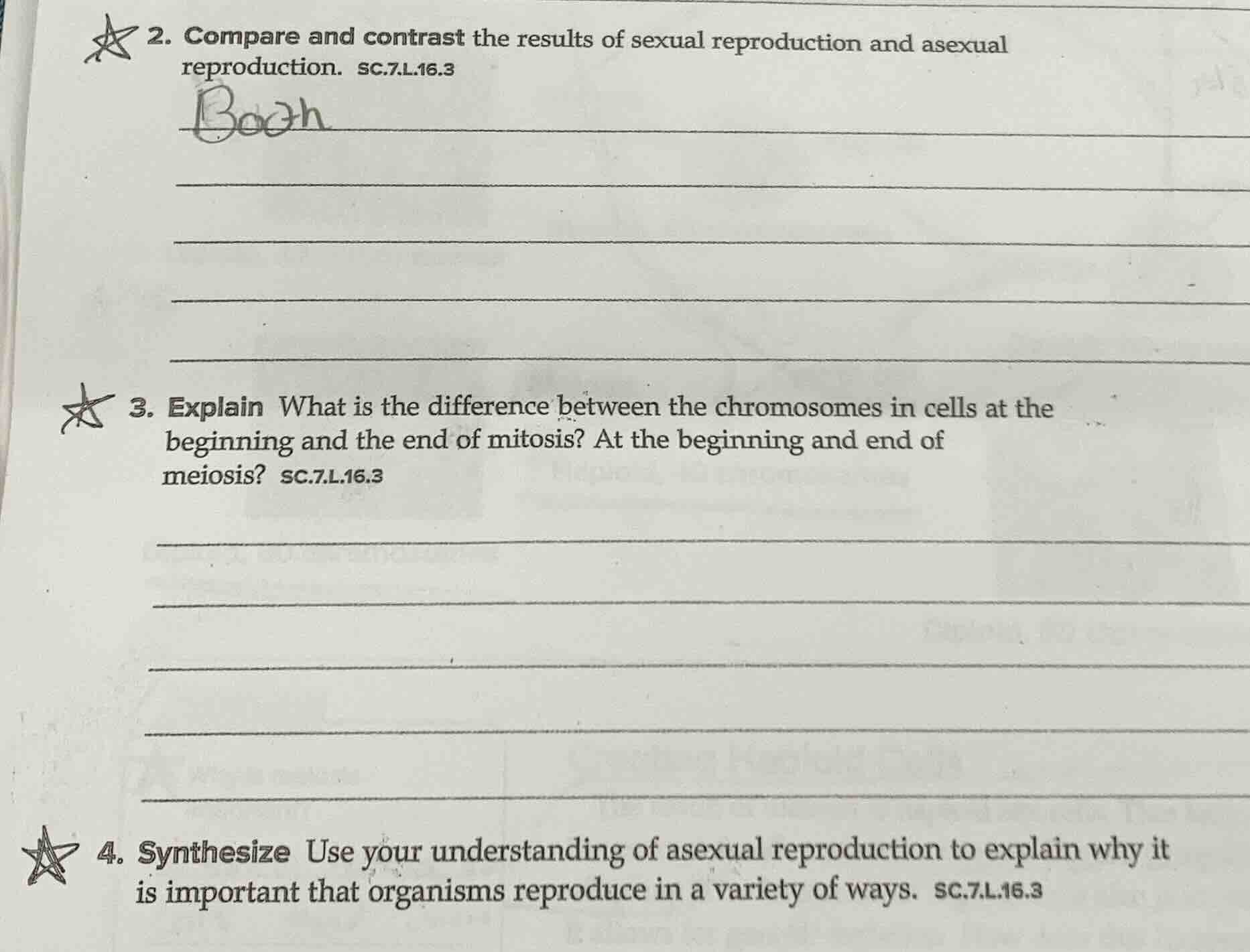
- compare and contrast the results of sexual reproduction and asexual reproduction. sc.7.l.16.3
- explain what is the difference between the chromosomes in cells at the beginning and the end of mitosis? at the beginning and end of meiosis? sc.7.l.16.3
- synthesize use your understanding of asexual reproduction to explain why it is important that organisms reproduce in a variety of ways. sc.7.l.16.3
For Question 2:
- Similarity: Both sexual and asexual reproduction produce new offspring to sustain the species.
- Contrasts: Sexual reproduction combines genetic material from two parents, resulting in genetically diverse offspring; it requires gamete fusion. Asexual reproduction only needs one parent, produces genetically identical clones, and has faster reproductive rates with no gamete involvement.
For Question 3:
- Mitosis: The parent cell starts with a full diploid (2n) set of chromosomes. After division, each daughter cell has an identical diploid (2n) chromosome set, matching the parent.
- Meiosis: The parent cell begins with a diploid (2n) set of chromosomes. After two rounds of division, the resulting gametes have a haploid (n) set, half the number of the parent, with unique genetic combinations.
For Question 4:
Asexual reproduction is fast and energy-efficient, allowing organisms to quickly colonize stable, favorable environments. However, it produces genetically identical offspring, which makes the population vulnerable to sudden environmental changes (like disease or climate shifts). Having multiple reproductive methods lets species use asexual reproduction for rapid growth when conditions are good, and sexual reproduction (when available) to introduce genetic diversity, improving the population's ability to adapt to new threats or changes.

Snap & solve any problem in the app
Get step-by-step solutions on Sovi AI
Photo-based solutions with guided steps
Explore more problems and detailed explanations
- Question 2:
- Similarity: Both produce new offspring.
- Contrasts: Sexual reproduction creates genetically diverse offspring from two parents; asexual reproduction creates genetically identical clones from one parent, with faster reproduction.
- Question 3:
- Mitosis: Start (2n diploid) → End (2n diploid, identical to parent)
- Meiosis: Start (2n diploid) → End (n haploid, half the parent's number, genetically unique)
- Question 4:
Asexual reproduction enables fast, low-energy population growth in stable environments, but lacks genetic diversity to handle environmental changes. Multiple reproductive methods let species balance rapid growth (asexual) and adaptive genetic diversity (sexual), improving survival across different conditions.