QUESTION IMAGE
Question
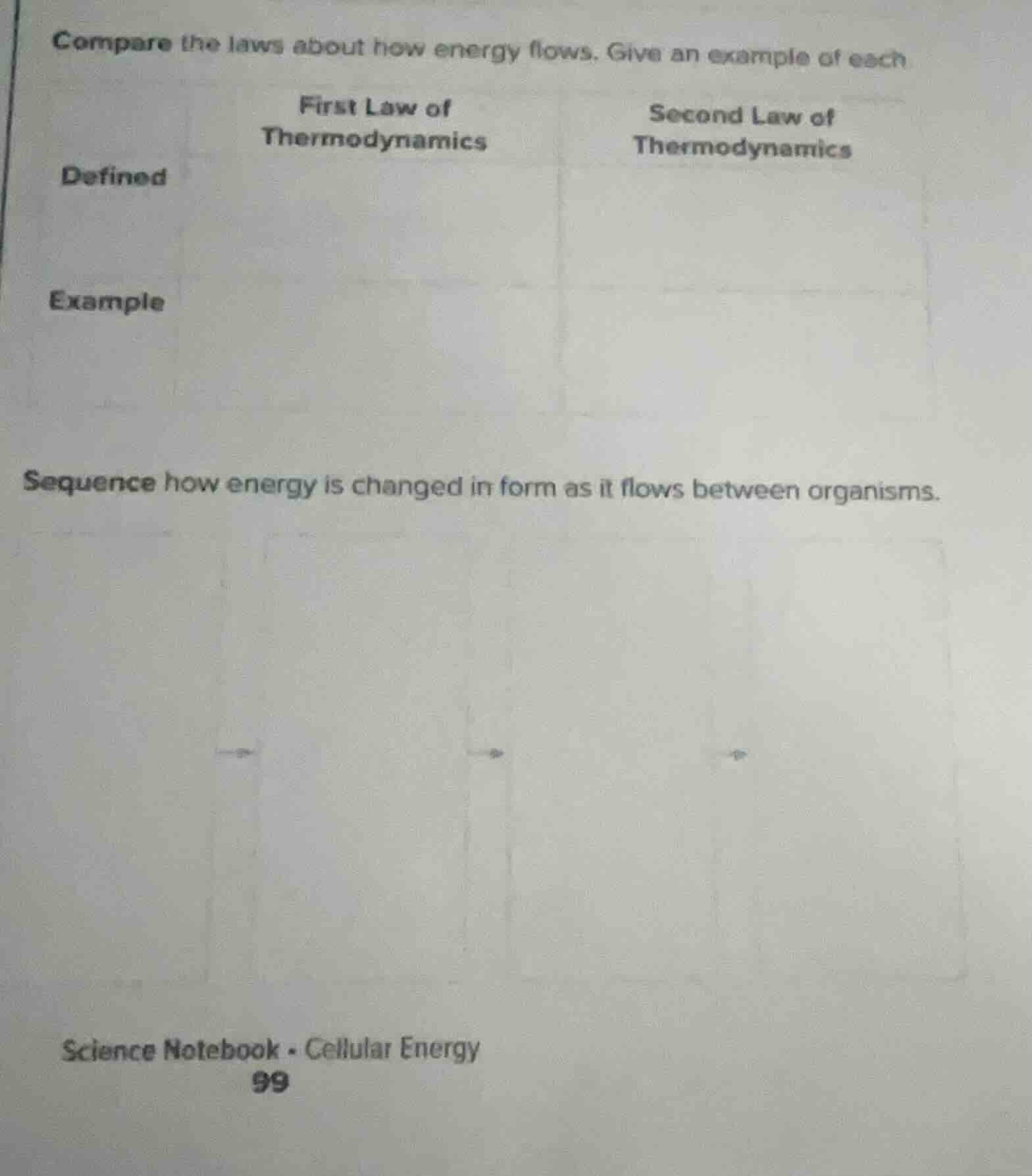
compare the laws about how energy flows. give an example of each
first law of thermodynamics\tsecond law of thermodynamics
defined\t\t
example\t\t
sequence how energy is changed in form as it flows between organisms.
science notebook · cellular energy
99
Part 1: Compare the laws of thermodynamics (Table Completion)
First Law of Thermodynamics (Defined)
The First Law of Thermodynamics (Law of Conservation of Energy) states that energy cannot be created or destroyed, only transformed from one form to another or transferred between systems. Mathematically, it can be expressed as $\Delta U = Q - W$, where $\Delta U$ is the change in internal energy of a system, $Q$ is the heat added to the system, and $W$ is the work done by the system.
First Law of Thermodynamics (Example)
- A battery stores chemical energy. When it powers a device (like a flashlight), the chemical energy is transformed into electrical energy, which is then converted into light (electromagnetic) and heat energy. The total energy (chemical + electrical + light + heat) remains constant (energy is conserved).
- In a car engine, fuel (chemical energy) is burned, and the energy is converted into mechanical work (to move the car), heat (lost to the environment), and sound. The total energy input (from fuel) equals the total energy output (mechanical + heat + sound).
Second Law of Thermodynamics (Defined)
The Second Law of Thermodynamics deals with the direction of energy flow and the concept of entropy ($S$), a measure of disorder or randomness in a system. A common statement is: Heat naturally flows from a hotter object to a colder object, and not the reverse, unless external work is done. Mathematically, for a spontaneous process, $\Delta S_{\text{universe}} = \Delta S_{\text{system}} + \Delta S_{\text{surroundings}} \geq 0$ (equality for reversible processes, inequality for irreversible processes).
Second Law of Thermodynamics (Example)
- When you place a hot cup of coffee on a table, heat flows from the coffee (hotter) to the surrounding air (colder) until the coffee and air reach thermal equilibrium (same temperature). You never see the coffee get hotter by absorbing heat from the cooler air spontaneously.
- In a refrigerator, heat is removed from the cold interior and expelled to the warmer exterior. This requires external work (from the refrigerator’s compressor), because heat does not naturally flow from cold to hot. The entropy of the refrigerator’s interior decreases, but the entropy of the surroundings (and the universe) increases overall (due to the work done and heat expelled).
Part 2: Sequence of Energy Change Between Organisms
Energy flow between organisms follows the food chain/energy pyramid and involves transformations of energy:
- Sunlight (Solar Energy) → Producers (Plants/Algae):
Producers (autotrophs) use photosynthesis to convert solar energy into chemical energy (stored in glucose, $C_6H_{12}O_6$). The reaction is:
$$6CO_2 + 6H_2O + \text{Light Energy} \xrightarrow{\text{Chlorophyll}} C_6H_{12}O_6 + 6O_2$$
Solar energy is transformed into chemical energy (stored in bonds of glucose).
- Producers → Primary Consumers (Herbivores):
Herbivores (e.g., rabbits, deer) eat plants. The chemical energy stored in the plant’s glucose (and other organic molecules) is transferred to the herbivore. The herbivore uses some of this energy for cellular respiration (to power its metabolism, movement, etc.), converting chemical energy into ATP (adenosine triphosphate, a usable energy form for cells) and heat (lost to the environment). The remaining energy is stored in the herbivore’s tissues (as fat, muscle, etc.).
- Primary Consumers → Secondary Consumers (Carnivores/Omnivores):
Secondary consumers (e.g., foxes, hawks) eat primary consumers. The chem…

Snap & solve any problem in the app
Get step-by-step solutions on Sovi AI
Photo-based solutions with guided steps
Explore more problems and detailed explanations
Part 1: Compare the laws of thermodynamics (Table Completion)
First Law of Thermodynamics (Defined)
The First Law of Thermodynamics (Law of Conservation of Energy) states that energy cannot be created or destroyed, only transformed from one form to another or transferred between systems. Mathematically, it can be expressed as $\Delta U = Q - W$, where $\Delta U$ is the change in internal energy of a system, $Q$ is the heat added to the system, and $W$ is the work done by the system.
First Law of Thermodynamics (Example)
- A battery stores chemical energy. When it powers a device (like a flashlight), the chemical energy is transformed into electrical energy, which is then converted into light (electromagnetic) and heat energy. The total energy (chemical + electrical + light + heat) remains constant (energy is conserved).
- In a car engine, fuel (chemical energy) is burned, and the energy is converted into mechanical work (to move the car), heat (lost to the environment), and sound. The total energy input (from fuel) equals the total energy output (mechanical + heat + sound).
Second Law of Thermodynamics (Defined)
The Second Law of Thermodynamics deals with the direction of energy flow and the concept of entropy ($S$), a measure of disorder or randomness in a system. A common statement is: Heat naturally flows from a hotter object to a colder object, and not the reverse, unless external work is done. Mathematically, for a spontaneous process, $\Delta S_{\text{universe}} = \Delta S_{\text{system}} + \Delta S_{\text{surroundings}} \geq 0$ (equality for reversible processes, inequality for irreversible processes).
Second Law of Thermodynamics (Example)
- When you place a hot cup of coffee on a table, heat flows from the coffee (hotter) to the surrounding air (colder) until the coffee and air reach thermal equilibrium (same temperature). You never see the coffee get hotter by absorbing heat from the cooler air spontaneously.
- In a refrigerator, heat is removed from the cold interior and expelled to the warmer exterior. This requires external work (from the refrigerator’s compressor), because heat does not naturally flow from cold to hot. The entropy of the refrigerator’s interior decreases, but the entropy of the surroundings (and the universe) increases overall (due to the work done and heat expelled).
Part 2: Sequence of Energy Change Between Organisms
Energy flow between organisms follows the food chain/energy pyramid and involves transformations of energy:
- Sunlight (Solar Energy) → Producers (Plants/Algae):
Producers (autotrophs) use photosynthesis to convert solar energy into chemical energy (stored in glucose, $C_6H_{12}O_6$). The reaction is:
$$6CO_2 + 6H_2O + \text{Light Energy} \xrightarrow{\text{Chlorophyll}} C_6H_{12}O_6 + 6O_2$$
Solar energy is transformed into chemical energy (stored in bonds of glucose).
- Producers → Primary Consumers (Herbivores):
Herbivores (e.g., rabbits, deer) eat plants. The chemical energy stored in the plant’s glucose (and other organic molecules) is transferred to the herbivore. The herbivore uses some of this energy for cellular respiration (to power its metabolism, movement, etc.), converting chemical energy into ATP (adenosine triphosphate, a usable energy form for cells) and heat (lost to the environment). The remaining energy is stored in the herbivore’s tissues (as fat, muscle, etc.).
- Primary Consumers → Secondary Consumers (Carnivores/Omnivores):
Secondary consumers (e.g., foxes, hawks) eat primary consumers. The chemical energy stored in the herbivore’s tissues is transferred to the secondary consumer. Again, the secondary consumer uses energy for respiration (producing ATP and heat) and stores the rest in its own tissues.
- Secondary Consumers → Tertiary Consumers (Top Predators):
Tertiary consumers (e.g., lions, eagles) eat secondary consumers. Energy is transferred, with some used for respiration (ATP, heat) and some stored.
- Decomposers (Bacteria, Fungi):
When organisms die (producers, consumers), decomposers break down their organic matter. The chemical energy in the dead tissues is converted into heat (during decomposition) and reused by the decomposers for their metabolism. Some nutrients are also released back into the environment (e.g., soil) to be used by producers, completing the cycle.
Summary Table (Filled)
| First Law of Thermodynamics | Second Law of Thermodynamics | |
|---|---|---|
| Example | Battery powering a device (chemical → electrical → light/heat). <br> Car engine (chemical → mechanical/heat/sound). | Hot coffee cooling (heat → surroundings). <br> Refrigerator (needs work to move heat from cold to hot). |
Energy Flow Sequence (Between Organisms)
- Solar Energy (from the Sun)
- → Producers (Plants/Algae) (photosynthesis: solar → chemical energy)
- → Primary Consumers (Herbivores) (chemical energy from plants → used for respiration (ATP/heat) + stored in tissues)
- → Secondary Consumers (Carnivores/Omnivores) (chemical energy from herbivores → used for respiration (ATP/heat) + stored in tissues)
- → Tertiary Consumers (Top Predators) (chemical energy from secondary consumers → used for respiration (ATP/heat) + stored in tissues)
- → Decomposers (Bacteria/Fungi) (chemical energy from dead organisms → converted to heat + nutrients recycled)
This sequence illustrates how energy is transformed and transferred between organisms, with a portion lost as heat at each trophic level (due to the Second Law of Thermodynamics, as entropy increases and energy becomes less available for work).