QUESTION IMAGE
Question
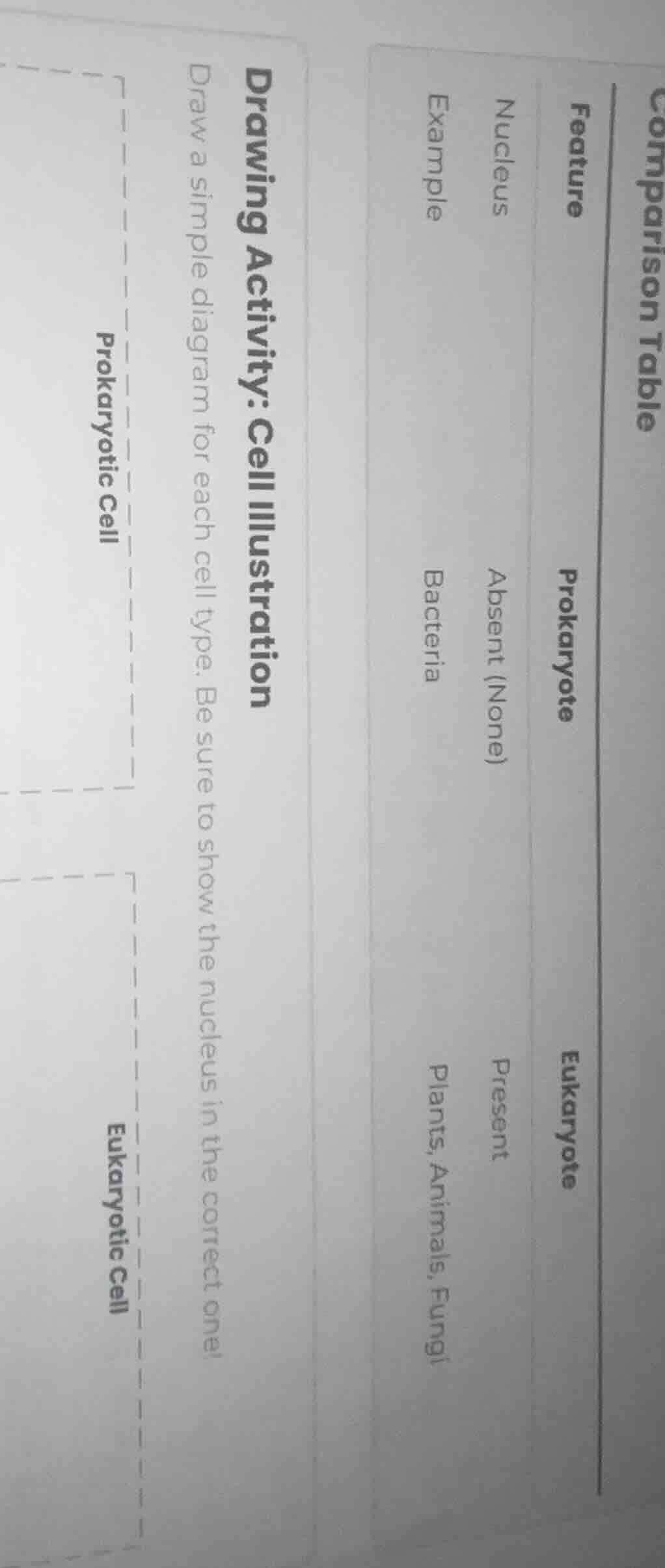
comparison table
feature\t\tprokaryote\teukaryote
nucleus\tabsent (none)\tpresent
example\tbacteria\tplants, animals, fungi
drawing activity: cell illustration
draw a simple diagram for each cell type. be sure to show the nucleus in the correct one!
prokaryotic cell
eukaryotic cell
The task covers two parts: completing the comparison table (already partially filled) and drawing the two cell types. For the table, the key distinction for the nucleus feature is defined, and the example organisms match the cell type. For the drawings, the prokaryote lacks a membrane-bound nucleus, while the eukaryote has a distinct, membrane-enclosed nucleus.

Snap & solve any problem in the app
Get step-by-step solutions on Sovi AI
Photo-based solutions with guided steps
Explore more problems and detailed explanations
Comparison Table Completion (Full Table):
| Feature | Prokaryote | Eukaryote |
|---|---|---|
| Example | Bacteria | Plants, Animals, Fungi |
Cell Drawing Guidelines:
- Prokaryotic Cell (e.g., Bacteria):
- Draw a simple oval/circular cell outline (cell membrane, surrounded by a cell wall).
- Add a small, unbound region of genetic material (nucleoid) near the center (no surrounding membrane).
- Optional: Add small dots for ribosomes scattered in the cytoplasm.
- Eukaryotic Cell (e.g., Animal/Plant):
- Draw a circular/rectangular cell outline (cell membrane; add a rigid cell wall if drawing a plant cell).
- Draw a large, distinct circle (nucleus) near the center, surrounded by a thick nuclear membrane, and add a small dot inside for the nucleolus.
- Optional: Add small organelles like mitochondria or chloroplasts (for plants) in the cytoplasm.