QUESTION IMAGE
Question
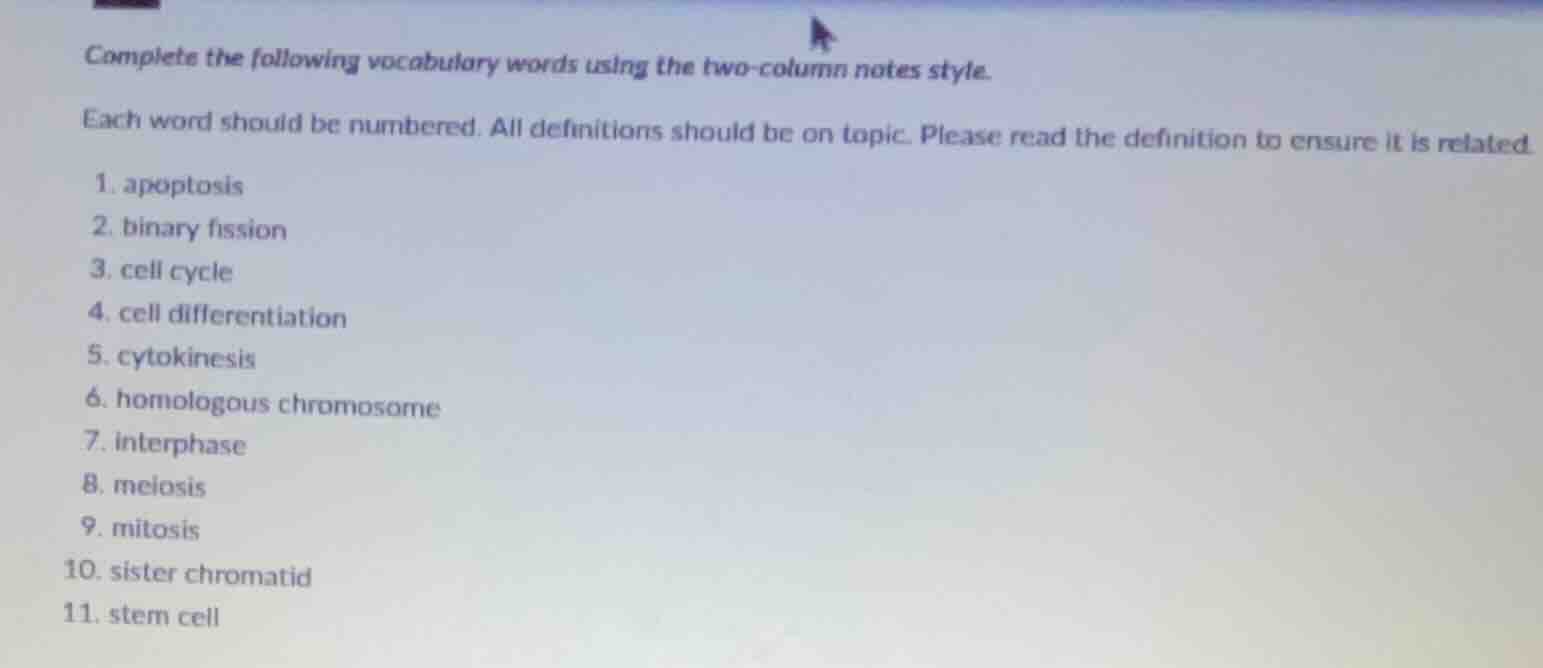
complete the following vocabulary words using the two - column notes style. each word should be numbered. all definitions should be on topic. please read the definition to ensure it is related. 1. apoptosis 2. binary fission 3. cell cycle 4. cell differentiation 5. cytokinesis 6. homologous chromosome 7. interphase 8. meiosis 9. mitosis 10. sister chromatid 11. stem cell
To complete the vocabulary words using the two - column notes style, we can create a table with two columns: one for the vocabulary word (numbered) and one for its definition.
| Number | Vocabulary Word | Definition |
|---|---|---|
| 2 | binary fission | A form of asexual reproduction in prokaryotes (and some single - celled eukaryotes) where a cell divides into two approximately equal - sized daughter cells. |
| 3 | cell cycle | The series of events that take place in a cell leading to its division and duplication (replication). It includes interphase (G1, S, G2 phases) and the mitotic (M) phase. |
| 4 | cell differentiation | The process by which a less specialized cell becomes a more specialized cell type, acquiring distinct structural and functional characteristics. |
| 5 | cytokinesis | The physical process of cell division that follows the division of the nucleus (mitosis or meiosis), resulting in the separation of the cytoplasm and the formation of two daughter cells. |
| 6 | homologous chromosome | Chromosome pairs (one from each parent) that are similar in length, gene position, and centromere location. They carry genes for the same traits. |
| 7 | interphase | The phase of the cell cycle where the cell is not dividing. It consists of three sub - phases: G1 (cell growth), S (DNA synthesis/replication), and G2 (preparation for mitosis). |
| 8 | meiosis | A type of cell division that reduces the chromosome number by half, producing four haploid daughter cells. It is involved in the production of gametes (sperm and egg cells) in sexually reproducing organisms. |
| 9 | mitosis | A type of cell division that results in two daughter cells each having the same number and kind of chromosomes as the parent nucleus. It is responsible for growth, repair, and asexual reproduction in eukaryotes. |
| 10 | sister chromatid | Two identical copies of a single replicated chromosome that are joined together at the centromere. They separate during anaphase of mitosis and anaphase II of meiosis. |
| 11 | stem cell | Undifferentiated cells that have the ability to differentiate into specialized cell types and can also self - renew (produce more stem cells). |

Snap & solve any problem in the app
Get step-by-step solutions on Sovi AI
Photo-based solutions with guided steps
Explore more problems and detailed explanations
To complete the vocabulary words using the two - column notes style, we can create a table with two columns: one for the vocabulary word (numbered) and one for its definition.
| Number | Vocabulary Word | Definition |
|---|---|---|
| 2 | binary fission | A form of asexual reproduction in prokaryotes (and some single - celled eukaryotes) where a cell divides into two approximately equal - sized daughter cells. |
| 3 | cell cycle | The series of events that take place in a cell leading to its division and duplication (replication). It includes interphase (G1, S, G2 phases) and the mitotic (M) phase. |
| 4 | cell differentiation | The process by which a less specialized cell becomes a more specialized cell type, acquiring distinct structural and functional characteristics. |
| 5 | cytokinesis | The physical process of cell division that follows the division of the nucleus (mitosis or meiosis), resulting in the separation of the cytoplasm and the formation of two daughter cells. |
| 6 | homologous chromosome | Chromosome pairs (one from each parent) that are similar in length, gene position, and centromere location. They carry genes for the same traits. |
| 7 | interphase | The phase of the cell cycle where the cell is not dividing. It consists of three sub - phases: G1 (cell growth), S (DNA synthesis/replication), and G2 (preparation for mitosis). |
| 8 | meiosis | A type of cell division that reduces the chromosome number by half, producing four haploid daughter cells. It is involved in the production of gametes (sperm and egg cells) in sexually reproducing organisms. |
| 9 | mitosis | A type of cell division that results in two daughter cells each having the same number and kind of chromosomes as the parent nucleus. It is responsible for growth, repair, and asexual reproduction in eukaryotes. |
| 10 | sister chromatid | Two identical copies of a single replicated chromosome that are joined together at the centromere. They separate during anaphase of mitosis and anaphase II of meiosis. |
| 11 | stem cell | Undifferentiated cells that have the ability to differentiate into specialized cell types and can also self - renew (produce more stem cells). |