QUESTION IMAGE
Question
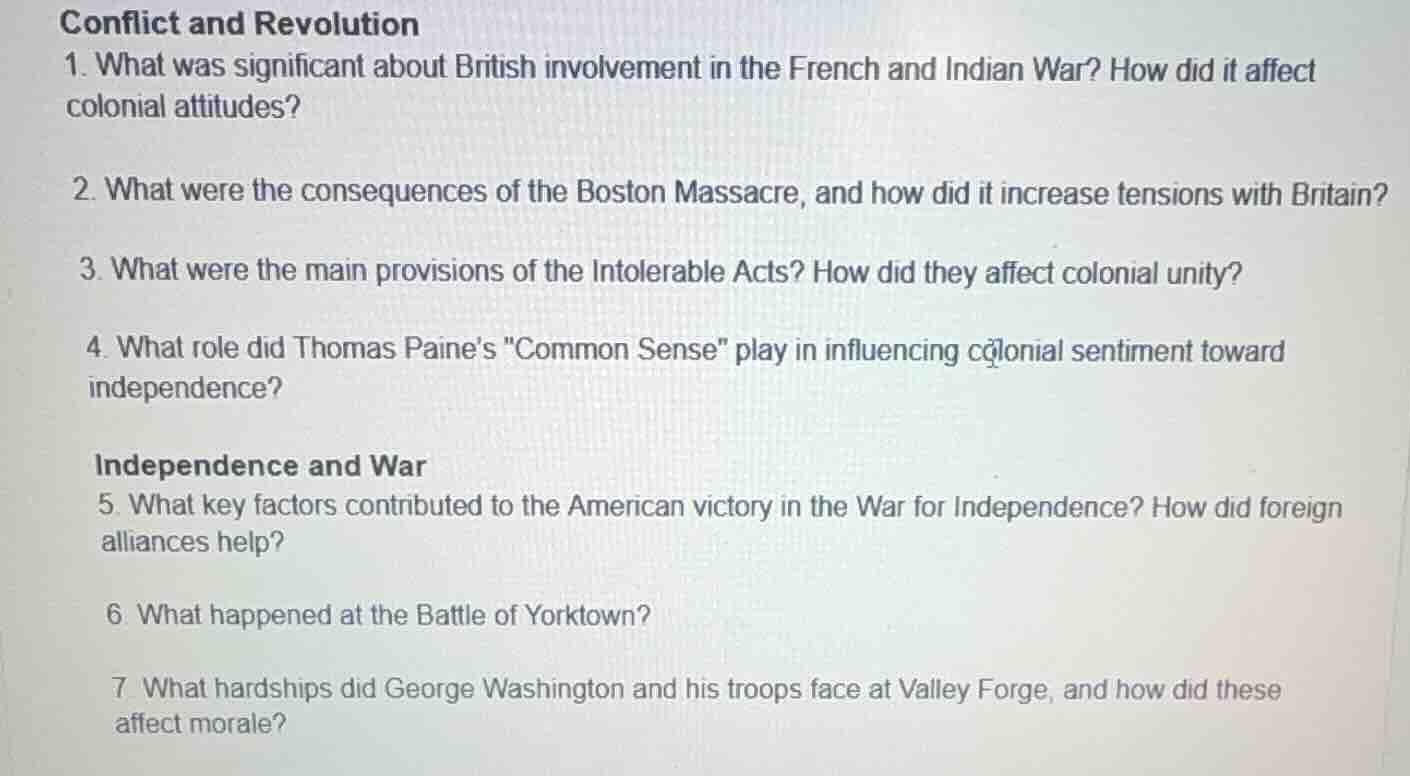
conflict and revolution
- what was significant about british involvement in the french and indian war? how did it affect colonial attitudes?
- what were the consequences of the boston massacre, and how did it increase tensions with britain?
- what were the main provisions of the intolerable acts? how did they affect colonial unity?
- what role did thomas paines \common sense\ play in influencing colonial sentiment toward independence?
independence and war
- what key factors contributed to the american victory in the war for independence? how did foreign alliances help?
- what happened at the battle of yorktown?
- what hardships did george washington and his troops face at valley forge, and how did these affect morale?
Brief Explanations
- Question 1: Britain's victory gave it control of most North American territory east of the Mississippi, but the war left it in massive debt. To pay this debt, Britain imposed new taxes on the colonies (like the Stamp Act), which angered colonists who argued they had no representation in Parliament, fueling anti-British sentiment and ideas of self-governance.
- Question 2: The Boston Massacre (1770) saw British soldiers kill 5 colonists. It was propagandized by figures like Paul Revere to paint Britain as a tyrannical oppressor. This turned colonial public opinion further against Britain, uniting colonists in anger and escalating tensions that led to more protests and eventual revolution.
- Question 3: The Intolerable Acts (1774) closed Boston Harbor until destroyed tea was paid for, revoked Massachusetts' self-government, allowed British officials accused of crimes to be tried in Britain, and forced colonists to quarter British troops. Instead of intimidating Massachusetts, the acts unified all 13 colonies, who sent delegates to the First Continental Congress to coordinate a response against British overreach.
- Question 4: Thomas Paine's Common Sense (1776) was a widely read pamphlet that argued for complete independence from Britain in plain, accessible language. It rejected the idea of monarchy as a legitimate system, framed Britain as a parasitic power, and convinced many undecided colonists that independence was the only viable path to self-governance, helping to build popular support for declaring independence.
- Question 5: Key factors included colonial familiarity with the terrain, strong leadership from George Washington, and the motivation of fighting for their homes and freedom. Foreign alliances, most critically the 1778 alliance with France, provided the colonists with military supplies, trained soldiers, naval support, and financial aid—turning the war into a global conflict that stretched British resources thin.
- Question 6: In 1781, George Washington's Continental Army, supported by French naval forces, trapped British General Charles Cornwallis and his 8,000 troops in Yorktown, Virginia. After weeks of siege, Cornwallis surrendered, effectively ending major combat operations in the Revolutionary War and paving the way for the 1783 Treaty of Paris, which formalized U.S. independence.
- Question 7: At Valley Forge (1777-1778), Washington's troops faced extreme cold, starvation, lack of proper clothing and shelter, and widespread disease (like typhus and pneumonia). Despite this, the army was reorganized and trained by Prussian officer Baron von Steuben, turning a ragged force into a disciplined, professional army. The shared hardship actually strengthened troop cohesion and morale, as soldiers emerged more unified and prepared to fight.

Snap & solve any problem in the app
Get step-by-step solutions on Sovi AI
Photo-based solutions with guided steps
Explore more problems and detailed explanations
- British victory gave it eastern North American territory, but war debt led to colonial taxes; this sparked anti-British sentiment and demands for "no taxation without representation."
- It killed 5 colonists, was used as anti-British propaganda, and unified colonists in anger against British oppression, escalating tensions.
- Provisions: closed Boston Harbor, revoked Massachusetts self-rule, allowed British trials in Britain, forced troop quartering. It unified all colonies, leading to the First Continental Congress.
- It used plain language to argue for full independence, rejected monarchy, and convinced undecided colonists to support breaking from Britain, building popular momentum for revolution.
- Key factors: terrain familiarity, Washington's leadership, home-field motivation. French (and later Spanish/Dutch) alliances provided troops, naval power, supplies, and funding, stretching British resources.
- Washington's army, with French naval support, trapped and forced the surrender of British General Cornwallis in 1781, ending major combat in the Revolutionary War.
- Hardships: extreme cold, starvation, lack of clothing/shelter, disease. Shared suffering and professional training under Baron von Steuben ultimately strengthened troop cohesion and morale, creating a more disciplined army.