QUESTION IMAGE
Question
conflicting goals cause divisions (pages 198–199)
what groups called for different kinds of changes?
in the fall of 1791, the assembly drew up a new constitution. it took away most of the king’s power. the assembly then turned over its power to a new assembly, the legislative assembly.
this new assembly soon divided into groups. some wanted an end to revolutionary changes. these were the émigrés, nobles and others who had fled france during the uprisings. another group of assembly members wanted even more radical changes. they included the sans - culottes. these wage - earners and small shopkeepers wanted a greater voice in government.
- in what ways did the émigrés and sans - culottes have opposite goals?
war and extreme measures (pages 199–200)
what caused the french people to take extreme measures?
at the same time, france faced serious trouble on its borders. kings in other countries feared that revolution would spread to their lands. they wanted to use force to restore control of france to louis xvi. soon foreign soldiers were marching toward paris. many people thought that the king and queen were ready to help the enemy. angry french citizens imprisoned them. many nobles were killed in other mob actions.
the government took strong steps to meet the danger from foreign troops. it took away all the king’s powers. in 1792, the national convention—another new government—was formed. it declared louis a common citizen. he was then tried for treason and convicted. like many others, the king was beheaded by a machine called the guillotine. the national convention also ordered thousands of french people into the army.
- what happened to the king?
terror grips france; end of terror (pages 202–203)
what was the reign of terror?
maximilien robespierre became leader of france. he headed the committee of public safety. it tried and put to death “enemies of the republic.” thousands were killed. robespierre’s rule, which began in 1793, was called the reign of terror. it ended in july 1794, when robespierre himself was put to death.
the french people were tired of the killing and the unrest. they wanted a return to order. moderate leaders drafted a new, less revolutionary plan of government.
- where did the reign of terror lead?
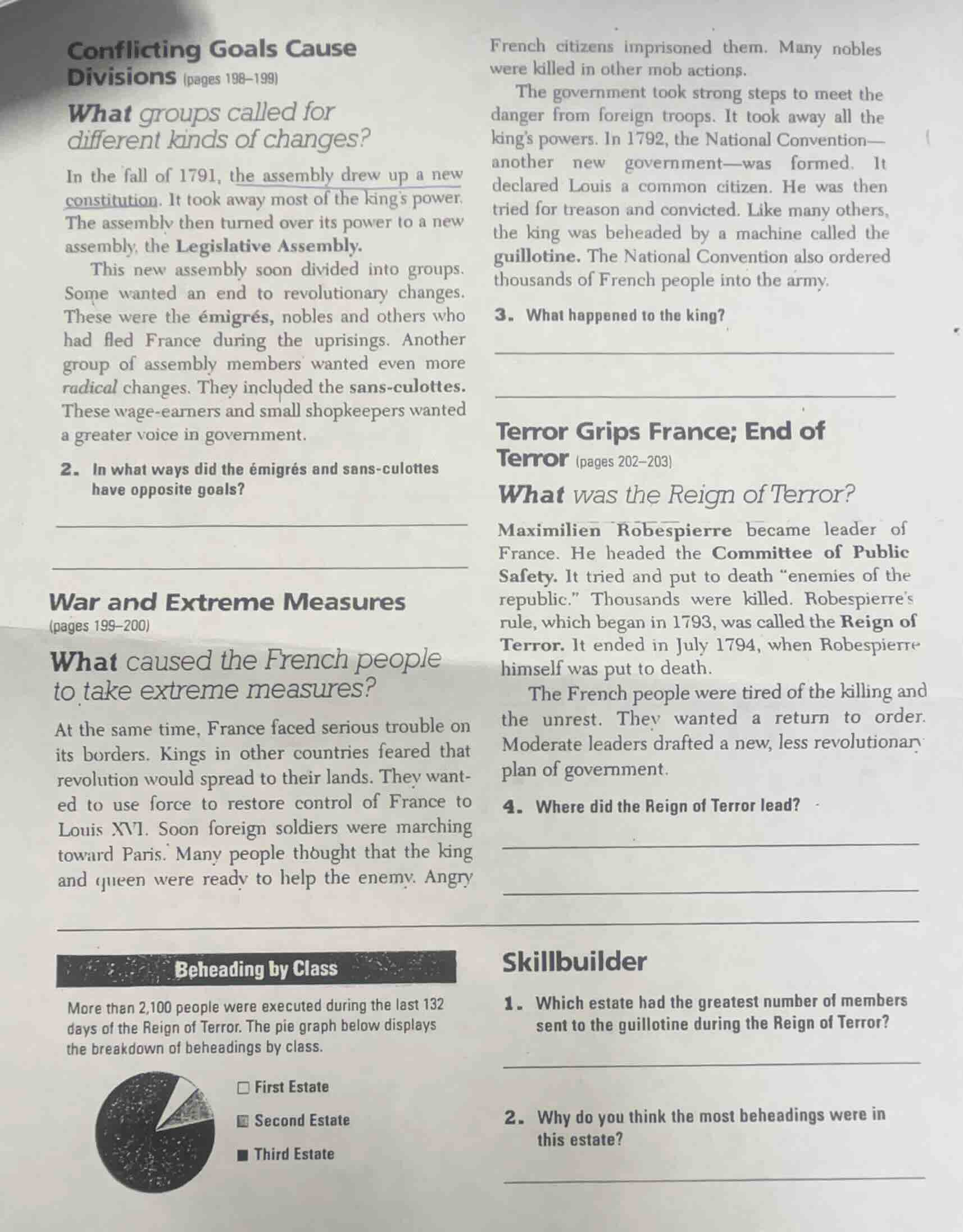
beheading by class
more than 2,100 people were executed during the last 132 days of the reign of terror. the pie graph below displays the breakdown of beheadings by class.
skillbuilder
- which estate had the greatest number of members sent to the guillotine during the reign of terror?
- why do you think the most beheadings were in this estate?
Question 2: In what ways did the émigrés and sans - culottes have opposite goals?
The émigrés (nobles and others who fled France) wanted to end revolutionary changes and likely restore the old order. The sans - culottes (wage - earners and small shopkeepers) wanted more radical revolutionary changes, like a greater voice in government. So their goals were opposite as one group opposed further revolution and the other sought more revolutionary changes.
According to the text, in 1792 the National Convention was formed. It declared Louis a common citizen, tried him for treason, convicted him, and he was beheaded by the guillotine.
The French people were tired of the killing and unrest from the Reign of Terror. Moderate leaders then drafted a new, less revolutionary plan of government, and it ended when Robespierre was put to death in July 1794.

Snap & solve any problem in the app
Get step-by-step solutions on Sovi AI
Photo-based solutions with guided steps
Explore more problems and detailed explanations
The émigrés (nobles, etc. who fled) wanted to end revolutionary changes (restore old order), while sans - culottes wanted more radical changes (greater government voice).